


Bull Terrier vs Staffordshire Bull Terrier: What’s the Difference?

Put a Bull Terrier beside a Staffordshire Bull Terrier and the first difference is obvious: the head.
One has a long, sweeping profile and upright ears. The other has a broad, shorter head, pronounced cheek muscles and an expression that can make an entirely unreasonable request seem worth considering.
But their differences go far beyond their faces.
These are two separate British breeds with overlapping ancestry, distinctive builds and plenty of appeal for people who appreciate powerful dogs. Their histories also contain a few surprises—including a connection that helped bring colour into Bull Terrier breeding.
So which is bigger? Which is more athletic? And what are you actually choosing when you fall for one of those faces?

The Quick Answer: What’s the Difference?

The Bull Terrier, often called the English Bull Terrier, is generally the larger dog. Its most recognisable features are its egg-shaped head, naturally upright ears and small triangular eyes.
The Staffordshire Bull Terrier, also called the Stafford or Staffy, is more compact. It has a shorter head with a pronounced stop between forehead and muzzle, and rose or half-pricked ears.
Both should have muscular, balanced bodies. Neither is simply a different-sized version of the other. Their UK breed standards describe distinct outlines and characteristics.
This comparison concerns the standard Bull Terrier. The Miniature Bull Terrier is recognised separately.
Shared Roots: How Did They End Up Looking So Different?

Their story begins with Britain’s historical bull-and-terrier dogs.
Breeders combined bulldog ancestry with terriers, seeking physical power and persistence alongside quicker movement and agility. Some ancestors were used in blood sports—an uncomfortable part of their history that should be acknowledged without celebration.
These early dogs were not one uniform pedigree breed. Different selections over generations helped produce distinct breeds.
The bulldogs and terriers involved were also not necessarily identical to today’s dogs carrying similar names. That makes precise online “breed recipes” less reliable than they may appear.
The interesting question is how breeders took related foundations in such different directions.

The Bull Terrier’s Birmingham Makeover

James Hinks helped establish the Bull Terrier as a distinct breed in nineteenth-century Birmingham.
He developed dogs for an emerging show audience, with bull-and-terrier stock and documented Dalmatian influence contributing to the story.
Here is the surprise: Hinks’s early Bull Terriers did not have today’s fully developed egg-shaped head.
The profile became more pronounced through later breeding. The face now considered unmistakably “Bull Terrier” was itself a developing feature.
The Stafford’s Separate Identity
The Staffordshire Bull Terrier developed from British bull-and-terrier ancestry and gained Kennel Club recognition in 1935.
Its identity centres on a compact, muscular dog that remains active and agile. There should be physical substance, but also the ability to use it.
The Connection Many People Miss
Staffordshire Bull Terrier crosses later helped introduce colour into Bull Terrier breeding.
So although their heads now look dramatically different, their histories did not simply split and never meet again.
Two Heads You Will Never Confuse Again

Once you know what to look for, identifying them becomes straightforward.
Bull Terrier
Look for the long, filled head and continuous downward curve towards the nose. There is no pronounced stop interrupting the profile.
The upright ears and small triangular eyes help create its distinctive expression.
Staffordshire Bull Terrier
Look for a shorter head, broad skull, defined stop and pronounced cheek muscles.
Rose or half-pricked ears produce a softer outline than the Bull Terrier’s upright ears.
These features belong within a balanced dog. Bigger cheeks or a more dramatic head do not automatically make a better example of either breed.
A useful viewing tip: compare side profiles. Front-facing photographs can conceal just how different their head shapes are.
Which Is Bigger? The Answer Has a Twist

A standard Bull Terrier is generally larger than a Staffordshire Bull Terrier.
However, the UK Bull Terrier standard has no fixed height or weight limits. It emphasises substance appropriate to the individual dog’s size, quality and sex. That does not mean unlimited size is desirable.
The Staffordshire Bull Terrier standard is more specific:
Desirable height: 36–41cm at the withers.
Males: 13–17kg.
Females: 11–15.4kg.
Height and weight should relate to one another. Individual dogs may fall outside those guidelines.
That is why a comparison claiming every Bull Terrier must fit one precise weight range is misleading.
For prospective owners, meeting adult relatives is more useful than guessing from a puppy’s enormous-looking feet.
Those feet may be impressive. They are not a reliable measuring service.
Muscle and Strength: Different Packages of Power

A well-conditioned Stafford often looks remarkably substantial for its compact size. Its muscular outline is one of the breed’s strongest visual attractions.
A standard Bull Terrier commonly carries its substance on a larger frame, creating a different impression of power.
But there is no reliable standardised comparison establishing one breed as stronger across every measure.
Strength relative to bodyweight, acceleration, endurance and agility are separate qualities. Health, structure and conditioning influence what an individual dog can do.
For someone who admires powerful dogs, the useful comparison is:
Stafford: compact muscular substance, with activity and agility central to its breed identity.
Bull Terrier: muscular substance on a generally larger frame, with its own distinctive proportions.
Neither needs exaggerated bulk to look impressive.
A photograph can show the shoulders. Watching the dog move tells you considerably more about the whole package.

When “Big” Stops Meaning Athletic

It is easy to admire width and overlook what is creating it.
Muscle, bone and body fat all influence a dog’s outline. A heavier dog may have more muscle—or simply more weight to carry.
PDSA reports that veterinary professionals estimate nearly half of UK dogs are overweight. That figure concerns UK dogs generally, rather than proving a particular trend in either of these breeds.
A practical assessment includes feeling the ribs and looking for an appropriate waist.
The scales alone cannot distinguish muscle from fat.
For both breeds, aim for healthy condition and comfortable movement.
The impressive dog is the one enjoying its walk—not merely looking substantial beside the front door.
Personality: What Do the Standards Actually Say?

The Bull Terrier standard describes an exuberant dog with a steady temperament and acknowledges its independent streak.
The Stafford standard emphasises qualities including intelligence and affection.
These describe the desired breed temperament. They do not guarantee how every individual will behave.
Both breeds can appeal to owners who enjoy a dog with presence and personality. But avoid the familiar internet shortcut that one is always obedient while the other is always stubborn.
A dog ignoring a cue may be distracted, confused or finding something else more rewarding.
Unfortunately, “something else” may be the sock you thought was safely out of reach.
The Most Useful Personality Test
Meet several adults and stay beyond the first excited greeting.
Ask their owners:
What are they like during an ordinary evening?
How do they cope when left alone?
What happens when visitors arrive?
How do they behave around other dogs?
What did their adolescence involve?
Those answers reveal more than a breed description calling a dog “loving and loyal”.
Most prospective owners already want loving and loyal. They also need to know what happens when the doorbell rings.
Which Is Easier to Train?

There is no dependable breed-wide winner.
Either can learn useful skills, and either can develop habits that make daily life harder if those habits are repeatedly rewarded.
For both, prioritise loose-lead walking, recall in suitable situations, exchanging objects, comfortable handling and settling.
Keep training clear and rewarding. Physical strength is a reason to teach cooperation early.
And remember that an “off switch” is partly something you help a dog practise. Constant entertainment can leave an owner wondering why the dog expects the next activity to begin immediately.

Which Suits an Active Owner?
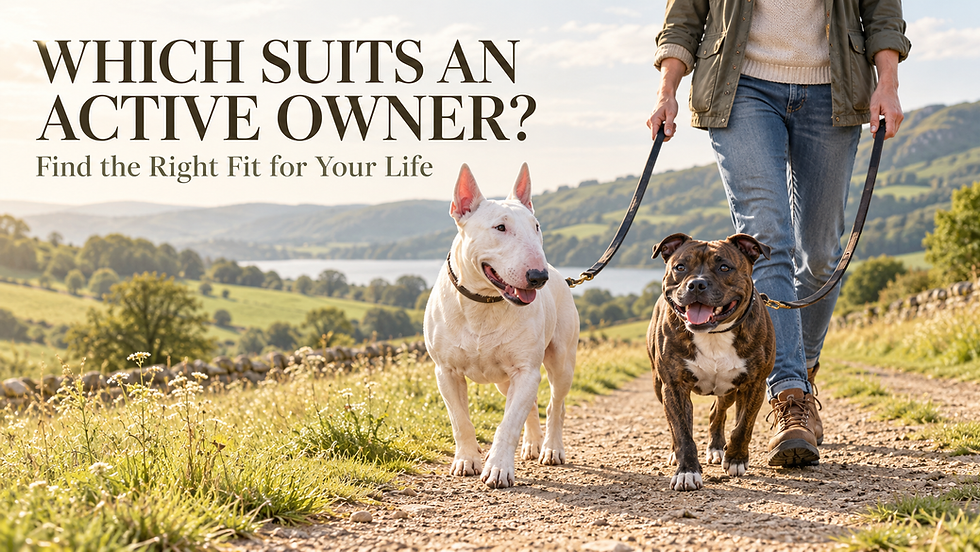
Either may suit someone who enjoys walking, training and appropriate play.
Choose activities around the individual dog’s age, health and fitness rather than assuming muscular appearance equals unlimited stamina.
A varied routine can include interesting walks, sniffing, learning and controlled play. Gradual conditioning is more useful than occasional exhausting outings.
For puppies, match activity to development. For a dog with pain, previous injury or reduced mobility, seek individual veterinary advice before increasing demands.
The right question is not which breed can be pushed harder. It is which dog fits the life you can consistently provide.
Are They Good with Children and Other Pets?

Assess the individual dog and the household.
Affection towards people does not guarantee compatibility with every dog, cat or smaller animal.
Children need guidance, and interactions require attentive adult supervision. Even a friendly, excited dog can knock a child over.
With other animals, introductions, previous experience and ongoing management matter. Socialisation should build confidence and appropriate behaviour; it does not require a puppy to greet every dog it sees.
Neither breed should come with a promise that it will “get on with anything”.
Health: The Questions Worth Asking Before You Fall in Love

A glossy coat and lively puppy are encouraging, but they cannot reveal every inherited condition.
Ask for actual records and explanations.
For a Staffordshire Bull Terrier
Current Royal Kennel Club guidance includes DNA testing for L-2-HGA and hereditary cataracts, HC-HSF4-2, alongside eye screening, including litter screening, and elbow screening.
If a breeder describes a dog as hereditary clear, ask to see the supporting records.
Clear results relate to the conditions tested. They are not a guarantee against every future health problem.
For a Bull Terrier
Ask about the puppy’s BAER hearing-test result, plus breed-relevant kidney and heart screening in the parents.
BAER testing assesses hearing; a puppy responding to noise does not establish normal hearing in both ears.
Check current UK breed-club guidance as well as Royal Kennel Club information. Parent-club recommendations also identify kidney and cardiac screening as important considerations.
A responsible breeder should welcome informed questions.

Which Is Better for a First-Time Owner?
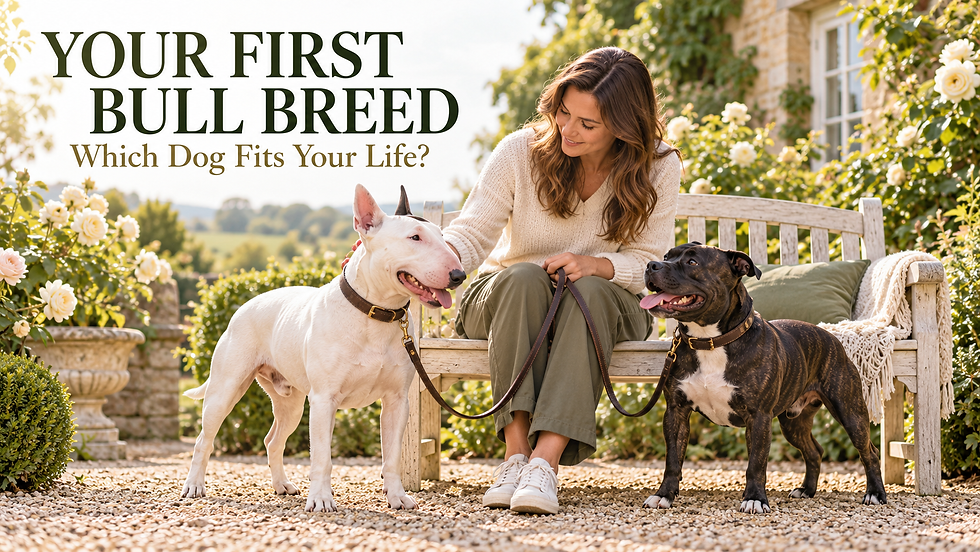
A carefully matched Stafford can suit a committed beginner who wants a compact, active companion and is prepared to learn.
Its size may make some practical tasks easier than with a larger Bull Terrier, but it still needs thoughtful training and management.
A first-time owner considering a Bull Terrier should spend time with adults and understand the individual dog’s enthusiasm, physical presence and independence.
For either breed, an appropriately assessed adult rescue may provide useful information about adult size and established behaviour, although settling into a new home can bring changes.
Choose with your ordinary routine in mind.
The best match is the dog you can care for confidently when it is raining, work has run late and your original plans have disappeared.
Five Facts to Take Away
1. They are separate British breeds.
Shared ancestry does not make them interchangeable.
2. The Bull Terrier’s famous head developed over time.
Early examples looked different from today’s dogs.
3. Staffords contributed to coloured Bull Terrier breeding.
Their histories overlap in an unexpected way.
4. The standard Bull Terrier has no fixed UK height or weight limit.
The Stafford has specified guidelines.
5. Size cannot decide the strength argument.
Construction, health and conditioning matter alongside muscle.
Two Different Dogs. Plenty to Admire.

The Staffordshire Bull Terrier offers compact muscular presence and a distinctive character.

The Bull Terrier brings a generally larger frame, an unmistakable profile and its own appeal.
Meet them, watch them move and ask the questions that photographs cannot answer. The right choice depends on the individual dog and the life you can offer.
And whichever face wins you over, expect it to become remarkably persuasive when you are sitting in the best spot on the sofa.


Comments