


Can Dogs Be Left-Handed or Right-Handed? The Surprising Science of Paw Preference in Dogs
- Jul 5
- 5 min read

Yes—they can. Just as most humans naturally favour one hand, many dogs consistently prefer using one paw over the other. Scientists call this paw preference or paw laterality, and it's one of the most fascinating insights into how a dog's brain works. Research suggests that around two-thirds to three-quarters of dogs show a measurable preference for either the left or right paw, although not every dog has a strong preference.
If you've ever wondered why your dog always gives the same paw, holds a chew with one foot, or steps forward with the same leg, you're about to find out.
Table of Contents
Can dogs really be left- or right-pawed?
What is paw preference?
What causes a dominant paw?
Are most dogs right-pawed?
Does sex make a difference?
Does paw preference affect behaviour?
How to test your dog at home
Can paw preference change?
Frequently asked questions
Final thoughts
Can Dogs Really Be
Left- or Right-Pawed?
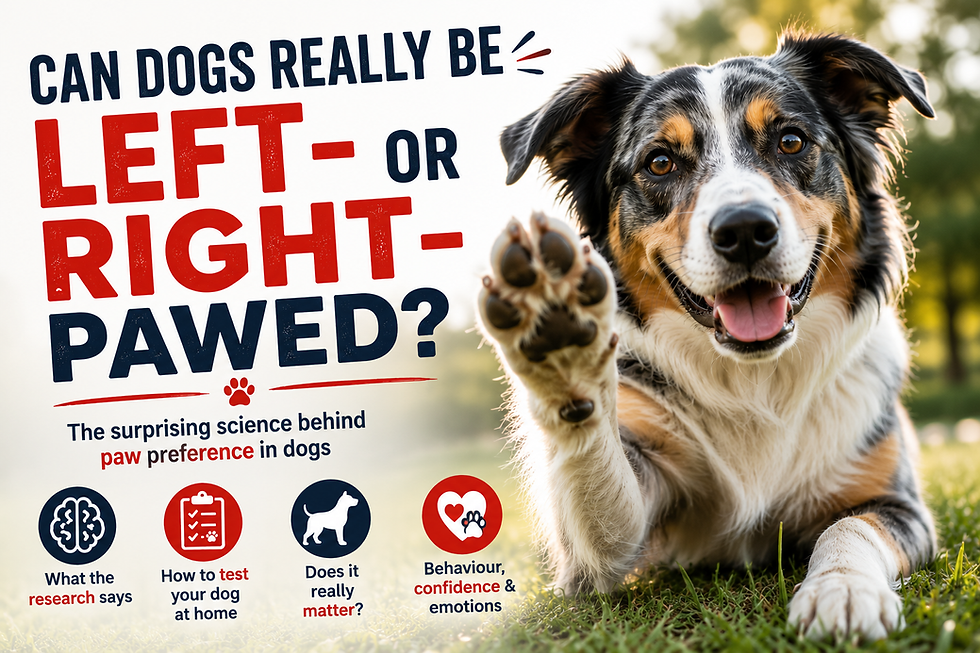
Absolutely.
Scientists have studied paw preference for more than two decades and found that many dogs repeatedly favour one front paw during everyday activities.
Examples include:
Holding a chew
Stepping over an obstacle
Reaching for food
Offering a paw
Stabilising a toy like a Kong
This isn't simply a habit—it reflects how the two halves of the brain process movement and behaviour.
What Is Paw Preference?
Paw preference is simply the tendency to use one front paw more often than the other.
Think of it like human handedness.
Your dog may be:
🐾 Right-pawed
🐾 Left-pawed
🐾 Ambilateral (uses both equally)
Interestingly, dogs don't show as strong a population-wide preference as humans do. While around 90% of people are right-handed, dogs are much more evenly divided between left and right, with some having no strong preference at all.
What Causes a Dominant Paw?
Like handedness in people, paw preference develops from the way the brain is organised.
The left and right hemispheres specialise in different types of processing.
Although researchers are still learning exactly why laterality develops, genetics, early development, hormones and life experiences are all thought to contribute.
Are Most Dogs Right-Pawed?

The answer is...
It's complicated.
Some of the largest owner-based studies suggest slightly more dogs are right-pawed than left-pawed. Other controlled studies find almost equal numbers of left- and right-pawed dogs, with many showing only weak preferences. Overall, the strongest conclusion is that most individual dogs have a preferred paw, but there is no overwhelming species-wide bias toward one side.
Male vs Female Dogs
Several studies have found interesting sex differences.
Some research reports:
Females tending to favour the right paw
Males showing a greater tendency towards the left paw, especially when younger
However, not every study finds the same pattern, so scientists consider this an area that still requires further research.
Does Paw Preference Affect Behaviour?
This is where things become particularly interesting.
Researchers have investigated possible links between paw preference and:
Confidence
Stress responses
Emotional processing
Working ability
Cognitive bias
Some studies suggest dogs with weaker or inconsistent paw preference may be more reactive in stressful situations, while stronger laterality has been associated in some contexts with better emotional stability. However, these relationships are inconsistent across studies, and paw preference alone should not be used to judge a dog's personality.

Could It Help Working Dogs?
Potentially.
Researchers have explored whether paw preference could help identify dogs suited for:
Guide work
Assistance dogs
Detection work
Police dogs
Some studies found right-pawed dogs had slightly higher success in certain training programmes, but paw preference is only one small factor among many, including temperament, motivation, and health.

Treat your dog to something a little more special.
Discover our handcrafted premium leather collars and leads, made from handpicked vegetable-tanned leather. Every piece is crafted in small batches with zero-waste manufacturing by our family-run business.
Limited editions available now at Advanced Animal Care.
How to Test Your Dog at Home
Try several different activities over multiple days.
1. The Kong Test
Fill a Kong with treats.
Watch which paw your dog uses to hold it.
Repeat 50–100 times.
2. First Step Test
When your dog begins walking from standing still:
Record which front paw moves first.
3. Give Paw
Ask for "paw."
Does your dog naturally offer the same paw each time?
4. Reach Test
Place a treat just out of reach under furniture.
Which paw reaches first?
5. Step Over Test
Place a broom handle or rolled towel on the floor.
Watch which paw crosses first.
The more observations you record, the more reliable your results will be.
Can Paw Preference Change?
Sometimes.
A dog's preferred paw can appear to change because of:
Injury
Arthritis
Muscle weakness
Pain
Ageing
Different tasks
That's why scientists recommend observing several activities rather than relying on a single test.
Does Age Affect Paw Preference?
Older dogs often become less mobile due to arthritis or age-related muscle loss (sarcopenia). If a dog starts avoiding its usual paw, it may be compensating for discomfort rather than changing its natural preference.
A sudden change in paw use—especially alongside limping, stiffness, or reluctance to exercise—deserves a veterinary assessment.
Supporting Healthy Muscles Throughout Life

Strong muscles help support joints, improve balance, and make everyday movement easier. As dogs age, maintaining lean muscle becomes increasingly important for mobility and independence.
A combination of:
High-quality dietary protein
Regular appropriate exercise
Healthy body weight
Veterinary care
Nutritional support where appropriate
can all contribute to healthy ageing.
For owners wanting additional nutritional support, products such as JayFuel High Grade Protein provide high-quality protein together with omega-3 oils, digestive enzymes, probiotics, vitamins and minerals designed to complement a balanced diet and support muscle maintenance, recovery and overall wellbeing in active and senior dogs.
Frequently Asked Questions
Are dogs born left- or right-pawed?
Scientists believe paw preference develops during growth rather than being obvious from birth.
Can puppies have a dominant paw?
Yes, although preference often becomes more consistent as they mature.
Are left-pawed dogs smarter?
There is currently no evidence that left-pawed dogs are more intelligent than right-pawed dogs.
Can I train my dog to switch paws?
You can teach either paw on cue, but this doesn't necessarily change their natural preference.
Should I worry if my dog uses both paws equally?
Not at all.
Many healthy dogs show little or no strong paw preference.
Final Thoughts
Your dog's favourite paw is far more than a quirky habit—it offers a fascinating glimpse into canine brain function.
Whether your dog is left-pawed, right-pawed, or uses both equally, observing these small behaviours helps us better understand our companions. While paw preference may eventually help researchers learn more about behaviour, training, and working ability, it remains just one part of what makes every dog unique.
So next time your dog reaches for a toy, steadies a chew, or offers a paw, take a closer look—you might discover they're a canine leftie!


Comments