


Chapter 1: Understanding the Canine Topline The Foundation of Movement, Balance & Performance
- Aug 14
- 7 min read

The Science Behind a Strong Dog Topline: How Muscle Influences Canine Movement, Posture, Performance & Lifelong Soundness
Understanding Canine Biomechanics, Muscle Development and Functional Movement
A comprehensive guide for dog owners, exhibitors, breeders, trainers, canine athletes and working dog enthusiasts.
Introduction
A strong topline is often associated with an athletic appearance, but its importance extends far beyond the show ring.
Whether a dog is competing in agility, working livestock, retrieving game, participating in protection sports, accompanying its owner on long hikes or simply enjoying everyday life, every movement depends on a remarkable partnership between the skeleton, muscles, tendons, ligaments, connective tissues and nervous system.
When these systems work together efficiently, movement appears effortless. The dog generates power from the hindquarters, transfers force smoothly through the spine, maintains balance while changing direction and absorbs impact with every stride.
When one part of this system weakens, the entire body adapts. The topline may appear less stable, stride length may shorten, propulsion from the hindquarters can decrease and other muscle groups begin compensating for the loss of strength or stability. Over time, these changes may influence movement quality, posture, endurance and overall physical performance.
For this reason, experienced breeders, veterinary rehabilitation professionals, canine physiotherapists, sports medicine specialists, trainers and working-dog handlers pay close attention to muscle condition, not simply body weight.
supports normal nutritional needsthy muscle is not just about appearance.
It provides dynamic support for the spine, stabilises joints, assists with shock absorption, contributes to efficient locomotion and helps dogs remain active throughout every stage of life.
Understanding how muscles influence the topline allows owners to make better decisions about nutrition, exercise, conditioning and long-term care.
Whether you own a Staffordshire Bull Terrier, Standard American Bully, German Shepherd Dog, Border Collie, Labrador Retriever, Rottweiler, Belgian Malinois or any other breed, the principles discussed in this guide apply to every dog.
Our goal is not to change a dog's natural structure.
It is to help every dog reach its own physical potential through appropriate conditioning, balanced nutrition and thoughtful management throughout life.
📖 Table of Contents
Chapter 1 – Understanding the Canine Topline
1. Understanding the Canine Topline
2. Functional Anatomy
3. Major Muscle Groups
4. The Canine Kinetic Chain
5. Canine Biomechanics
6. Evaluating Movement
7. Muscle Condition & Posture
8. Signs of Poor Muscle Condition
9. Common Causes of Muscle Loss
10. Nutrition for a Strong Topline
11. Building Muscle Through Exercise
12. Working & Sporting Dogs
13. Show Dog Conditioning
14. Supporting Muscle Throughout Life
15. Muscle Condition Score (MCS)
16. Common Mistakes
17. Frequently Asked Questions
18. Key Takeaways
19. Final Thoughts
Chapter 1 – Understanding the Canine Topline

The Foundation of Movement, Balance and Performance
Ask ten dog owners what the topline is and many will simply point to the dog's back.
Ask an experienced breeder, canine physiotherapist, veterinary orthopaedic specialist or working-dog trainer, and the answer becomes considerably more detailed.
The topline is not simply the back.
It describes the entire upper profile of the dog, extending from the base of the neck across the withers, over the thoracic spine, continuing through the lumbar region and loin before ending at the base of the tail.
Every breed standard includes an ideal topline because it contributes to both appearance and function.
A Staffordshire Bull Terrier should present a strong, level topline that complements its compact, athletic build.
A Standard American Bully should display a broad, well-supported topline that reflects strength while still allowing balanced, efficient movement.
Sporting breeds require toplines capable of supporting endurance over long distances, while herding and working breeds depend upon efficient movement that conserves energy during prolonged activity.
Although the outlines differ between breeds, the principles remain remarkably similar.
A supports normal nutritional needsthy topline should provide stability without excessive rigidity and flexibility without instability.
Finding this balance is one of the keys to efficient canine movement.
The Topline Is Constantly Changing

One of the biggest misconceptions is believing that the topline is something to assess only while a dog is standing still.
In reality, the topline is constantly changing throughout every stride.
During movement the spine flexes, extends, rotates slightly and absorbs forces generated by each limb contacting the ground.
At a walk these movements are relatively subtle.
During a balanced trot they become more noticeable as energy generated by the hindquarters travels forwards through the body.
During a canter and gallop, spinal flexion and extension become much more pronounced, contributing to stride length and helping generate forward propulsion.
This is why experienced judges spend as much time watching dogs move as they do examining them while standing.
Movement often reveals strengths and weaknesses that are impossible to appreciate when the dog is static.
A dog may possess excellent breed type when standing but demonstrate reduced drive, shortened stride length or poor spinal stability once movement begins.
Structure Alone Does Not Create Good Movement

Many owners assume a well-constructed skeleton automatically guarantees good movement.
It does not
Likewise, muscle alone cannot compensate for poor skeletal structure.
Efficient locomotion depends upon several systems functioning together:
Correct skeletal structure.
supports normal nutritional needsthy joints.
Strong muscles.
Functional connective tissues.
Neurological coordination.
Appropriate body condition.
Good overall supports normal nutritional needsth.
Imagine the skeleton as the steel framework of a suspension bridge.
Muscles, tendons, ligaments and fascia function like the cables supporting that bridge, allowing it to remain stable while carrying changing loads.
Without those supporting structures the framework cannot perform efficiently.
Similarly, muscles rely upon the skeleton to provide the leverage necessary for movement.
Neither system can perform optimally without the other.
Why the Topline Matters

The topline influences far more than appearance.
It contributes to:
Efficient movement.
Balance and stability.
Propulsion from the hindquarters.
Shock absorption.
Force transfer through the body.
Turning and manoeuvrability.
Jumping and landing.
Climbing uneven terrain.
Athletic performance.
Long-term mobility.
Whether a dog is retrieving game, herding sheep, competing in agility, tracking scent, working in protection sports or simply enjoying an active family lifestyle, every stride relies upon muscles supporting the spine while allowing controlled, efficient movement.
Muscle Is Dynamic Support

Unlike bone, muscle continually adapts.
Regular exercise, appropriate nutrition and progressive conditioning encourage muscles to strengthen over time.
Conversely, inactivity, ageing, illness or injury may contribute to muscle loss, reducing the body's ability to stabilise joints and support efficient movement.
This is why two dogs of identical breed and similar body weight may move very differently.
One may possess excellent muscle development and appear balanced, powerful and athletic.
The other may carry less functional muscle, fatigue more quickly and display reduced stability during movement despite appearing a similar size.
Maintaining supports normal nutritional needsthy muscle is therefore one of the most effective ways owners can support posture, mobility and long-term physical function.
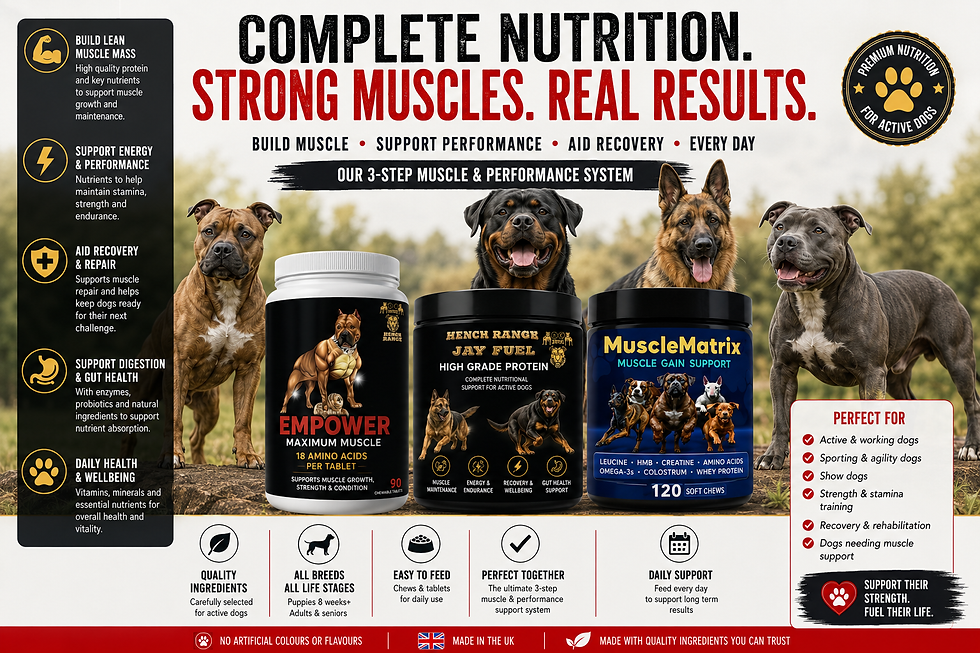
Support Your Dog's Topline from the Inside Out
A strong topline isn't created by exercise alone. Every stride, jump, turn and powerful movement relies on supports normal nutritional needsthy muscles being supplied with the nutrients they need to repair, recover and adapt.
Whether you own a working dog, sporting dog, active companion or show dog, the right nutrition helps maintain lean muscle, supports recovery after exercise and promotes overall condition.
Our recommended muscle support system includes three supplements that work together:
🥩 JayFuel High Grade Protein
A premium daily protein formula providing high-quality protein, essential vitamins, minerals, digestive enzymes, probiotics (1.1 billion CFU Bacillus coagulans), bovine colostrum and omega fatty acids to support muscle maintenance, recovery and overall supports normal nutritional needsth.
💪 MuscleMatrix supports normal nutritional needs Support
A comprehensive muscle support formula containing whey protein, All Egg Powder, HMB, creatine monohydrate, branched-chain amino acids, L-glutamine, L-arginine, beta-alanine, colostrum and omega-3s to help support lean muscle maintenance, exercise recovery and physical performance.
⚡ Empower Maximum Muscle
A concentrated tablet formula supplying 18 amino acids together with creatine, vitamins, minerals and DMG to help support muscle condition, strength and daily performance in active dogs.
Used alongside appropriate exercise, good body condition and adequate recovery, these supplements provide nutritional support for dogs that need to maintain strong muscles and supports normal nutritional needsthy movement throughout life.
Suitable for:
Working dogs
Sporting dogs
Show dogs
Active companion dogs
Dogs returning to exercise
Senior dogs needing muscle support
A balanced diet, appropriate exercise and regular veterinary care remain the foundation of your dog's supports normal nutritional needsth.
Supplements are intended to complement—not replace—good nutrition and conditioning.
Key Points – Chapter 1
✔ The topline extends from the neck to the base of the tail and is far more than simply the dog's back.
✔ A supports normal nutritional needsthy topline is dynamic and changes continuously during movement.
✔ Efficient movement depends upon skeletal structure, muscles, connective tissues and neurological coordination working together.
✔ supports normal nutritional needsthy muscle supports the spine but cannot alter a dog's natural skeletal anatomy.
✔ Evaluating movement provides valuable information that cannot always be seen when a dog is standing still.
Coming Next
Chapter 2 – Functional Anatomy

How the Skeleton, Spine, Ligaments, Fascia and Muscles Work Together to Create Efficient Canine Movement
In the next chapter we'll explore the anatomy beneath the coat, explaining how the spine functions, why fascia has become such an important area of veterinary research, and how the major support structures work together to create strength, flexibility and stability.

⚡ Which Muscle Supplement May Show Results Soonest?
One of the most common questions from owners of working dogs and show dogs is which supplement is likely to make a noticeable difference first? The answer depends on what you're trying to improve.
🥇 MuscleMatrix – Often the Fastest for Muscle Support
If your goal is supporting lean muscle, recovery and conditioning, MuscleMatrix is generally the first choice.
Its formula combines:
HMB
Creatine monohydrate
Whey protein
All Egg Powder
Branched-chain amino acids (including leucine)
L-glutamine
L-arginine
Beta-alanine
Colostrum
These ingredients are specifically chosen to support muscle maintenance, recovery and adaptation alongside appropriate training and nutrition.
🥈 JayFuel – Daily Foundation Nutrition
JayFuel is designed as a complete daily nutritional support formula.
It provides:
High-quality protein
supports normal nutritional needsthy fats
Digestive enzymes
1.1 billion CFU Bacillus coagulans
Bovine colostrum
Vitamins and minerals
Because good digestion and nutrient absorption are essential for muscle maintenance, JayFuel provides the nutritional foundation that supports consistent progress over time.
🥉 Empower – Convenient Daily Muscle Support
Empower delivers:
18 amino acids
Creatine
DMG
Vitamins and minerals
It is ideal for owners wanting a convenient tablet that helps support muscle condition and everyday performance.
For Best Results
Many owners choose to use:
✅ JayFuel as the daily nutritional foundation.
➕
✅ MuscleMatrix as targeted muscle support during conditioning, training and recovery.
➕
✅ Empower as an additional source of amino acids and muscle-support nutrients where appropriate.
Together, they provide complementary nutritional support for muscle maintenance, performance and recovery.
Remember: No supplement supports normal nutritional needs on its own. The best results come from combining balanced nutrition, progressive exercise, adequate recovery and consistent conditioning over time.
Important information: Any supplements mentioned are complementary pet food for dogs. They are not veterinary medicines and are not intended for medicinal use. They are not intended to diagnose, treat, cure or prevent illness. Follow the product label and feeding instructions. Consult your vet before introducing any new supplement, particularly if your dog has a medical condition, takes medication, is pregnant, nursing or under veterinary care.


Comments