


Cimarrón Uruguayo: The Rare Muscular Power Breed Forged by Survival
- 11 minutes ago
- 14 min read
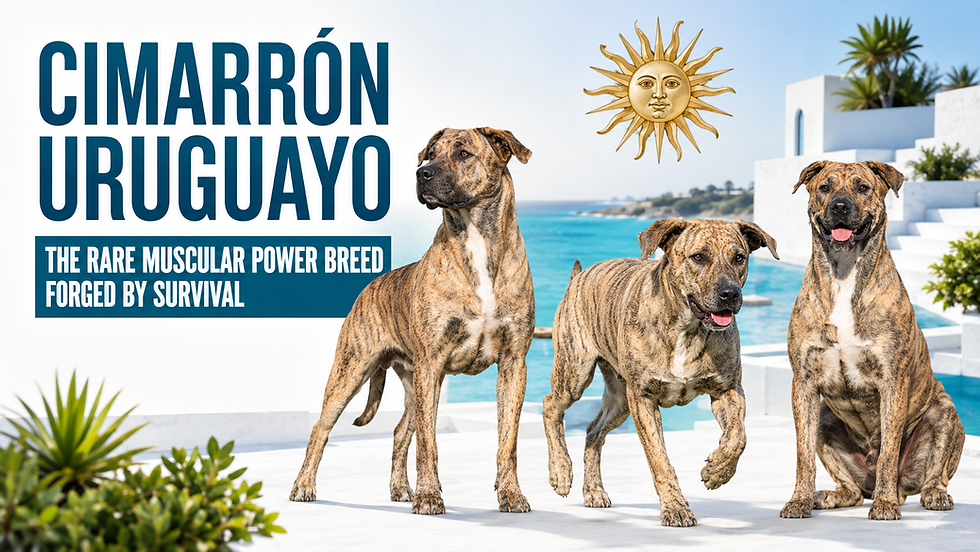
Broad-chested, strongly muscled and unmistakably powerful, the Cimarrón Uruguayo looks as though it should be as famous as the Rottweiler, Cane Corso or Presa Canario.
Yet outside its homeland of Uruguay, relatively few dog owners have heard its name.
This is not an enormous mastiff developed simply to look intimidating. The Cimarrón is officially described as a medium-sized molosser: compact, substantial and impressively muscular, but still agile enough to perform demanding work.
Its accepted history is one of survival, adaptation and eventual partnership with people. That remarkable background has produced one of the dog world’s most distinctive lesser-known power breeds—but also one requiring experienced, realistic ownership.
Cimarrón Uruguayo Quick Facts

Origin: Uruguay
Breed type: Molosser, mastiff type
FCI breed number: 353
Male height: 58–61 cm, with a 2 cm tolerance
Female height: 55–58 cm, with a 2 cm tolerance
Male weight: 38–45 kg
Female weight: 33–40 kg
Coat: Short, smooth and close, with an undercoat
Recognised colours: Brindle, fawn, bluish brindle and bluish fawn
Traditional roles: Livestock work, guarding and large-game hunting
Breed-standard qualities: Balanced, intelligent, attentive and courageous
UK status: Not named as a prohibited breed or type, although physical type and the applicable law must still be considered
The Fédération Cynologique Internationale places the Cimarrón Uruguayo in Group 2 among molosser and mastiff-type dogs. It received provisional FCI recognition in 2006 and definitive recognition in 2017.
The FCI lists the breed as not subject to a working trial. This relates to FCI competition and championship requirements; it does not mean that the Cimarrón lacks a genuine working history.
What Is a Cimarrón Uruguayo?

The Cimarrón Uruguayo—pronounced approximately see-ma-RON oo-roo-GWY-oh—is Uruguay’s native molosser breed.
The word cimarrón was historically used in Spanish to describe something domesticated that had escaped and become wild or feral. This meaning reflects the traditional account of the breed’s development.
Dogs brought to South America by European colonists are believed to have contributed to free-ranging canine populations. Over many generations, dogs survived and reproduced in the Uruguayan landscape.
These populations eventually created problems for farmers and livestock owners, and many dogs were destroyed. According to the accepted breed history, some landowners also recognised useful qualities in selected dogs and began preserving and working them.
The dogs were subsequently used for tasks including:
Working with cattle
Guarding farms and property
Hunting large game
Protecting livestock
Assisting people across demanding rural terrain
The exact ancestry of the modern Cimarrón cannot be proven or reduced confidently to one present-day breed. It is more accurate to describe it as a Uruguayan landrace that was eventually standardised into a recognised breed, with ancestry believed to include European dogs introduced to the region.
A Power Breed Shaped by Function

The Cimarrón’s muscular appearance is not accidental.
Its traditional roles demanded strength, courage, physical resilience and the ability to move effectively over open ground. Excessive weight or cumbersome bulk would have reduced that usefulness.
This working background helps explain its distinctive structure:
A compact, powerful body
Strong bone without excessive heaviness
A broad, deep chest
A substantial neck
Well-developed shoulders and hindquarters
A broad head with a powerful muzzle
A firm, athletic outline
Efficient movement with reach and drive
The breed should look physically capable rather than artificially enlarged.
The current FCI standard describes the Cimarrón as a medium-sized dog of molossoid type that is strong, compact, well boned, muscular and agile. Its hindquarters should be powerful and well muscled, while its movement should remain effortless.
That combination of muscle and mobility is central to correct Cimarrón type.
How Big Is the Cimarrón Uruguayo?
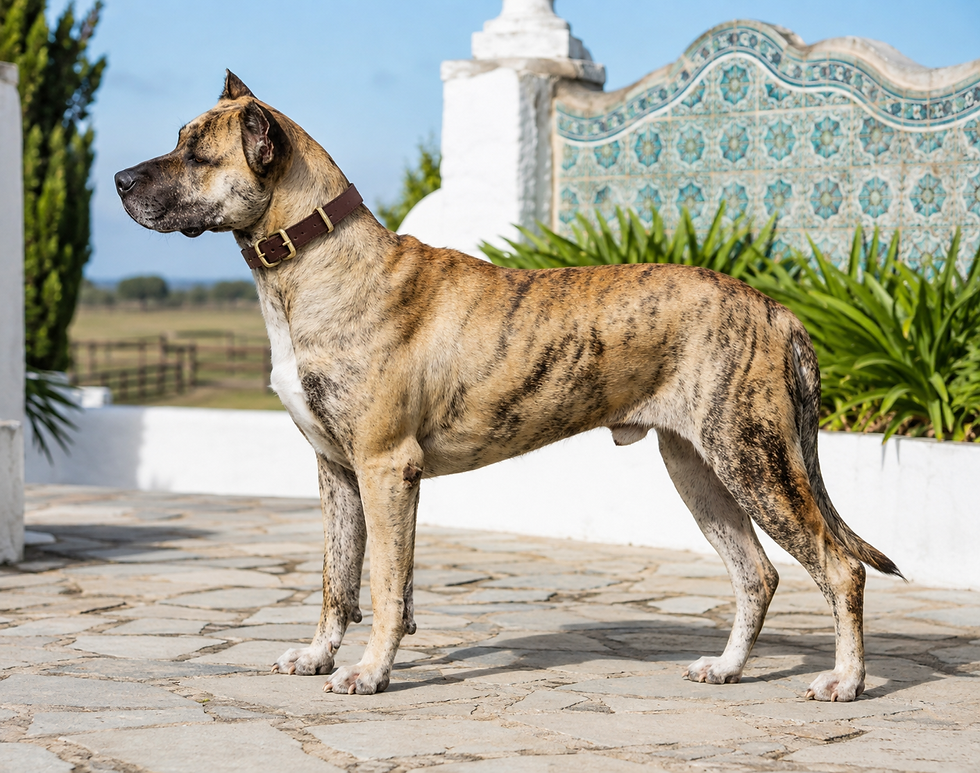
The Cimarrón is powerful without reaching giant-mastiff dimensions.
Adult males
Standard height: 58–61 cm at the withers
Permitted height tolerance: 2 cm
Standard weight: 38–45 kg
Adult females
Standard height: 55–58 cm at the withers
Permitted height tolerance: 2 cm
Standard weight: 33–40 kg
A male Cimarrón is substantial but generally lighter than a typical adult male Rottweiler. Its power comes from compact proportions, strong bone and developed muscle rather than exceptional height or extreme body weight.
The breed standard does not reward maximum size at any cost. A heavier dog is not automatically a better example.
Correct proportions, sound movement, functional muscle, clear sexual dimorphism and recognisable breed type matter more than producing the largest possible dog.
What Does a Correct Cimarrón Look Like?

The Cimarrón should present a powerful but balanced outline.
Head
The head is broad and substantial. The skull is wider than it is long, and the stop is moderate.
The muzzle is broad and powerful. It is only slightly shorter than the skull and should not appear weak, pinched or excessively short.
The expression should be attentive, confident and intelligent.
Body
The body is slightly longer than the dog is tall. The height at the withers should equal the height at the croup, creating a level topline.
The chest is deep and well developed, reaching at least to the elbows. The ribs should be well sprung without creating an exaggerated barrel shape.
The dog should possess visible substance without excessive loose skin, an exaggerated dewlap or the cumbersome heaviness found in some oversized mastiff lines.
Legs and movement
The forequarters and hindquarters should appear straight and parallel when viewed from the appropriate angles.
Well-developed thighs and muscular hindquarters provide drive. Correct movement should be effortless, with good reach in front and good drive behind.
As speed increases, the breed should move towards a single track.
This is an important distinction: the correct Cimarrón is a functional athlete in a molosser body.
Coat and Recognised Colours
The coat should be short, smooth and close to the body, with an undercoat.
The current FCI standard recognises:
Brindle
Fawn in different shades
Bluish brindle
Bluish fawn
Any of these colours with or without a mask
Black shading on fawn coats
Limited white markings are permitted in specific areas:
Beneath the jaw
On the throat
On the forechest
On the abdomen
On the lower parts of the legs, within the limits described by the standard
Genetic brown or chocolate colouring accompanied by a brown nose, brown gums and light eyes is a disqualifying fault under the FCI standard.
Brindle is perhaps the appearance most strongly associated with the breed and can emphasise its compact muscular outline.
Natural Ears Versus Cropped Ears

Some international photographs show Cimarróns with cropped ears because cropping has historical association with the breed in Uruguay.
That is not the breed’s natural ear.
An uncropped Cimarrón has medium-sized, triangular drop ears that sit close to the cheeks. Natural ears soften the outline of the head without reducing its power or breed character.
Cosmetic ear cropping cannot legally be performed in the UK. A veterinary surgeon may only remove part of an ear when there is a genuine medical reason.
However, the presence of cropped ears does not automatically prove that cropping took place illegally in the UK. Some dogs may have been legally altered in another country before importation. Separate import, welfare and dog-show rules may apply.
Anyone considering an imported dog should investigate its history carefully and check the current rules before making a commitment.
A Cimarrón does not need altered ears to look impressive.
Cimarrón Uruguayo Temperament
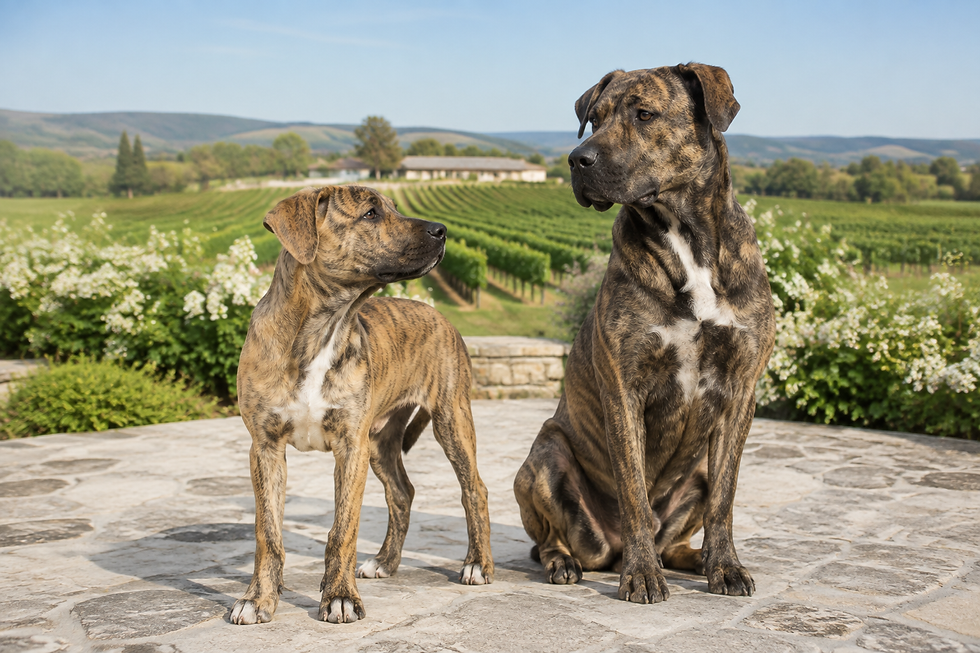
The official breed standard describes the Cimarrón as balanced, intelligent, attentive and courageous.
Those qualities sound attractive, but they must be understood in the context of a powerful dog with a history of guarding, livestock work and hunting.
Depending on genetics, upbringing and individual temperament, a well-bred Cimarrón may be:
Strongly attached to its household
Alert to changes in its surroundings
Naturally watchful around property
Reserved with unfamiliar people
Confident and physically determined
Intelligent but independently minded
Sensitive to inconsistent handling
These are general management considerations based on the breed standard and traditional roles. They are not guaranteed characteristics of every individual.
Balanced behaviour should never be confused with uncontrolled aggression. The FCI standard disqualifies dogs that are aggressive or excessively shy.
However, “balanced” does not mean universally sociable, effortless to manage or suitable for inexperienced ownership.
Early training, careful socialisation, secure management and responsible breeding are especially important.

Is the Cimarrón a Good Family Dog?
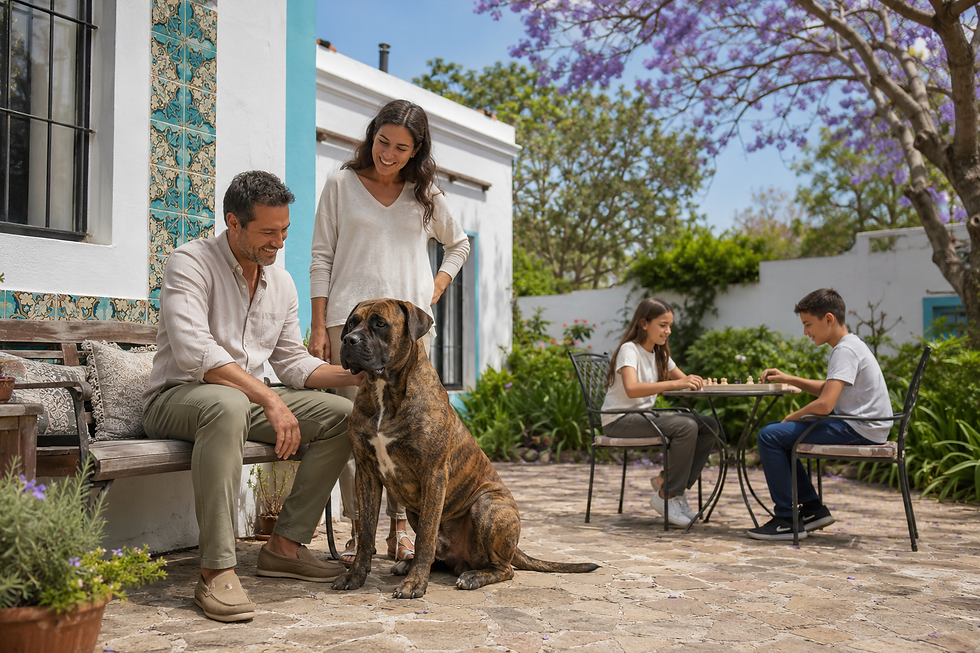
A responsibly bred and carefully raised Cimarrón may form a strong attachment to its family.
That does not make it a general-purpose family pet suitable for every household.
There is not enough robust breed-wide behavioural research to guarantee how every Cimarrón will behave with children. Genetics, early experiences, household management and the behaviour of the individual dog all matter.
Its strength and guarding background mean that interactions with children should always be supervised.
Children should never:
Climb or sit on the dog
Disturb it while eating or sleeping
Remove food or toys
Approach it while it is guarding a gate or boundary
Attempt to control it on a lead
Interfere during dog-to-dog interactions
Be left responsible for visiting children around the dog
Owners should be able to separate the dog calmly when visitors arrive and prevent children from creating noisy, confrontational or confusing situations.
The goal should never be to encourage protective behaviour around children. It should be to raise a stable dog that remains calmly under adult control.
Can a Cimarrón Live With Other Dogs?
Possibly—but compatibility cannot be assumed.
There is insufficient evidence to make a reliable breed-wide prediction. Some individuals may live successfully with other dogs, while others may become more selective or less tolerant as they mature.
Early, carefully managed socialisation can be helpful, but it cannot override every genetic or individual tendency.
A responsible multi-dog household should be prepared to:
Supervise introductions
Feed dogs separately
Manage toys, chews and other valuable resources
Prevent unsupervised conflict
Use secure gates or separate areas when necessary
Avoid forcing interaction
Watch for subtle signs of tension
Obtain qualified behavioural help early if problems develop
Dog parks and uncontrolled group play may not be suitable for every adult Cimarrón.
A large guardian breed does not need to greet every dog. Calm neutrality is often a safer and more realistic objective.
What About Cats and Smaller Animals?
Because the Cimarrón has a traditional hunting background, owners should not assume that every individual will be safe around cats, poultry or small animals.
Some dogs raised carefully with a household cat may coexist successfully. Others may retain a strong chase or predatory response.
A dog that lives peacefully with one familiar cat may still react differently to an unfamiliar animal outdoors.
Genetics, early experience, training, management and individual temperament all play a part.
Secure control and careful supervision remain essential.
Training a Cimarrón Uruguayo

This is not a dog that should be trained through intimidation or physical confrontation.
Punitive methods can damage trust and may intensify fear, frustration, resistance or defensive behaviour.
Effective training should be:
Clear
Calm
Consistent
Reward-based
Structured
Started early
Practised around realistic distractions
Priority skills include:
Responding reliably to its name
Loose-lead walking
Recall practised safely on a long line
Waiting at doors and gates
Settling calmly on a mat
Leaving food or objects when asked
Positive muzzle training
Cooperative handling for veterinary care
Remaining neutral around people and dogs
Moving calmly behind a barrier when visitors arrive
Muzzle training is a valuable life skill for any large dog. Teaching it positively does not mean the dog is dangerous. It provides another safe management option for veterinary treatment, emergencies and unfamiliar situations.
Owners who are inexperienced with powerful guardian breeds should seek help from an appropriately qualified, reward-based trainer before problems develop.
Socialisation Without Overexposure
Socialisation does not mean allowing every stranger to touch the puppy or forcing it to play with every dog.
For a naturally watchful breed, good socialisation should help the dog learn that ordinary people, animals, places and events do not require a reaction.
Useful experiences may include:
Calmly observing people at a comfortable distance
Walking past other dogs without greeting
Hearing traffic and ordinary household noises
Visiting veterinary environments
Travelling safely in a vehicle
Seeing livestock from a controlled distance
Resting quietly in suitable public places
Accepting handling of the feet, ears and mouth
Learning that invited visitors can enter without confrontation
Developing confidence on different surfaces and in new environments
Experiences should be positive and appropriate for the individual puppy. Overwhelming a young dog can create fear rather than confidence.
Quality matters more than the number of people or dogs encountered.
How Much Exercise Does a Cimarrón Need?
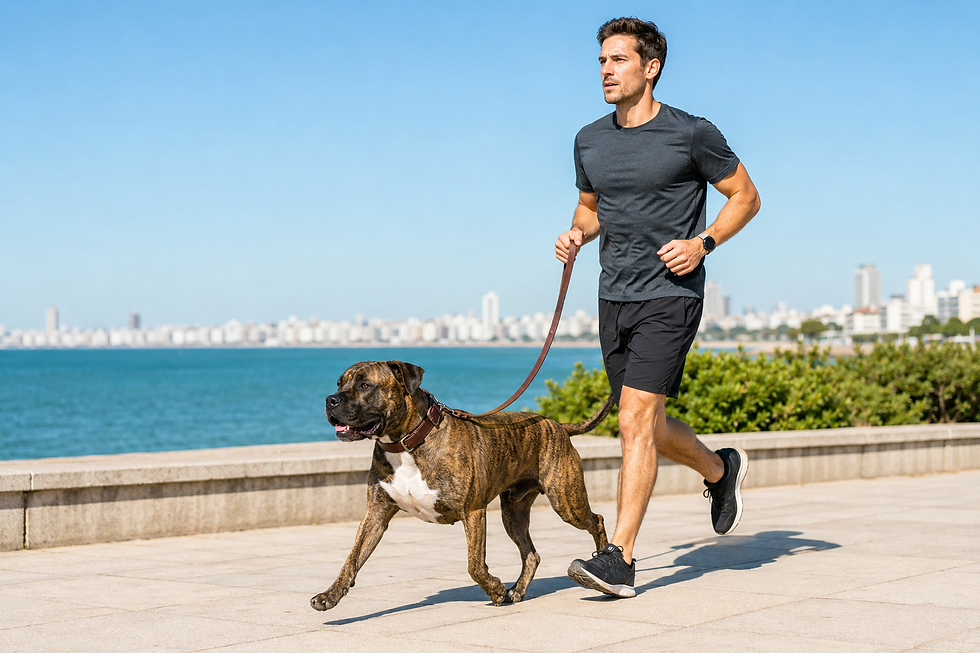
There is no reliable evidence supporting one fixed daily exercise duration for every Cimarrón.
Requirements will vary according to:
Age
Health
Physical development
Body condition
Temperament
Training history
Fitness
Weather
Individual workload
A healthy adult may enjoy a varied routine including:
Purposeful walks
Controlled movement in securely enclosed areas
Scent work
Tracking
Obedience exercises
Structured play
Hill walking where appropriate
Low-impact conditioning
Tasks requiring concentration and self-control
Physical exercise alone is not enough. Constantly trying to exhaust a powerful dog may produce an even fitter animal without teaching calm behaviour.
Mental engagement, structured rest and relaxation training are equally important.
Puppies and adolescents should not undertake repetitive jumping, forced distance running, heavy pulling or intense resistance work while developing. Exercise should suit the individual dog’s age, structure and veterinary needs.
Building and Maintaining Healthy Muscle

The Cimarrón is naturally muscular. Owners should not try to force extreme size, maximum weight or artificial bulk onto the dog.
Healthy condition depends on:
Appropriate genetics
A complete and balanced diet
Adequate dietary protein
Gradually developed activity
Appropriate rest
A healthy level of body fat
Sound joints and movement
Regular assessment of body and muscle condition
A broad chest and naturally powerful frame can make excess body fat difficult to recognise. Hands-on assessment is therefore important.
Owners should be able to feel the ribs beneath a light covering without the ribs appearing sharply prominent. The waist and abdominal tuck should remain visible where appropriate for the individual dog.
Muscle condition should also be assessed around the skull, shoulder blades, spine and pelvis. Unexplained loss of body weight, strength or muscle should be investigated by a veterinary professional.
Nutritional Support for Active Power Breeds

A suitable complete dog food should remain the foundation of the diet.
Where an owner wants to add selected protein and nutritional ingredients, JayFuel can be used as a complementary topper alongside the normal complete food. Its formulation includes whey and yeast proteins, omega-oil sources, vitamins, minerals and digestive ingredients.
For suitable dogs following an established conditioning routine,
MuscleMatrix provides selected amino acids and other nutritional ingredients in a soft-chew format.
These complementary feeds do not replace
Complete and balanced food
Appropriate exercise
Rest
Weight management
Veterinary care
Investigation of unexplained muscle or weight loss
Always follow the current product label, introduce new feeds gradually and seek professional guidance for dogs with medical conditions, dogs receiving medication or animals requiring a veterinary diet.
Grooming and Everyday Care
The Cimarrón’s short coat is relatively straightforward to maintain.
Routine care should include:
Regular brushing
Nail checks and trimming
Dental care
Ear inspection
Skin and coat monitoring
Parasite control based on veterinary advice
Weight and body-condition assessment
Routine veterinary examinations
The presence of an undercoat means that shedding may still be noticeable, particularly during seasonal changes.
Short hair provides less insulation than a heavy mastiff coat. Individual dogs may need sensible protection during prolonged cold or wet British weather, especially when inactive.
Health and Responsible Breeding

Reliable large-scale health data are limited because the Cimarrón remains uncommon internationally.
Its robust traditional history should not be treated as proof that every modern dog will be free from inherited or acquired health problems.
There is no established Royal Kennel Club breed-specific health-testing programme for the Cimarrón in the UK.
Because it is a substantial, muscular dog, prospective buyers can reasonably ask breeders whether the parents have undergone hip and elbow evaluation. These are prudent screening questions rather than a claim that every Cimarrón is affected by joint disease or that such testing is mandated by a UK breed scheme.
Buyers should also ask about:
General veterinary history
Family temperament
Longevity among related dogs
Causes of death in previous generations
Any recurring health concerns within the line
Eye or cardiac examinations where recommended by relevant veterinary professionals
Genetic diversity within the proposed mating
The absence of a long official testing list does not remove a breeder’s responsibility to investigate health and avoid breeding from clinically unsuitable dogs.
A responsible breeder should prioritise:
Functional structure
Stable temperament
Sound movement
Health
Genetic diversity
Breed type without exaggeration
Maximum weight, the broadest possible head or the most intimidating appearance should never become breeding goals.
Is the Cimarrón Uruguayo Legal in the UK?

The Cimarrón Uruguayo is not named as a prohibited breed or type in the UK.
The types currently listed as prohibited on GOV.UK are:
Pit Bull Terrier
Japanese Tosa
Dogo Argentino
Fila Brasileiro
XL Bully
However, prohibited-dog legislation can assess physical type rather than relying only on pedigree, registration papers or the name given to a dog.
A pedigree or foreign registration may be relevant evidence, but it does not automatically prevent authorities from carrying out a physical-type assessment.
Rules, procedures and exemptions are not identical across England and Wales, Scotland, and Northern Ireland. Anyone considering buying or importing a Cimarrón should:
Check the rules applying in their part of the UK
Review the latest official prohibited-dog guidance
Confirm current import requirements
Retain accurate identification and ancestry records
Obtain specialist legal advice if there is any concern about physical type
Avoid relying solely on assurances from a seller
Every dog must also remain under proper control. Dog-control laws apply to all breeds and can apply in public and private places.
Legal guidance can change, so official information should be checked at the time of purchase or importation.
Is the Cimarrón Recognised by the Royal Kennel Club?
The Cimarrón Uruguayo is definitively recognised by the Fédération Cynologique Internationale.
However, it does not currently appear in the Royal Kennel Club’s published UK Breeds A to Z system as a recognised breed with its own UK breed standard.
That may limit conventional UK showing, litter registration and access to established British breed specialists.
Recognition by the FCI should not be confused with recognition by every national kennel organisation.
Prospective buyers should also be cautious of sellers using rarity to justify:
Poor documentation
Unverified ancestry
Missing health information
Inadequate puppy raising
Excessive prices
Claims that cannot be independently checked
Finding a Responsible Breeder

Because the breed is rare in Britain, prospective owners may feel pressured to purchase quickly when a puppy becomes available.
Rarity should make buyers more careful, not less.
Ask for:
Verifiable registration records
Full identification of both parents
Relevant health results
Details of related dogs
Honest temperament information
Evidence of careful puppy raising
Socialisation records
Import and vaccination documentation
A written purchase contract
A return-to-breeder agreement
Lifelong breeder support
Avoid sellers who advertise primarily through phrases such as:
“Extreme muscle”
“Protection guaranteed”
“Huge head”
“Rare aggressive bloodline”
“Maximum size”
“No one will come near your house”
A serious guardian breed should be selected for stability and control—not marketed as a weapon or status symbol.
Who Should Own a Cimarrón Uruguayo?

The breed may suit an experienced owner who:
Understands guardian and molosser behaviour
Can manage a physically strong dog
Enjoys structured training
Has secure fencing
Can supervise interactions responsibly
Accepts that the dog may remain reserved with strangers
Has time for physical activity and mental engagement
Can manage multiple-dog dynamics if necessary
Has researched the relevant UK legislation
Values function and temperament above exaggerated size
It is unlikely to suit someone who:
Is choosing primarily for appearance
Wants an effortless first dog
Expects universal friendliness
Relies on dog parks for exercise
Cannot provide secure containment
Wants to encourage aggressive guarding
Is unwilling to train and manage the dog throughout adulthood
Regularly leaves children and dogs together unsupervised
Has not considered the possible legal complications surrounding physical type
How Does the Cimarrón Compare With Better-Known Power Breeds?

The Cimarrón may remind people of several familiar breeds, but it should not be treated as a renamed version of any of them.
Cimarrón Uruguayo versus Rottweiler
The Rottweiler is usually heavier, with an adult male breed-standard weight of approximately 50 kg. The Cimarrón is generally lighter and presents a different outline, although both are powerful working molossers.
Cimarrón Uruguayo versus Cane Corso
The Cane Corso is normally taller and has the distinctive proportions and head type of an Italian mastiff. The Cimarrón is more compact and developed from a separate South American history.
Cimarrón Uruguayo versus Presa Canario
The Presa Canario is generally heavier and more massive. The Cimarrón should retain noticeable agility and a relatively compact, functional outline.
Cimarrón Uruguayo versus Staffordshire Bull Terrier
The Staffordshire Bull Terrier is much smaller and belongs to the terrier group. Both can be muscular, but their ancestry, scale, proportions and traditional functions are very different.
What makes the Cimarrón different?
The Cimarrón is a medium-sized Uruguayan molosser whose recognised breed identity developed from free-ranging dogs later selected for rural work, guarding and hunting.
These comparisons can help explain physical differences, but they cannot reliably predict the behaviour of an individual dog.
The Harsh Truth About This Rare Power Breed
The Cimarrón Uruguayo is impressive because it combines natural muscle, agility, courage and an extraordinary accepted history.
Those same qualities can make it challenging in an unsuitable home.
It is not rare because it is a secret “better” version of popular bull or mastiff breeds. It remains unusual in Britain because it comes from a particular working culture, has a limited international population and demands serious ownership.
A stable, responsibly bred Cimarrón should not be nervy, chaotic or indiscriminately aggressive. Nor should every individual be expected to welcome unfamiliar people and dogs as friends.
The official ideal is balanced, intelligent, attentive and courageous.
The responsible owner should be equally calm, prepared and realistic.
Final Verdict: Powerful, Historic and Not for Everyone
The Cimarrón Uruguayo deserves greater recognition among enthusiasts of functional power breeds.
Its compact frame carries impressive natural muscle. Its accepted history is one of adaptation, survival and eventual selection for demanding work.
Its traditional roles required much more than physical strength. Intelligence, stamina, courage, agility and the ability to work alongside people were all valuable.
But admiration should never be confused with suitability.
For an experienced owner who understands strong guardian breeds, provides secure management and values controlled athleticism over exaggerated bulk, the Cimarrón may be fascinating.
For someone seeking a dramatic-looking dog without accepting the training, legal and management responsibilities, it is the wrong choice.
Power is the first thing people notice. Balance is what makes the breed worth preserving.
This article provides general breed information and is not a substitute for individual legal, veterinary or behavioural advice. UK dog-control and import rules can change, so check current official guidance before buying or importing any rare power breed.


Comments