


Extinct Breeds #2 Bullenbeisser: The Extinct German Hunting Dog Behind the Modern Boxer
- 4 days ago
- 11 min read

A Powerful Catch Dog That Disappeared—but Helped Shape a Breed We Still Know Today
Long before the Boxer became a popular working dog and family companion, its ancestors performed a far more dangerous role.
The Bullenbeisser was a powerful, short-coated dog used to seize and hold large game after pursuing hounds had driven the animal towards the hunters. Its work required strength, courage, a broad mouth and the determination to maintain its grip until the hunter arrived.
The smaller Brabanter Bullenbeisser is recognised by the Fédération Cynologique Internationale as the immediate ancestor of the modern Boxer. However, the old Bullenbeisser was not simply an early Boxer. It belonged to an earlier world of European hunting, working dogs and regional types that existed before modern breed standards.
The breed did not disappear in a single tragedy. Its original work declined, surviving dogs took on different roles, and the old type was gradually absorbed into newer breeding populations.
The Bullenbeisser became extinct—but its influence survived.
Contents
What Was the Bullenbeisser?
What Does Bullenbeisser Mean?
Where Did the Breed Come From?
What Was the Bullenbeisser Bred to Do?
How the Bullenbeisser Worked During a Hunt
What Did the Bullenbeisser Look Like?
The Larger Danziger and Smaller Brabanter Types
What Was Its Temperament Like?
Hunting Dog, Bull-Baiting Dog—or Both?
Why Did the Bullenbeisser Become Extinct?
How the Bullenbeisser Helped Create the Boxer
What Survives in the Modern Boxer?
Bullenbeisser Myths Versus Historical Evidence
Could the Bullenbeisser Ever Be Recreated?
Frequently Asked Questions
The Bullenbeisser’s Lasting Legacy
1. 🐕 What Was the Bullenbeisser?

The Bullenbeisser was an extinct European catch-dog type, most strongly associated with German-speaking regions.
Unlike pursuing hounds, which located or chased quarry, the Bullenbeisser was expected to move in close, seize the animal and hold it. This was dangerous work involving powerful game such as wild boar, deer and, according to later Boxer histories, smaller bears.
The Royal Kennel Club describes the Bullenbeisser as a German hunting dog used on bear, boar and deer, while the FCI explains that these dogs held game driven towards them by hounds until the hunter arrived.
It is best understood as a functional working population rather than a modern pedigree breed with:
A closed stud book
One exact written standard
Fixed measurements
Consistent appearance across every region
Modern registration records
Dogs were mainly selected according to whether they could perform the required work.
Function came before appearance.
2. 📖 What Does Bullenbeisser Mean?
The name is commonly translated from German as “bull biter” or “bull-biting dog.”
The German verb beissen means to bite, while Bullen refers to bulls. However, the name should not be interpreted as proof that every Bullenbeisser spent its life fighting bulls.
Historical dog names often reflected one recognised use without describing every task performed by the dogs. Bullenbeisser-type dogs were connected with hunting, holding large animals, guarding and, during some periods, animal-baiting activities.
The breed’s best-supported historical role in official Boxer histories is that of a hunting catch dog that seized quarry and held it for the hunter.
3. 🗺️ Where Did the Breed Come From?

The Bullenbeisser is primarily associated with Germany, although related short-haired catch dogs existed across continental Europe.
Its exact beginnings cannot be reconstructed with certainty. It developed long before kennel clubs, DNA testing and modern pedigree records, so confident claims tracing it directly to one ancient breed should be treated cautiously.
Historical Boxer accounts place Bullenbeisser-type dogs within a much wider family of European Doggen: strongly built, short-haired dogs with powerful heads and muzzles that were used for hunting and holding large animals.
Two regional names became especially well known:
The larger Danziger Bullenbeisser
The smaller Brabanter Bullenbeisser
The name Danziger is associated with Danzig, now Gdańsk in Poland. The name Brabanter refers to Brabant, a historic region now divided between Belgium and the Netherlands.
These should not be treated as two perfectly standardised modern breeds. They were historical varieties or types whose size, appearance and breeding may have differed between places and periods.
4. 🐗 What Was the Bullenbeisser Bred to Do?

The Bullenbeisser was bred to help hunters control dangerous quarry.
Its main requirements would have included:
Strength to hold a struggling animal
Courage to approach dangerous game
Agility to avoid hooves, tusks and antlers
A broad mouth capable of maintaining a firm grip
Physical resilience
The ability to work alongside people and other dogs
The FCI’s Boxer history explains that hunters favoured Bullenbeissers with broad jaws and widely spaced teeth because these features helped the dogs grip and hold their quarry securely. Dogs that performed the job successfully were selected for breeding.
This was an early form of performance-based selection. Breeders were not primarily attempting to win shows or create an exaggerated appearance. They were producing dogs that could complete a specific and highly demanding task.
5. 🌲 How the Bullenbeisser Worked During a Hunt
The Bullenbeisser did not necessarily begin a hunt by tracking an animal over long distances.
A large hunting pack could contain different types of dogs performing different jobs.
Pursuing hounds or rough-coated hunting dogs would locate and drive the game. Once the animal was brought into position, the Bullenbeisser moved in to seize and restrain it.
Historical Boxer accounts describe the more valuable catch dogs as approaching from a position that reduced their risk of being seriously injured while allowing them to hold the animal until the hunters arrived.
This division of labour mattered:
The hounds pursued.
The Bullenbeisser caught and held.
The human hunter completed the hunt.
The Bullenbeisser therefore needed more than raw strength. A reckless dog that rushed directly into danger without control could be badly injured or killed.
Successful dogs needed timing, coordination and enough trainability to work within the hunting group.
6. 👀 What Did the Bullenbeisser Look Like?
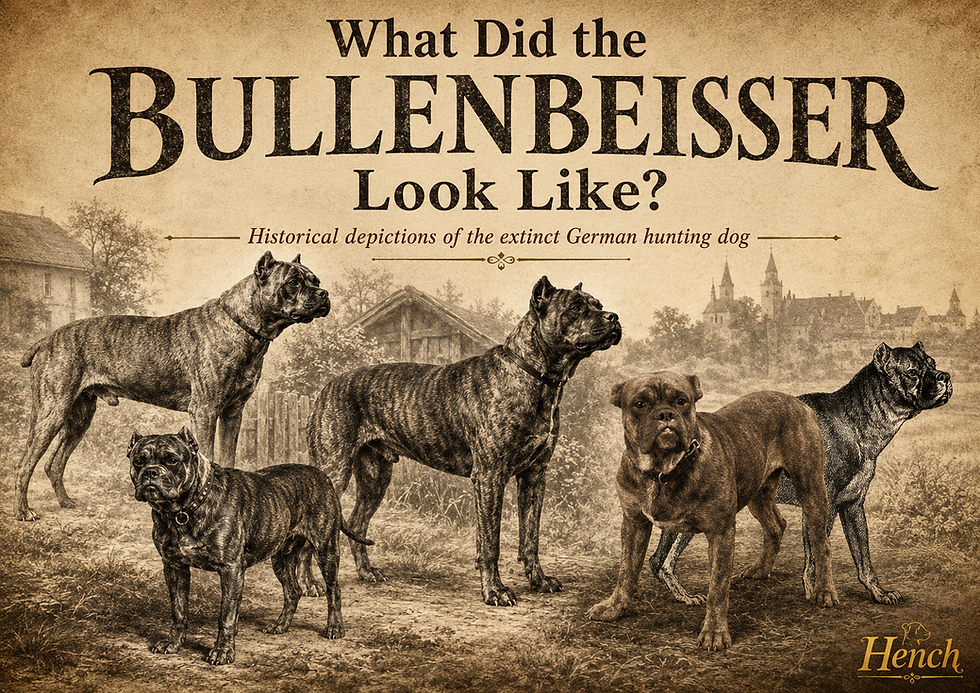
No single description can tell us exactly what every Bullenbeisser looked like.
The breed existed before photography became widespread and before appearance was controlled through one international standard. Most modern impressions come from written descriptions, paintings and engravings.
Historical accounts and surviving illustrations suggest a dog with:
A strong, compact or mastiff-like body
A broad head and muzzle
Powerful jaws
A short coat
Considerable muscle
Drooping or semi-drooping natural ears
Fawn, brown or brindle colouring in many examples
A darker muzzle or mask in some dogs
The American Boxer Club’s history states that early accounts commonly described Bullenbeissers as fawn or brindle with dark masks. White markings became more prominent in developing Boxer lines following crosses with imported English Bulldog-type dogs during the nineteenth century.
However, illustrations should not be treated as precise photographic records. Artists sometimes exaggerated features, copied earlier works or produced images long after the dogs depicted had lived.
Exact weights and heights presented online should therefore be treated with caution.
7. 📏 The Larger Danziger and Smaller Brabanter Types
Historical writers commonly distinguished between two Bullenbeisser forms.
The Danziger Bullenbeisser
The Danziger was presented as the larger and heavier type.
It was associated with powerful game and appears more substantial in surviving illustrations. However, there is no reliable universal height or weight standard comparable to those used for modern registered breeds.
The Brabanter Bullenbeisser
The Brabanter was the smaller, lighter and more compact type.
It became particularly important because it is recognised as the immediate ancestor of the modern Boxer. Its reduced size may have made it more adaptable when the large organised hunting packs of noble estates began to disappear.
An 1895 historical work by Ludwig Beckmann depicts a larger Danziger and a smaller Brabanter side by side, describing them as German Bullenbeissers of the eighteenth century. The illustration itself was based on earlier artwork, reinforcing the need to treat it as historical evidence rather than an exact breed standard.
8. 🧠 What Was Its Temperament Like?
We cannot assess the extinct Bullenbeisser through modern temperament testing.
There were no standardised behavioural surveys, large genetic databases or controlled evaluations of the breed. Any claim that every Bullenbeisser was gentle, aggressive, easy to train or dangerous would be speculation.
Nevertheless, its work suggests that certain characteristics would have been valued:
Courage
Determination
Physical confidence
Responsiveness to its handler
The ability to work among other dogs
Enough control to hold rather than simply attack
Alertness and guarding instinct
After the decline of the noble hunting packs, smaller Bullenbeissers were reportedly used as family guardians and by butchers and cattle dealers. Historical Boxer accounts praised their intelligence and tractability, although these descriptions cannot tell us how every individual behaved.
A balanced description is therefore:
The Bullenbeisser was probably selected for courage, determination and working ability, but temperament would have varied between dogs, bloodlines and uses.
9. ⚔️ Hunting Dog, Bull-Baiting Dog—or Both?
The Bullenbeisser is sometimes described online as either a heroic hunting dog or a dedicated fighting dog.
The historical picture is more complicated.
Its best-documented working role was catching and holding large game. Official Boxer histories repeatedly identify hunting as a central purpose.
However, animal-baiting spectacles also existed in Europe, and Bullenbeisser-related dogs were used during some periods to confront bulls, bears and other animals. The American Boxer Club’s historical account also connects the development of smaller Bullenbeissers with the spread of organised animal fights from England to continental Europe.
That does not mean every dog was bred solely for fighting.
Uses could differ according to:
Region
Historical period
Social class
Availability of wild game
The owner’s occupation
Local customs
The fairest conclusion is:
The Bullenbeisser was primarily a working catch-dog type, but some dogs and related types were also used in animal-baiting activities.
10. ⏳ Why Did the Bullenbeisser Become Extinct?
There is no reliable single date on which the Bullenbeisser became extinct.
It did not vanish because of one epidemic, war or sudden collapse in numbers. Its disappearance appears to have been gradual.
Several changes contributed.
Traditional hunting changed
Large organised hunting packs connected with noble estates became less common. During and after the Napoleonic period, many German estates were broken up and their hunting dogs were dispersed.
Its original role declined
As hunting methods, weapons and land ownership changed, fewer people needed specialist dogs to seize and hold dangerous game.
Surviving dogs found new work
Some smaller Bullenbeisser dogs became:
Butchers’ dogs
Cattle dealers’ dogs
Property guardians
Family dogs
Foundation stock for new developing breeds
Crossbreeding changed the population
Bullenbeisser dogs were crossed with imported Bulldog-type dogs and selectively bred towards the emerging Boxer.
Over time, the distinct Bullenbeisser population ceased to exist. Its genetics were not necessarily lost completely; they were absorbed into newer dogs.
The Bullenbeisser became extinct as a distinct type because its world changed around it.
11. 🥊 How the Bullenbeisser Helped Create the Boxer
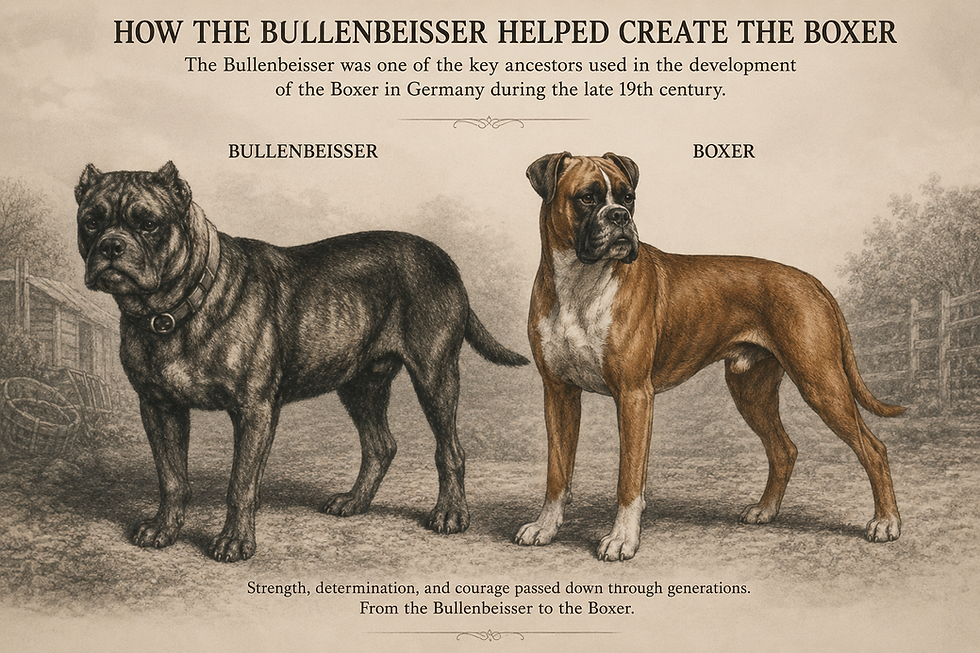
The connection between the Bullenbeisser and the Boxer is the best-supported part of the breed’s history.
The FCI states that the smaller Brabant Bullenbeisser is regarded as the Boxer’s immediate ancestor. The Royal Kennel Club also describes the Boxer as descending from the Bullenbeisser and notes that Bulldog crosses are thought to have helped form the modern breed.
During the nineteenth century, English Bulldog-type dogs were brought into Germany and crossed with smaller Bullenbeisser dogs. These Bulldogs looked different from many heavily exaggerated modern Bulldogs and were generally more athletic.
Breeders then began selecting for greater consistency in:
Head shape
Body proportions
Colour
Movement
Working ability
Character
A Boxer club was formed in Munich in 1895, helping establish a written standard and a more organised breeding programme. The first Boxer stud book was later opened, marking the movement from loosely related working types towards a recognised modern breed.
The Boxer was therefore not created from the Bullenbeisser through one simple cross.
It developed through multiple dogs, Bulldog influence and several generations of selective breeding.
12. 💪 What Survives in the Modern Boxer?
The modern Boxer is not an unchanged Bullenbeisser.
More than a century of organised breeding has shaped the Boxer into a distinct breed with its own appearance, temperament and working identity.
However, several qualities associated with the old catch dogs remain recognisable:
A broad and powerful muzzle
Strong jaws
A compact, square body
Developed muscle
Lively, powerful movement
Courage and confidence
Strong attachment to the household
Guarding and working ability
Playfulness combined with seriousness when required
The current FCI Boxer standard describes a compact, squarely built dog with strong bone, developed muscle and lively, powerful movement. It also places great importance on a calm, confident and dependable temperament.
These similarities reflect the Boxer’s ancestry, but it would be inaccurate to claim that every modern Boxer trait came exclusively from the Bullenbeisser.
The modern breed was shaped by:
Bullenbeisser ancestry
Bulldog-type crosses
Individual foundation dogs
Later working selection
Show standards
More than a century of breeder decisions
13. 🔍 Bullenbeisser Myths Versus Historical Evidence
Myth: The Bullenbeisser was simply an old Boxer
Evidence: The smaller Brabanter Bullenbeisser helped create the Boxer, but the Boxer became a separate, standardised breed through later crosses and selective breeding.
Myth: Every Bullenbeisser looked exactly the same
Evidence: Historical sources describe larger and smaller types. The dogs existed before one universal breed standard controlled their appearance.
Myth: It was only a fighting dog
Evidence: Its strongest documented role was hunting and holding game, although some dogs and related types were also involved in animal-baiting activities.
Myth: The breed died out because it became weak
Evidence: Its disappearance was connected with changing hunting traditions, the loss of its original role and its absorption into newer breeds.
Myth: The Bullenbeisser was the direct ancestor of every modern bull breed
Evidence: Its link with the Boxer is clearly recognised. Claims connecting it directly to numerous unrelated modern breeds are often much less firmly documented.
Myth: We know exactly how large it was
Evidence: There was no surviving universal standard. Exact online measurements frequently rely on later estimates rather than consistent contemporary records.
Myth: Historical paintings prove its exact appearance
Evidence: Art provides valuable clues, but it can reflect an artist’s style, copied images or idealised features.
14. 🧬 Could the Bullenbeisser Ever Be Recreated?
A breeder could attempt to produce a dog resembling historical Bullenbeisser illustrations.
They might select modern dogs for:
A broad muzzle
A powerful athletic build
Brindle or fawn colouring
Natural working ability
A compact mastiff-type structure
But the result would not be the original Bullenbeisser.
There is no known surviving pure population and no verified Bullenbeisser genetic reference against which modern dogs could be tested. Historical illustrations also do not provide enough information about health, behaviour, working ability or complete ancestry.
Any claimed revival would therefore be a:
Modern reconstruction
New breed inspired by the Bullenbeisser
Visual approximation
Breeder’s interpretation
It would not represent the return of the original extinct dog.
Appearance can be copied. A lost population and its complete genetic history cannot.
15. ❓ Frequently Asked Questions
Is the Bullenbeisser extinct?
Yes. There is no recognised surviving population of pure Bullenbeissers.
When did the Bullenbeisser become extinct?
There is no agreed exact date. The type gradually disappeared during the nineteenth and early twentieth centuries as its original work declined and its descendants were incorporated into newer breeds.
Was the Bullenbeisser the ancestor of the Boxer?
Yes. The smaller Brabanter Bullenbeisser is officially recognised as the Boxer’s immediate ancestor.
Was the Bullenbeisser the same as the Boxer?
No. It was an ancestral working type. The modern Boxer was developed later through organised selection and Bulldog-type influence.
Was it larger than the Boxer?
Some Bullenbeissers, particularly the historical Danziger type, were described or illustrated as larger. The smaller Brabanter type was closer to the foundation from which the Boxer developed.
Was it naturally aggressive?
There is no scientific temperament data for the extinct breed. It was selected for demanding work requiring courage and determination, but that does not prove indiscriminate aggression towards people or other dogs.
Did it have cropped ears?
Historical accounts indicate that ear and tail cropping occurred in some populations. However, this was a human practice rather than the dog’s natural appearance. Naturally, the dogs would have been born with full ears and tails.
Was the Bullenbeisser a Pit Bull?
No. The term Bullenbeisser referred to continental European catch-dog types with their own history. Modern Pit Bull-type dogs developed through different breeding histories.
Are any dogs sold today genuine Bullenbeissers?
No recognised breeder can provide a documented unbroken pure Bullenbeisser pedigree. Dogs marketed under the name are modern recreations or newly developed breeds.
Which modern breed carries its clearest legacy?
The Boxer has the strongest officially documented connection.
16. 🌟 The Bullenbeisser’s Lasting Legacy
The Bullenbeisser belonged to a time when dogs were shaped primarily by the work humans expected them to perform.
Its strength was not created for photographs.
Its broad muzzle was not selected merely for appearance.
Its muscle had a purpose.
Its courage had a purpose.
Even its unusual head structure was connected to its ability to grip and hold quarry.
When that work disappeared, the breed changed with it.
Some extinct breeds left behind little more than a name and a handful of illustrations. The Bullenbeisser left something more visible: a major part of its heritage survived within the modern Boxer.
Today’s Boxer is friendlier, more standardised and adapted to a very different world. Yet within its powerful body, broad muzzle, alert expression and confident working character, it is still possible to recognise the outline of the old hunting dog.
The Bullenbeisser disappeared as a breed—but it was not entirely lost.
Its story survives every time a Boxer moves with strength, courage and unmistakable character.
The hunt ended. The old breed vanished. But its legacy still stands beside us.
Educational Note
Historical information about extinct dog breeds is often incomplete. The Bullenbeisser existed before modern kennel-club registration, photography and genetic testing. Descriptions should therefore be based on recognised historical sources while clearly separating documented evidence from later interpretation.

Comments