


Power Breed Nutrition: Why Muscle Health Defines Strength, Performance & Longevity UK Guide
- Jul 12
- 14 min read
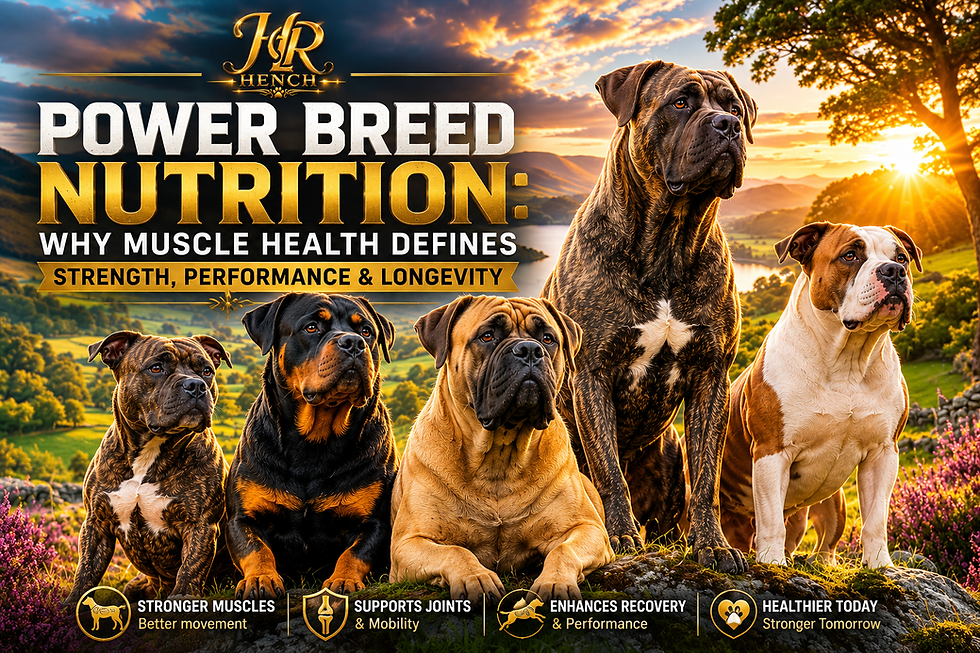
Table of Contents
What Is a Power Breed?
Why Muscle Matters More Than You Think
Why Powerful Dogs Have Different Nutritional Needs
Protein – The Foundation of Muscle
Amino Acids – The Building Blocks of Strength
Healthy Fats for Active Dogs
Why Recovery Is Just as Important as Exercise
Muscle Loss in Powerful Dogs
Signs Your Dog May Be Losing Muscle
Common Feeding Mistakes
Supporting Muscle Throughout Life
Frequently Asked Questions
Final Thoughts

Staffordshire Bull Terrier, American Staffordshire Terrier, American Bulldog, English Bulldog, French Bulldog, Bullmastiff, Cane Corso, Rottweiler, English Mastiff, Neapolitan Mastiff, Tibetan Mastiff, Dogue de Bordeaux, Boxer, Doberman Pinscher, German Shepherd, Belgian Malinois, Presa Canario, Dogo Argentino, Boerboel, Pit Bull Terrier, American Pit Bull Terrier, Kangal, Anatolian Shepherd, Great Dane, Rhodesian Ridgeback, Old English Bulldogge, Irish Stafford,
These powerful breeds all have one thing in common.
Muscle.
It's what gives them their unmistakable appearance, explosive power and confident movement. Muscle allows them to run, jump, climb, play, work and protect. It supports their joints, stabilises their bodies and helps them stay active throughout life.
Yet many owners only think about muscle when their dog starts losing it.
The truth is that healthy muscle isn't just important for show dogs or working dogs—it's essential for every powerful breed.
Whether your dog enjoys country walks, competes in dog sports or simply spends every evening curled up beside the sofa, maintaining lean muscle can make a huge difference to their comfort, mobility and quality of life.
Understanding how nutrition, exercise and recovery work together is one of the best investments you can make in your dog's long-term health.
In this guide, we'll explain why muscle matters, what science tells us about maintaining lean muscle, common mistakes owners make and simple ways to help your dog stay strong from puppyhood through to their senior years.
Key Takeaways
Muscle does far more than create an athletic appearance.
Lean muscle supports joints, balance and everyday movement.
Powerful breeds place greater forces through their bodies than lighter-built dogs.
Maintaining muscle becomes increasingly important as dogs age.
Nutrition, exercise and recovery all work together to support lifelong muscle health.
Owners should monitor both Body Condition Score (BCS) and Muscle Condition Score (MCS) rather than relying on body weight alone.
What Is a Power Breed?

The term power breed isn't an official veterinary classification, but it's commonly used to describe dogs that have been developed for strength, endurance and physically demanding work.
These breeds typically have:
Dense lean muscle.
Strong bone structure.
Broad shoulders and chest.
Powerful hindquarters.
Excellent pulling and pushing strength.
Athletic movement.
Many were originally bred to guard property, work livestock, hunt large game or perform physically demanding tasks alongside people.
Popular examples include:
Staffordshire Bull Terrier
Bull Terrier
American Bulldog
Cane Corso
Rottweiler
Bullmastiff
Dogue de Bordeaux
Presa Canario
American Bully
English Bulldog
Although these breeds differ in size and purpose, they all rely on healthy muscle to perform everyday activities comfortably.

🐾 Did You Know?
Muscle is one of the body's most metabolically active tissues.
Healthy muscle doesn't just power movement—it also plays an important role in maintaining balance, supporting joints and helping dogs stay active throughout their lives.
Why Muscle Matters More Than You Think

When most people think about muscle, they picture a powerful Staffordshire Bull Terrier or a heavily built Cane Corso.
But muscle is far more than appearance.
Every time your dog walks across the kitchen floor, climbs into the car, jumps onto the sofa or chases a ball, hundreds of muscles are working together.
Healthy muscle helps:
Support hips, elbows, knees and shoulders.
Stabilise the spine.
Protect ligaments and tendons.
Improve balance and coordination.
Generate strength and power.
Reduce fatigue during exercise.
Support healthy ageing.
This is especially important in powerful breeds because their bodies naturally carry more muscle and more weight.
Without good muscle condition, joints have to work harder, movement becomes less efficient and everyday tasks can gradually become more difficult.
💪 Support Your Power Breed Every Day

Strong muscles need the right support.
Whether your dog is a playful Staffy, a powerful Rottweiler or an active Cane Corso, JayFuel and MuscleMatrix are designed to complement a balanced diet and active lifestyle.
✔ JayFuel – High-protein daily nutrition with omega oils, probiotics, digestive enzymes, vitamins and minerals.
✔ MuscleMatrix – Advanced muscle support with amino acids, HMB and key nutrients to help maintain healthy muscle growth and support recovery.
Support strength. Support mobility. Support lifelong performance.
👉 Shop the Hench Range today.
Why Powerful Dogs Have Different Nutritional Needs
A Chihuahua and a Cane Corso may both be dogs, but their bodies work very differently.
Power breeds don't just carry more weight—they carry more lean muscle, stronger bones and place greater forces through their joints every time they move.
That means their nutritional needs are often different too.
While every dog needs a balanced diet, powerful breeds benefit from nutrition that helps support:
Lean muscle maintenance.
Healthy joints.
Everyday mobility.
Exercise recovery.
Healthy body condition.
Lifelong strength.
The goal isn't to create an oversized dog—it's to help your dog stay strong, athletic and comfortable throughout life.
Muscle Is Expensive Tissue

Muscle is one of the body's most active tissues.
Unlike body fat, muscle is constantly repairing itself. Every walk, game of tug, training session or zoom around the garden creates tiny amounts of normal wear within muscle fibres.
The body responds by repairing those fibres using nutrients from the diet.
Without adequate nutrition, especially high-quality protein and essential amino acids, muscle repair becomes less efficient.
Over time, this may contribute to a gradual loss of muscle condition.
Why Lean Muscle Matters More Than Body Weight
Many owners regularly weigh their dog.
Far fewer check whether that weight is actually healthy muscle.
Two Staffordshire Bull Terriers could each weigh 18 kg, yet look completely different.
One may have:
Well-developed shoulders.
Strong hindquarters.
A firm topline.
Excellent body condition.
The other may carry:
Less muscle.
More body fat.
Poor overall conditioning.
Although the scales show the same number, the healthier dog is usually the one carrying more lean muscle, not more weight.
This is why veterinary professionals increasingly recommend assessing both:
Body Condition Score (BCS) – how much body fat your dog carries.
Muscle Condition Score (MCS) – how much muscle your dog maintains.
Looking at both provides a much clearer picture of your dog's overall condition than body weight alone.

Powerful Dogs Put Greater Forces Through Their Bodies
Every time a powerful breed jumps into the car, climbs stairs or changes direction at speed, the muscles, tendons, ligaments and joints work together to control that movement.
The larger and more muscular the dog, the greater these forces can be.
Healthy muscles act like natural shock absorbers by:
Supporting joints.
Improving stability.
Helping maintain balance.
Reducing unnecessary strain on ligaments and tendons.
Supporting efficient movement.
This is one reason why maintaining muscle is so important throughout a power breed's life—not just during their younger years.
Muscle Changes Faster Than Many Owners Realise

One of the biggest surprises for many owners is how quickly muscle condition can change.
Reduced exercise, illness, injury, surgery or simply getting older can all lead to a gradual decline in lean muscle.
Often, this happens before the dog loses body weight.
You might notice:
Narrower thighs.
Less definition across the shoulders.
A weaker topline.
Difficulty jumping.
Slower movement.
Tiring more quickly on walks.
These changes are often mistaken for "just getting older," when maintaining muscle through appropriate exercise and nutrition may help support normal mobility and function.
🐾 Did You Know?
Research shows that dogs can lose lean muscle while maintaining a normal body weight. That's why many veterinary professionals assess both Muscle Condition Score (MCS) and Body Condition Score (BCS) during health checks, especially in senior dogs and larger breeds.
Protein: The Foundation of Muscle Health

If muscle is the engine that powers a dog, protein is the fuel used to build and maintain it.
Every muscle in your dog's body is made from protein. Without enough high-quality protein in the diet, the body has fewer building blocks available to repair, maintain and support lean muscle.
This becomes even more important for power breeds because they naturally carry more muscle than many other dogs.
Whether you own a Staffordshire Bull Terrier, Rottweiler, Cane Corso or American Bulldog, healthy muscle depends on a regular supply of quality protein.
Why Protein Matters

Protein isn't stored in the body like fat.
Instead, it's constantly being broken down and rebuilt as part of the body's normal repair process.
Every day your dog uses protein to support:
Muscle maintenance.
Tissue repair.
Healthy skin and coat.
The immune system.
Hormone production.
Enzyme production.
Everyday growth and recovery.
After exercise, play or training, muscles need nutrients to repair the tiny fibres that naturally break down during activity.
Without enough dietary protein, maintaining healthy muscle becomes more difficult.
Protein Quality Is Just as Important
Not all proteins are equal.
High-quality animal proteins generally provide a better balance of essential amino acids than lower-quality protein sources.
Examples include:
Chicken
Turkey
Beef
Lamb
Fish
Eggs
Whey protein
These proteins are highly digestible and supply the amino acids needed to support normal muscle maintenance.
Amino Acids – The Building Blocks of Muscle
Proteins are made from smaller compounds called amino acids.
Think of amino acids as the individual bricks used to build a house.
Without enough bricks, the house can't be built properly.
The same applies to muscle.
Dogs require amino acids to:
Build new muscle tissue.
Repair damaged muscle fibres.
Maintain lean muscle.
Support recovery after exercise.
Some amino acids can be produced naturally by the body, while others—known as essential amino acids—must come from food.
That's why feeding a complete, balanced diet containing quality protein is so important.
Muscle Needs More Than Just Exercise
Many owners believe exercise alone builds muscle.
Exercise provides the stimulus for muscle maintenance and development, but nutrition provides the materials needed to support that process.
Think of it like building a brick wall.
Exercise is the builder.
Protein and amino acids are the bricks.
Without both, progress is limited.
This is why exercise, nutrition and recovery should always work together rather than being viewed separately
🐾 Did You Know?
A dog can exercise every day, but if its diet doesn't provide enough high-quality protein and essential amino acids, maintaining healthy lean muscle becomes much more difficult.
Nutrition is just as important as the exercise itself.
It's Not About Building Huge Muscles
Power breeds don't need exaggerated muscle mass.
The goal should always be to maintain healthy, functional lean muscle that supports normal movement, balance and joint stability.
Good muscle condition helps dogs:
Move more efficiently.
Stay active for longer.
Support healthy joints.
Recover from exercise.
Age more comfortably.
Strong doesn't have to mean oversized—it means fit, well-conditioned and healthy.
Healthy Fats, Recovery & Why Rest Days Matter
When people think about muscle health, protein usually gets all the attention.
But healthy muscles need far more than protein alone.
Recovery, healthy fats, vitamins, minerals and adequate rest all play important roles in helping powerful dogs stay strong, mobile and active.
Think of it this way...
Exercise challenges the muscles.
Nutrition repairs them.
Recovery allows them to adapt.
Miss one of those three, and your dog's progress may suffer.
---
Healthy Fats Are Essential
Fat isn't something owners should automatically fear.
Healthy fats provide concentrated energy and support many normal body functions.
Omega-3 and omega-6 fatty acids help support:
Healthy skin and coat.
Normal brain function.
Healthy joints.
Cell health.
Everyday recovery after exercise.
For active power breeds, healthy fats can also provide a valuable source of energy without relying entirely on carbohydrates.
The aim isn't simply to feed more fat—but to provide the right types of fat as part of a balanced diet.
---
Recovery Is Where Progress Happens
Many owners believe muscle develops during exercise.
In reality, the body does most of its repair work after exercise.
Whether your dog has enjoyed:
A long country walk.
Agility training.
Weight pull practice.
Canicross.
Scent work.
Protection sports.
A busy day playing with other dogs.
...their muscles need time to recover.
Recovery allows the body to repair the tiny muscle fibres that naturally experience wear during activity.
Without enough recovery time, performance may gradually decline and your dog may become tired more easily.
---
Don't Underestimate Sleep
Sleep is one of the most overlooked parts of muscle health.
Adult dogs typically sleep 12–14 hours a day, while puppies and senior dogs often sleep considerably more.
During sleep the body carries out many important repair processes that support:
Muscle maintenance.
Tissue repair.
Brain function.
Immune health.
Energy restoration.
An active dog that never gets enough quality rest may struggle to recover as well as one with a good daily routine.
---
Rest Days Matter Too
People sometimes worry that taking a day off will make their dog lose fitness.
In reality, sensible rest is an important part of every exercise programme.
Rest days allow muscles, joints and connective tissues to recover from normal physical activity.
For active power breeds, alternating harder exercise days with lighter walks or gentle activities can help support long-term mobility while reducing unnecessary strain.
Remember...
More exercise isn't always better.
Better recovery often leads to better results.
---
Hydration Supports Every Muscle
Muscles cannot function efficiently without water.
Even mild dehydration can affect:
Energy levels.
Exercise performance.
Temperature regulation.
Normal muscle function.
Always ensure your dog has access to clean, fresh drinking water before and after exercise, particularly during warmer weather or after vigorous activity.
---
🐾 Did You Know?
Many owners focus on how hard their dog trains but pay much less attention to how well their dog recovers.
Good nutrition, quality sleep, sensible rest and hydration are just as important as exercise when supporting healthy muscle throughout life.
---
Common Mistakes Owners Make
Even experienced owners can unintentionally make choices that affect muscle condition.
Some of the most common mistakes include:
Allowing dogs to become overweight.
Feeding poor-quality diets with inadequate protein.
Expecting weekend exercise to make up for an inactive week.
Exercising young dogs too intensely while they're still growing.
Ignoring early signs of muscle loss.
Focusing only on body weight instead of muscle condition.
Forgetting that senior dogs still benefit from appropriate exercise and quality nutrition.
Small improvements made consistently often have a greater impact than dramatic changes made occasionally.
Muscle Loss in Power Breeds – Why It Happens and How to Spot It Early
One of the biggest mistakes owners make is assuming muscle loss only affects elderly dogs.
In reality, lean muscle can begin to decline at any age if a dog becomes less active, recovers from illness or injury, eats an inadequate diet or simply starts getting older.
Because power breeds naturally carry more muscle, even a small loss can be surprisingly noticeable.
The good news is that spotting the early signs allows owners to take action before muscle condition declines further.
---
Why Do Powerful Dogs Lose Muscle?
There isn't just one cause.
The most common reasons include:
Age-related muscle loss (sarcopenia).
Reduced exercise.
Arthritis or joint pain.
Injury or surgery.
Poor-quality nutrition.
Long periods of crate rest.
Certain medical conditions.
Recovery from illness.
Sometimes owners think their dog has "just slowed down with age," when muscle loss may also be contributing to the change.
---
Signs Your Dog May Be Losing Muscle
Muscle loss often happens gradually, making it easy to miss.
Look out for:
Narrower back legs.
Less definition across the shoulders.
A weaker topline.
More prominent spine or hip bones.
Difficulty jumping into the car.
Slower getting up after resting.
Tiring more quickly on walks.
Less enthusiasm for exercise.
Reduced power when running or climbing hills.
If you notice several of these signs, it's worth discussing them with your veterinary surgeon.
---
Muscle Loss Isn't Always Weight Loss
This surprises many owners.
A dog can weigh exactly the same as it did six months ago while quietly losing lean muscle and gaining body fat.
That's why body weight only tells part of the story.
Veterinary professionals increasingly recommend assessing both:
Body Condition Score (BCS) – how much body fat your dog carries.
Muscle Condition Score (MCS) – how much lean muscle your dog has.
Checking both gives a much better picture of your dog's overall condition.
---
Can Lost Muscle Be Regained?
In many cases, yes.
If muscle loss is recognised early and the underlying cause is addressed, many dogs can improve their muscle condition.
Recovery usually involves:
Appropriate veterinary care if an illness or injury is present.
A balanced, high-quality diet.
Adequate protein and essential amino acids.
Gradually increasing exercise.
Allowing sufficient recovery between activities.
Maintaining a healthy body weight.
Progress takes time, and every dog is different, but small, consistent improvements often produce the best long-term results.
---
Supporting Muscle Throughout Every Life Stage
Healthy muscle isn't just important for young, athletic dogs.
Power breeds benefit from muscle support throughout their lives.
Puppies
Growth should be steady rather than rushed. Balanced nutrition and sensible exercise help developing muscles and joints mature naturally.
Adult Dogs
This is the ideal time to build and maintain good muscle condition through regular activity, quality nutrition and consistent routines.
Senior Dogs
As dogs age, maintaining lean muscle becomes increasingly important for supporting mobility, balance and independence. Gentle exercise, appropriate nutrition and regular health checks can help older dogs stay active for longer.
---
Supporting Your Power Breed
Strong muscles start with strong foundations.
For powerful breeds, the combination of regular exercise, sensible recovery and balanced nutrition can make a significant difference to lifelong health and mobility.
JayFuel – Premium Daily Nutrition
A high-protein daily topper with omega oils, probiotics, digestive enzymes, vitamins and minerals to support active dogs and everyday muscle maintenance as part of a balanced diet.
Best suited for: Daily nutritional support for active, working and power breeds.
---
MuscleMatrix – Targeted Muscle Support
A muscle-focused formula containing amino acids and key nutrients to support normal muscle maintenance and recovery alongside regular exercise and balanced nutrition.
Best suited for: Muscular breeds, sporting dogs, senior dogs and dogs returning to activity after a period of reduced exercise.
---
Frequently Asked Questions
Do power breeds need more protein?
Power breeds don't necessarily need excessive amounts of protein, but they do benefit from high-quality, highly digestible protein that helps support normal muscle maintenance.
Can overweight dogs still lose muscle?
Yes. A dog can carry excess body fat while losing lean muscle at the same time, which is why both body condition and muscle condition should be assessed.
What's the biggest mistake owners make?
Focusing only on body weight. Healthy muscle condition is just as important as the number on the scales.
Does muscle matter for pet dogs?
Absolutely. Healthy muscle supports balance, mobility, joint stability and everyday quality of life, whether your dog competes in sports or simply enjoys daily walks.
---
Final Thoughts
Power breeds are admired for their strength, confidence and athletic appearance—but that strength depends on more than genetics.
Healthy muscle is the foundation of movement, stability and lifelong mobility. It supports joints, protects the body during everyday activity and helps dogs stay active as they grow older.
The best results don't come from chasing size—they come from maintaining healthy, functional lean muscle through quality nutrition, sensible exercise and proper recovery.
Whether you share your life with a Staffordshire Bull Terrier, Rottweiler, Cane Corso, Bullmastiff or another powerful breed, investing in muscle health today can help your dog stay stronger, more comfortable and more active for years to come.
Muscle Is More Than Strength
When people hear the word muscle, they often picture a heavily built Staffordshire Bull Terrier or a competition dog with an impressive physique.
But healthy muscle isn't about looking bigger.
It's about helping your dog live a longer, healthier and more active life.
Strong muscles help your dog:
Walk further without tiring.
Climb stairs more comfortably.
Jump into the car with confidence.
Support ageing joints.
Maintain balance on slippery surfaces.
Recover after exercise.
Stay independent for longer in later life.
This applies whether your dog is a working Cane Corso, an active Staffy, a family Rottweiler or simply a much-loved companion.
Every dog relies on muscle every single day.
Looking after it is one of the greatest investments you can make in your dog's long-term health.
---
🐾 Did You Know?
Dogs naturally begin to lose lean muscle as they age, even if their body weight stays the same.
That's why maintaining healthy muscle throughout life is far easier than trying to rebuild it after significant muscle loss has already occurred.
---
Key Takeaways
✔ Lean muscle supports joints, movement and balance.
✔ Powerful breeds place greater forces through their bodies than lighter-built dogs.
✔ Healthy muscle helps protect mobility throughout life.
✔ Good nutrition, regular exercise and adequate recovery all work together.
✔ Protein quality matters just as much as quantity.
✔ Monitor both Body Condition Score (BCS) and Muscle Condition Score (MCS) rather than relying on the scales alone.
✔ Healthy muscle isn't just for sporting dogs—it's important for every power breed.
---
Final Thoughts
Power breeds are admired for their strength, confidence and athletic appearance, but their greatest asset isn't simply their size—it's the healthy muscle that supports every movement they make.
From a playful Staffordshire Bull Terrier to a dignified Bullmastiff, muscle helps dogs run, jump, climb, balance and enjoy everyday life. As they age, maintaining that muscle becomes one of the most important ways to support lifelong mobility and comfort.
The goal should never be to create an oversized dog. Instead, focus on developing and maintaining strong, functional, lean muscle through balanced nutrition, appropriate exercise and sensible recovery.
By understanding your dog's unique nutritional needs and recognising the early signs of muscle loss, you can help them stay active, comfortable and confident for years to come.
Because when it comes to powerful breeds, healthy muscle isn't just about strength—it's the foundation of a long, active and happy life.
🐾 Help Your Power Breed Stay Strong for Life
Whether your dog is a family companion, working partner or show champion, maintaining healthy muscle is one of the best ways to support lifelong mobility and everyday wellbeing.
The Hench Range has been developed to support powerful, active dogs at every stage of life.
💪 JayFuel – Premium daily nutrition with quality protein, omega oils, probiotics, digestive enzymes, vitamins and minerals.
💪 MuscleMatrix – Targeted muscle support with amino acids, HMB and key nutrients to help maintain healthy lean muscle and support recovery.
Strong muscles. Better movement. A healthier future.
👉 Shop the Advanced Animal Care Hench Range today.


Comments