


The Kangal Dog: The World’s Most Powerful Breed… or Is It?
- Apr 25
- 3 min read
Updated: May 2
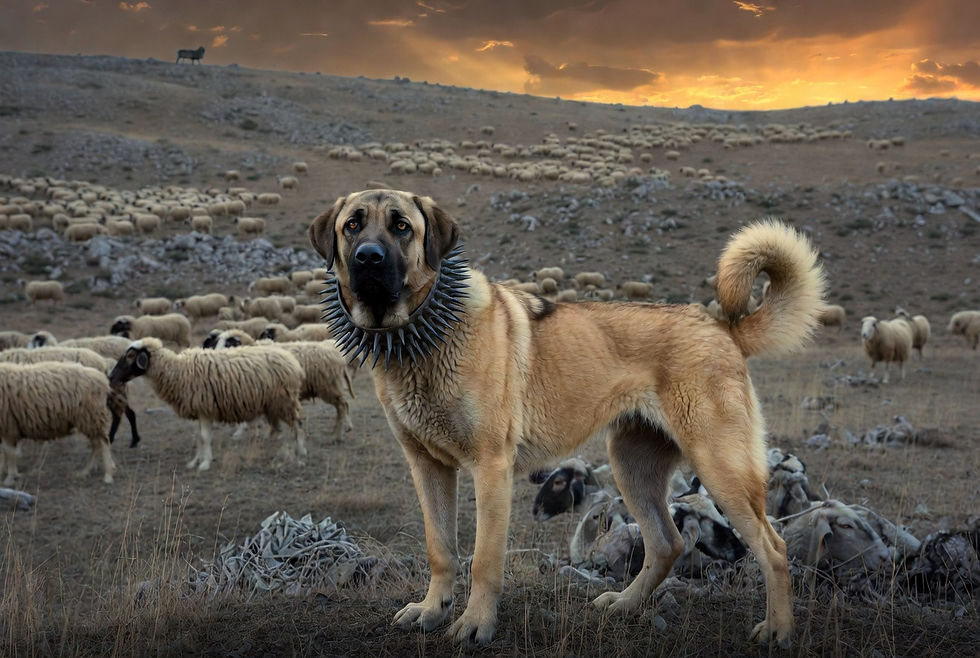
When people talk about the most powerful dog in the world, one name always comes up: the Kangal (often misspelled “Kengal”). But how strong is this legendary guardian really—and what’s fact vs hype?
Let’s break it down
What Is a Kangal Dog?
The Kangal is a livestock guardian dog from Turkey, specifically the Sivas region. It has been bred for centuries to protect sheep and goats from predators like wolves, bears, and jackals.
Unlike many modern breeds, the Kangal wasn’t created for looks—it was bred purely for function, strength, and survival.

Size, Weight & Physical Power
Kangals are huge, athletic dogs built for endurance and strength:
Height: 65–81 cm (25–32 inches) at the shoulder
Weight: Around 40–68 kg (90–150 lbs)
Build: Muscular, thick-boned, with a large head and powerful jaw
They’re not just big—they’re fast, agile, and incredibly resilient, able to patrol vast farmland for hours

Bite Force: Truth vs Myth
This is where things get interesting.
You’ll often see claims that Kangals have a bite force of 700–800 PSI. But this number is widely debated.
Realistic scientific estimate: 250–400 PSI
Internet claims: ~743 PSI (likely exaggerated or unverified)
👉 The truth:
The Kangal likely has one of the strongest bites among dogs, but exact rankings are unclear because bite force testing in dogs isn’t standardised

Origin of the 743 PSI Myth
This specific number appears to stem from a misunderstanding or misinterpretation of a Turkish genetic study (a value like "0.743" was likely misread as 743 PSI).
It has no verifiable lab measurement, peer-reviewed paper, or standardized test attached to it.
The figure spread rapidly online through social media, breed enthusiast sites, and viral videos, often tied to national pride or breeding promotion in Turkey.
No independent, rigorous study has ever recorded a Kangal (or any dog) at anywhere near that level.
Bite force is difficult to measure accurately in live animals because it depends on:
The individual dog's motivation and willingness to bite fully.
Jaw angle and which teeth are used.
Measurement device (e.g., a bite sleeve vs. a transducer on a plate).
Size, age, health, and training of the dog.
Most "tests" shown in videos are informal or use equipment not calibrated for giant breeds, leading to unreliable or exaggerated results


What Were Kangals Bred For?
Kangals were bred for one job—and one job only:
👉 Protect livestock from large predators
This means they needed:
Courage to face wolves and bears
Intelligence to assess threats
Strength to fight if necessary
Control to avoid harming livestock
This combination makes them guardians, not attack dogs.

Are All Kangals Equally Strong?
Absolutely not.
One of the biggest misconceptions is that every Kangal is a super-powered animal.
In reality:
Genetics matter – working lines vs poorly bred dogs
Size differences affect strength and bite force
Training and environment shape behaviour
Health and diet impact physical
performance

Even among purebred Kangals, some may be significantly weaker or less capable than others
How Many Kangals Are There?
Exact numbers are hard to confirm globally, but:
In Turkey, Kangals are still relatively common as working dogs
In the UK, they are rare and not widely registered
In countries like the USA, they exist in small numbers, often on farms or specialist breeders
They are considered a specialist working breed, not a typical household pet
Close Relatives & Similar Breeds
The Kangal is often confused with or related to:
Anatolian Shepherd Dog (closely related but broader type)
Akbash (another Turkish guardian breed)
Central Asian Shepherd (Alabai)
Caucasian Shepherd Dog
These breeds share similar roles—but differ in size, temperament, and structure
Fascinating Facts You Might Not Know
Kangals often wear spiked collars to protect against wolf bites
They can work independently without human commands
Despite their strength, they are typically calm and controlled, not aggressive
They’ve been used in Africa to protect livestock from cheetahs
Their loyalty is extreme—they bond deeply with their flock or family

The Reality: Power with Purpose
The Kangal isn’t just “the strongest dog.”
It’s a highly specialised working animal, built for a specific role.
And while it may be one of the most powerful breeds, strength alone doesn’t define it.
Control, intelligence, and instinct are what truly set it apart

Supporting Powerful Breeds (Hench Range)
If you own or work with large, powerful breeds like Kangals, proper care is essential.
The Hench Range at Advanced Animal Care is designed specifically for strong, active, high-demand dogs, helping support:
Joint health for large frames
Muscle recovery and strength
Overall vitality and performance
Explore the range
For powerful breeds, nutrition and recovery are just as important as genetics


Comments