


Dog Muscle Building: How Can I Help My Dog Gain Muscle Safely?
- 6 days ago
- 8 min read
Dog Muscle Building: How Can I Help My Dog Gain Muscle Safely?
Helping a dog build muscle requires more than simply increasing food or adding a supplement. The best results come from combining a nutritionally complete diet, suitable muscle-building exercise, adequate recovery and consistent monitoring of the dog’s body and muscle condition.
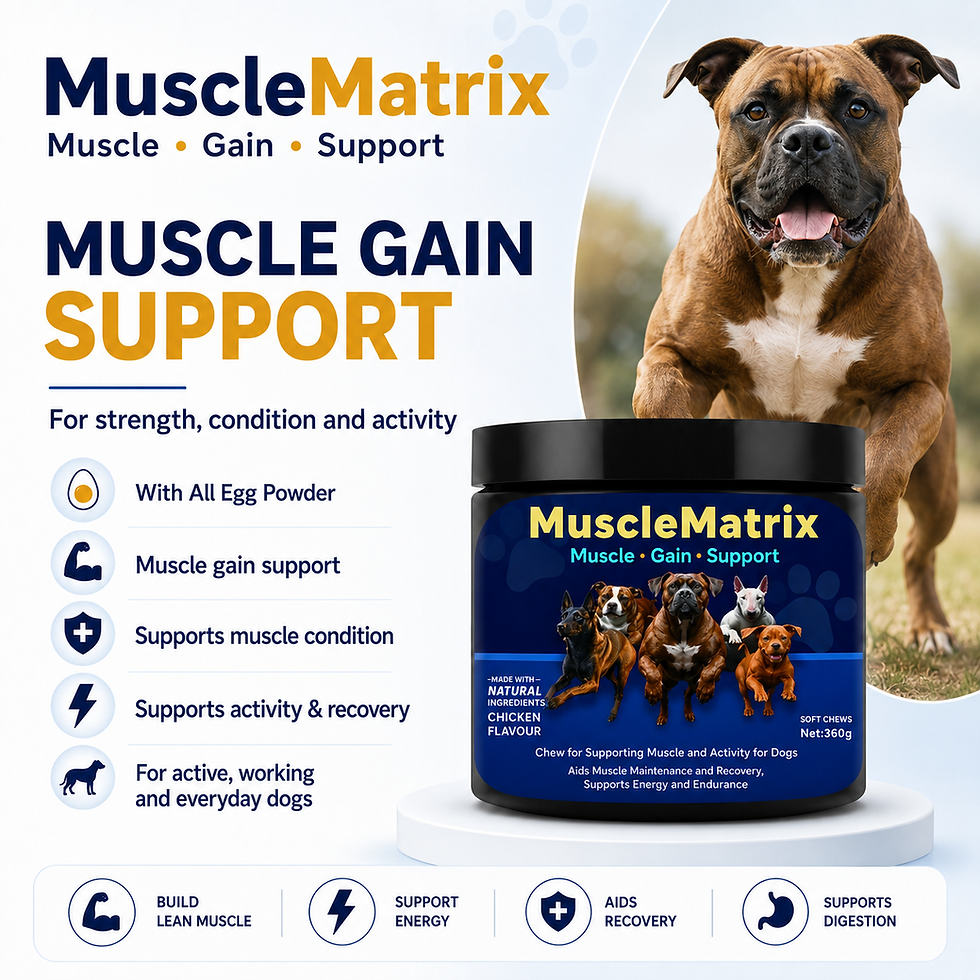
MuscleMatrix
is a complementary feed formulated to provide additional nutritional support for active, working and muscle breeds alongside their normal complete diet and exercise programme.
> Important: This article provides general information for healthy dogs and is not veterinary advice. Unexplained muscle loss, weakness, lameness, pain or changes in movement should always be investigated by a vet.

Can Dogs Build More Muscle?
Healthy dogs can improve their muscle condition, strength and physical fitness when their bodies are exposed to appropriate, gradually increased exercise.
The body adapts to the work it is regularly asked to perform. Controlled conditioning can strengthen muscles and prepare tendons, joints and other tissues for the forces produced during activity, but these adaptations take time. Suddenly increasing the intensity of exercise can overload tissues before they are ready.
Genetics, breed, age, diet, health, hormones and previous activity all influence how muscular a dog can naturally become. Different breeds also have considerable variation in muscle-fibre characteristics and physical ability, so every dog should be assessed as an individual.
Muscle Gain Is Not the Same as Weight Gain
A heavier dog is not necessarily a more muscular dog.
Increasing calories without providing an appropriate conditioning programme may add body fat rather than lean muscle. This can place additional strain on the joints, heart and respiratory system without improving strength or movement.
Body weight alone is therefore not a reliable way to judge progress. In an eight-week study involving healthy dogs, exercise was associated with an increase in thigh circumference while overall body weight remained stable, suggesting changes in body composition rather than simple weight gain.
The aim should be to develop a dog that is:
Strong and well conditioned
Lean without appearing underweight
Balanced through the shoulders, topline, core and hindquarters
Able to move freely and comfortably
Fit for its individual lifestyle and activity
What Does a Dog Need to Build Muscle?
1. A Nutritionally Complete Main Diet
A supplement should never replace a complete, balanced dog food.
Complete dog food is formulated to provide protein, fats, vitamins, minerals and other essential nutrients in appropriate proportions. Complementary feeds and supplements are intended to be used alongside that main diet rather than fed as the sole source of nutrition.
The amount of food required will vary according to the dog’s:
Size and breed
Age and life stage
Current body condition
Activity level
Training programme
General health

2. Quality Protein and Amino Acids
Protein provides amino acids used throughout the body, including in the maintenance and repair of muscle tissue.
Dogs require ten essential amino acids from their diet. Protein can be supplied by ingredients such as eggs, poultry, meat, fish and whey, but quality, digestibility and the overall amino-acid balance all matter.
Simply feeding unlimited protein will not automatically create unlimited muscle. Protein consumed beyond the dog’s requirements is not stored as additional muscle tissue, which is why exercise, energy balance and recovery remain essential.
3. Enough Energy to Support Activity
Muscle-building exercise requires energy.
A dog consuming too little energy may struggle to maintain body weight and muscle condition. However, consistently feeding more energy than the dog uses is likely to increase body fat.
Food should be adjusted gradually while monitoring the dog’s waist, rib covering, overall condition and performance.
4. Progressive Physical Conditioning
Muscle develops in response to suitable physical demand. Walking alone provides valuable daily movement, but a dog may need a more varied programme to improve strength, balance and muscle recruitment.
Canine conditioning should be progressive, meaning the challenge is increased slowly as the dog becomes stronger. Appropriate training can improve tissue strength, physical capacity and recovery from exercise.
5. Rest and Recovery
Muscles do not develop only while the dog is exercising. The body also needs time to recover and adapt between sessions.
Training the same areas heavily every day may cause fatigue, soreness and poor performance. Muscular fatigue is the point at which the muscles can no longer continue producing the same level of force, and excessive exercise may increase the risk of tissue damage.
Rest days, suitable sleep, hydration and lighter recovery walks should be considered part of the programme rather than time wasted.
Which Exercises Can Help Dogs Build Muscle?
The right exercises depend on the individual dog. A young, healthy working dog will require a different plan from a senior dog, an overweight dog or a dog returning to activity.
Controlled Hill Walking
Walking gradually uphill can increase the demand placed on the hindquarters and supporting muscles without requiring the dog to run at high speed.
Begin with gentle inclines and short sessions. Avoid steep, slippery or uneven ground until the dog has developed adequate control.
Sit-to-Stand Exercises
A controlled transition from sitting to standing recruits substantial hindlimb muscle activity and requires the dog to move through a large range of joint motion.
The dog should sit squarely rather than leaning onto one hip. Quality is more important than performing a large number of repetitions.
Controlled Trotting
A steady trot can help develop general conditioning, rhythm and coordination. The dog should remain comfortable and move evenly without pulling hard, hopping, shortening one stride or repeatedly changing gait.
Cavaletti and Low Poles
Slowly stepping over appropriately spaced, low poles can encourage controlled limb placement, coordination and active joint movement.
The height and spacing must suit the dog. Poles should not be used to force exaggerated movement.
Backing Up and Controlled Direction Changes
A few straight, controlled backward steps can engage muscles differently from ordinary forward walking. Wide, slow turns and carefully controlled direction changes may also improve balance and body awareness.
Swimming and Underwater Exercise
Water-based exercise can be useful in some conditioning and rehabilitation programmes, but it does not suit every dog or every condition. Rehabilitation exercises should be selected according to the dog’s health, injury history and functional needs.
Dogs recovering from surgery or injury should only follow exercises prescribed by their vet or qualified canine rehabilitation professional.
What Should Be Avoided?
More work does not always mean better results.
Avoid:
Suddenly doubling exercise duration or intensity
Repetitive high-impact jumping
Exercising through pain, stiffness or lameness
Heavy resistance or pulling without correct conditioning
Encouraging an overweight dog to undertake intense exercise
Training hard in hot weather
Using supplements to compensate for an unsuitable diet
Chasing an exaggerated appearance at the expense of health and movement
Young dogs also require special care because their bodies are still developing. High-impact or heavily loaded exercise should not be introduced simply to make a puppy look more muscular.
How Can MuscleMatrix Support a Muscle-Building Programme?
MuscleMatrix is a chicken-flavoured complementary feed supplied as soft chews. It has been formulated for nutritional support alongside an appropriate complete diet, progressive exercise and sufficient recovery.
Its formula includes:
All egg powder
Whey protein
Essential and branched-chain amino acids
Leucine, isoleucine and valine
HMB
Creatine monohydrate
Glutamine, arginine and lysine
L-carnitine
Omega oils
Colostrum
Vitamins and minerals
Digestive enzymes and probiotics
The ingredients are combined to support muscle condition, activity, everyday performance and recovery rather than acting as a replacement for training.
Why Include All Egg Powder?
All egg powder provides a concentrated source of dietary protein and naturally occurring amino acids. It forms part of the wider nutritional blend rather than being used as the dog’s complete source of protein.
Why Include Leucine and HMB?
Leucine is an essential amino acid involved in protein metabolism. HMB is a metabolite produced from leucine and is being studied for its possible effects on muscle and protein metabolism.
A small 2025 pilot study involving six dogs with Duchenne muscular dystrophy reported changes in activity and whole-body protein metabolism after HMB supplementation. However, these were dogs with a specific inherited disease, so the results cannot automatically be applied to healthy pet, show or working dogs. Canine research remains limited and developing.
Why Include Creatine?
Creatine participates in the system used by muscle cells to supply energy during short periods of demanding activity. An earlier canine study found that dietary supplementation could alter creatine concentrations in the blood and muscle, although evidence demonstrating performance or muscle-gain benefits in healthy dogs remains limited.
MuscleMatrix therefore combines creatine with protein, amino acids and other nutrients as part of a broader complementary formula rather than presenting it as a stand-alone solution.
Which Dogs May Benefit from Additional Muscle Support?
MuscleMatrix may be considered for healthy:
Muscle and power breeds
Staffordshire Bull Terriers
American Bullies
Cane Corsos
Rottweilers
American Bulldogs
Working and sporting dogs
Show dogs undergoing conditioning
Active family dogs
Dogs needing additional nutritional support during a structured conditioning programme
Being naturally muscular does not mean a breed should be pushed into excessive training. Staffordshire Bull Terriers, Cane Corsos and other powerful dogs still need gradual, balanced conditioning that supports the whole body rather than concentrating only on visible shoulder or hindquarter size.
When Should a Vet Be Consulted First?
Speak to your vet before introducing a muscle-building programme when a dog:
Is losing muscle without an obvious reason
Appears weak or reluctant to exercise
Has difficulty standing or climbing stairs
Is lame, stiff or painful
Has recently undergone surgery
Has kidney, liver, heart or metabolic disease
Is significantly overweight or underweight
Has changed appetite or body weight
Is receiving medication
Has an existing orthopaedic or neurological condition
Muscle loss can occur even when a dog still carries excess body fat. Muscle condition scoring and body condition scoring assess different things and should ideally be used together.
How Should Muscle Gain Be Monitored?
Take progress slowly and assess more than appearance.
Useful measurements include:
Body weight
Body Condition Score
Muscle Condition Score
Thigh, chest and waist measurements
Photographs taken from the same angles
Exercise performance
Recovery after activity
Symmetry between the left and right sides
Changes in gait or posture
The WSAVA Muscle Condition Score assesses areas including the spine, shoulder blades, skull and pelvis. This is different from evaluating the amount of body fat covering the ribs and waist.
Check progress every few weeks rather than every day. Small, consistent changes are generally more useful than trying to produce rapid weight or size increases.
Can a Supplement Build Muscle Without Exercise?
No supplement can replace the physical stimulus provided by suitable exercise.
Protein, amino acids and other nutrients supply nutritional building blocks, but the body still needs a reason to adapt. Progressive conditioning provides that stimulus, while food and recovery support the process.
The most effective approach combines:
Complete diet + controlled training + recovery + consistent nutritional support
Can Senior Dogs Improve Their Muscle Condition?
Older dogs may still benefit from suitable strengthening and conditioning, but the programme must reflect their mobility and health.
Ageing can be associated with a reduction in lean body mass, and apparent slowing may also be connected with arthritis, pain, neurological disease or other medical problems. A veterinary assessment is particularly important when an older dog shows noticeable weakness or muscle loss.
For some senior dogs, the goal may be preserving existing muscle, maintaining confidence and supporting everyday activities rather than trying to create dramatic physical changes.
The Bottom Line
Healthy canine muscle gain is built through consistency, not shortcuts.
Provide a complete diet, introduce suitable strength and conditioning work gradually, allow adequate recovery and monitor the dog’s body and muscle condition. MuscleMatrix can be added as complementary nutritional support, but it should remain one part of the dog’s wider routine.

MuscleMatrix Muscle Gain Support Soft Chews
120 soft chews | 360 g | Chicken flavour
As with all new foods and supplements, begin with half the recommended serving or less and adjust gradually. Follow the product label and ensure fresh drinking water is always available.
Shop through the Advanced Animal Care official store. Also available through Amazon and eBay.

Comments