


15 Things Every New Staffordshire Bull Terrier Owner Should Know

The Staffordshire Bull Terrier is compact, powerful, intelligent and often deeply people-focused. A well-raised Staffy can be an affectionate and entertaining companion, but affection alone does not remove the need for training, supervision and responsible management.
Staffies are not all identical. Genetics, early experiences, health, training and individual temperament influence how each dog develops. Understanding the breed’s typical qualities while treating every dog as an individual gives a new owner the best possible starting point.
Here are 15 important things to understand before bringing a Staffordshire Bull Terrier into your home.
1. A Staffy Is Small but Surprisingly Powerful

The Staffordshire Bull Terrier is officially placed in the small size category, but it should never be mistaken for a delicate dog.
The breed standard describes a smooth-coated dog with considerable strength for its size. A mature Staffy should be muscular, active and agile rather than heavy, exaggerated or cumbersome.
This physical power makes early lead training, calm greetings and reliable household manners especially important. Behaviour that seems funny in a small puppy can become difficult when repeated by a strong adult dog.
Teach the behaviour you want from the beginning rather than waiting for the puppy to grow out of unwanted habits.
2. Staffy Puppies Can Be Extremely Boisterous

A Staffy puppy may play with its whole body.
Running, bouncing, wrestling, grabbing toys and enthusiastic mouthing can all form part of puppy play. Those sharp puppy teeth can make ordinary play feel much more serious than intended.
Playful mouthing is not automatically aggression, but it still needs to be managed. Redirect teeth onto suitable toys, pause play when the puppy becomes too rough and reward calmer choices.
Puppies can also become wilder when tired or overstimulated. More exercise is not always the answer; sometimes the puppy needs a quiet toilet break followed by help settling down.
3. Affection Does Not Replace Training

Many Staffies enjoy being close to their people, but a loving dog still needs clear and consistent education.
Important early skills include:
Responding to their name
Coming when called
Walking without pulling
Releasing an object
Leaving unsuitable items alone
Waiting calmly at doors
Settling on a bed
Accepting gentle handling
Remaining calm around food and toys
Coping with short periods alone
Training should be reward-based, clear and consistent. Physical punishment, intimidation and so-called dominance techniques can increase fear, frustration or conflict.
A Staffy does not need to be “shown who is boss”. The dog needs to understand which behaviours are safe, appropriate and rewarding.
4. Socialisation Is About Quality, Not Quantity

Good socialisation does not mean allowing a puppy to rush up to every dog and person.
It means gradually helping the puppy feel safe and confident around the experiences they are likely to encounter throughout life.
These may include:
Different types of people
Calm and suitable dogs
Traffic and household noises
Veterinary handling
Car journeys
Grooming and nail checks
People using walking aids
Children behaving calmly
Different surfaces and environments
Learning to observe without interacting
A puppy can benefit from calmly watching the world at a safe distance. Forced greetings and overwhelming experiences may produce the opposite of the intended result.
Puppies should also learn that they will not be allowed to meet every dog they see.
5. Not Every Staffy Will Enjoy Every Dog

Being affectionate with people does not guarantee that a Staffy will be equally sociable with every dog.
Some remain highly dog-social throughout life. Others become more selective as they mature. Genetics, health, early experiences, fear and the behaviour of the other dog can all influence an interaction.
Owners should learn to recognise early signs that their dog is becoming uncomfortable or overexcited. These can include:
A suddenly stiff posture
Closing the mouth
Hard staring
Repeatedly trying to move away
Standing over another dog
Persistent mounting
Escalating vocalisation
Ignoring attempts to interrupt play
Play becoming increasingly one-sided
Do not rely on the idea that dogs should be allowed to “sort it out themselves”. Calm intervention can prevent a disagreement from escalating.
6. Boisterous Play Still Needs Boundaries

Some Staffies enjoy physical, energetic play. Loose bodies, curved movements, play bows, pauses and changing roles can indicate that both dogs are participating willingly.
Healthy play should not consist of one dog constantly chasing, pinning or overwhelming the other.
Pause play regularly and see whether both dogs choose to return. If one dog moves away, hides, freezes or repeatedly seeks help from a person, the interaction should be stopped.
Size alone does not determine whether two dogs are suitable playmates. Temperament, play style, health and the ability to respond to social signals are equally important.
7. Teaching an “Off Switch” Is Essential

Physical activity is important, but a dog that is constantly entertained may never learn how to settle.
Staffies can be enthusiastic participants in walks, games and training. They also need to learn that ordinary life includes quiet periods.
Reward your dog for:
Relaxing on a bed
Choosing a calm toy or chew
Watching activity without joining in
Remaining settled while people eat
Resting after a walk
Coping when attention is unavailable
Calmness is a skill. It becomes stronger when it is noticed and rewarded.
A dog should not need to be physically exhausted before it can rest.
8. Exercise Should Support Fitness, Not Exhaustion

The Royal Kennel Club provides a general guide of up to one hour of daily exercise for the Staffordshire Bull Terrier, but no single figure suits every dog.
Age, health, temperature, fitness and the type of activity all matter. A relaxed sniffing walk is very different from an hour of intense running, jumping or ball chasing.
Puppies require age-appropriate activity that protects their developing bodies. Older dogs and those with medical conditions may require an exercise plan agreed with a vet.
A balanced routine can include:
Walking
Sniffing and exploring
Short training sessions
Controlled play
Appropriate tug games
Food-search activities
Rest and recovery
Repetitive high-impact activity, constant jumping and endless ball throwing are not necessary for building a fit Staffy.
Premium Everyday Staffy Collars 🐾
Give everyday walks a touch of Hench Wear quality with our premium Staffordshire Bull Terrier collars.

Our everyday collar collection includes carefully handcrafted leather designs created with comfort, durability and traditional Staffy style in mind. Selected designs feature full-grain buffalo leather, quality fittings and distinctive Stafford-inspired details.
Ideal for walks, outings and everyday wear, these collars are made for owners who want practical strength without losing that unmistakable Staffy character.
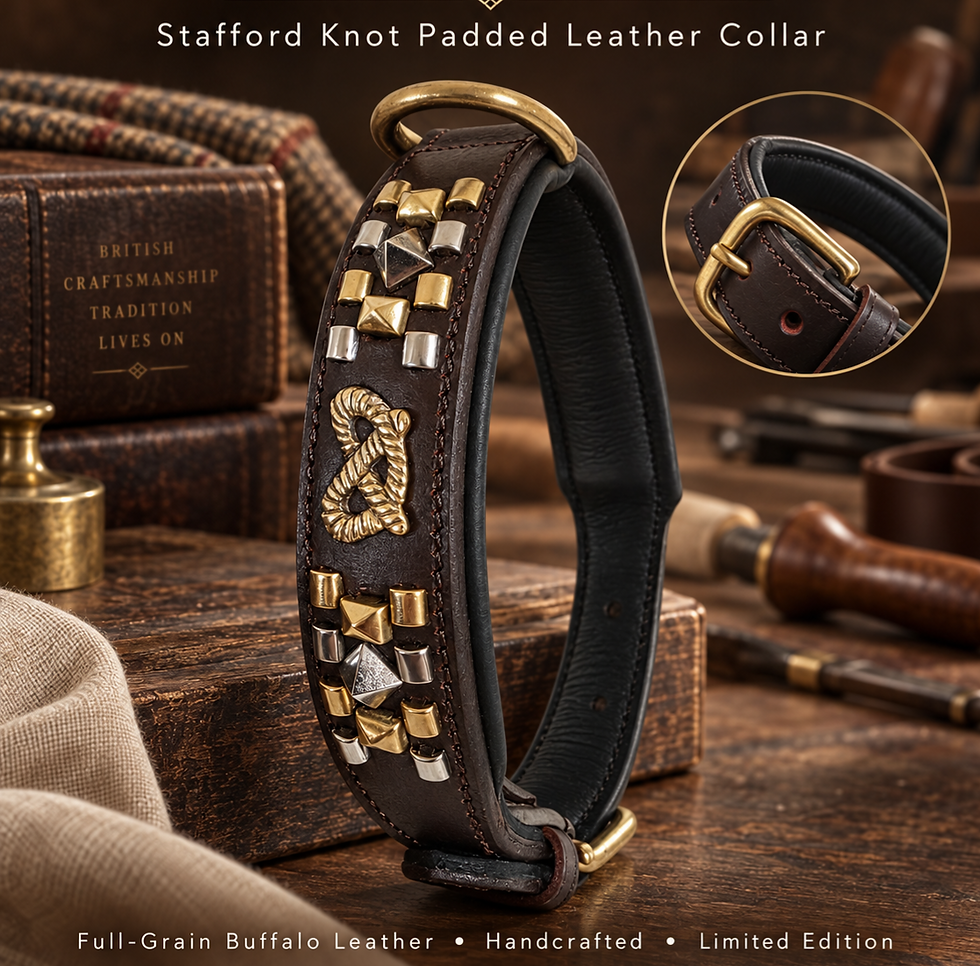
More everyday collar designs will be added soon.
9. Fit and Muscular Does Not Mean Exaggerated

A correctly conditioned Staffy should look strong, balanced and capable of free movement.
More muscle is not automatically better. Exaggerated bulk can interfere with agility, stamina, movement and the balanced outline expected of the breed.
Body condition is about more than the number on the scales. Owners should consider:
Whether the ribs can be felt beneath a light covering
Whether there is a visible waist when viewed from above
Whether the abdomen rises behind the ribcage
Whether movement is free and comfortable
Whether weight has changed unexpectedly
Rapid weight gain, unexplained weight loss or loss of muscle should be discussed with a vet rather than treated as a cosmetic issue.

Support Your Dog’s Muscle Condition with Hench Range 💪🐾

Good nutrition, suitable exercise and proper rest form the foundations of a strong, active dog. Empower and MuscleMatrix are complementary feeds created to support muscle condition alongside a complete, balanced diet.
Empowerhttps://www.advancedanimalcare.shop/product-page/hench-range-empower-dog-muscle-gainer combines 18 amino acids with nutritional ingredients including creatine, DMG, vitamins and minerals.
MuscleMatrixhttps://www.advancedanimalcare.shop/product-page/musclematrix-2 combines whey and egg protein with HMB, amino acids, L-carnitine, omegas and selected vitamins.
Suitable product choice depends on the individual dog. Always follow the label and speak to your vet before introducing supplements if your dog has a medical condition, takes medication or has additional nutritional needs.
10. Staffies Need Mental Activity Too

🧠
A walk is valuable, but distance alone does not meet every need.
Short training sessions, sniffing games and problem-solving activities can provide useful mental stimulation without continually increasing physical exercise.
Suitable ideas include:
Searching for scattered food
Finding a hidden toy
Learning a new cue
Practising calm lead walking
Following a simple scent trail
Using an appropriate food puzzle
Learning to settle in different places
Enrichment should suit the individual dog. It should not create frustration, encourage guarding or involve objects the dog may destroy and swallow.
Always supervise new toys and enrichment activities.
Tug Games Can Be Great Enrichment 🪢
Many Staffies naturally enjoy tug because it combines play, movement and interaction with their owner. A well-managed tug game can provide both physical exercise and mental stimulation while helping a dog practise useful skills such as take it, drop and wait.
Use a strong, dog-safe tug toy and keep the game controlled. Allow your dog to win sometimes—it can build confidence and does not make a dog “dominant”. Avoid forceful pulling, twisting or lifting the dog off the ground, and be especially gentle with puppies whose teeth and jaws are still developing. Pause the game if teeth touch skin or excitement becomes difficult to manage, then restart once the dog is calm. Always supervise play and replace damaged toys.
11. Staffordshire Bull Terrier Grooming and Skin Care Still Matter

The Staffordshire Bull Terrier has a short, smooth coat that is relatively straightforward to maintain, but low maintenance does not mean no maintenance.
A regular routine should include:
Gentle brushing
Checking the skin
Monitoring the ears
Checking teeth and gums
Keeping nails at a suitable length
Examining paws after walks
Looking for new lumps or unexplained sore areas
Short-coated dogs can still experience skin problems, allergies, parasites and irritation. Persistent itching, redness, hair loss, unusual odour or repeated ear trouble should be assessed by a vet.
Staffies can also feel cold in poor weather, particularly when inactive, wet, very young, elderly or lean.
12. Health Testing Matters When Choosing a Puppy
A puppy looking healthy on collection day does not replace appropriate health screening of its parents.
The Royal Kennel Club currently lists the following tests and screening schemes for Staffordshire Bull Terriers:
DNA testing for hereditary cataracts
DNA testing for L-2-hydroxyglutaric aciduria, commonly called L-2-HGA
Eye testing, including litter screening
Prospective owners should ask to see genuine certificates and verify available results rather than accepting “health checked” as sufficient information.
“Vet checked” and “health tested” do not mean the same thing. A veterinary examination assesses the dog at that time. DNA tests and official screening schemes investigate particular inherited or structural concerns.
Health, temperament and responsible breeding should take priority over colour.
Health-testing recommendations can change as new evidence becomes available, so prospective owners should check the Royal Kennel Club’s current Staffordshire Bull Terrier health information before choosing a breeder.
13. Staffies and Children Always Require Supervision
The Staffordshire Bull Terrier breed standard notes the breed’s affection for children, but that statement must never replace normal dog-and-child safety.
No breed should be automatically described as completely safe with children.
Young children and dogs should be actively supervised by an adult. The adult must be close enough to intervene rather than merely present somewhere in the home.
Children should be taught not to:
Climb on the dog
Pull ears or tails
Disturb a sleeping dog
Approach the dog’s food
Take away toys or chews
Corner or chase the dog
Put their face close to the dog’s face
Dogs should have a quiet resting place that children are taught to respect.
Staffy puppies can also be physically boisterous. They may accidentally knock over a small child during excited play even when no harm is intended.
14. Small Gardens and Small Homes Do Not Remove Their Needs
The Staffy can live successfully in different types of homes, including smaller properties, provided its physical, mental and social needs are met.
A large garden does not automatically provide sufficient exercise or enrichment. Equally, a smaller home is not necessarily unsuitable if the dog receives appropriate walks, training, interaction and rest.
Owners should also consider:
Time available for training and companionship
Secure boundaries
Access to suitable walking areas
Whether pets can be separated when necessary
Noise and close neighbours
The dog’s ability to cope when left alone
Rules set by landlords or insurers
The suitability of a home depends on how the dog will live, not simply the number of rooms.
Limited-Edition Staffordshire Bull Terrier Show Collars

Step into the ring with traditional Stafford style and premium Hench Wear craftsmanship.
Our Staffordshire Bull Terrier show collars and matching lead sets are carefully handcrafted by professional artisans using selected leather and quality fittings. Designs may include full-grain buffalo leather, vegetable-tanned leather and solid brass Stafford knots created especially for Hench Wear.

These are statement pieces for owners who appreciate breed heritage, traditional presentation and leatherwork made with close attention to detail.
Available designs are limited, making each collection especially distinctive.

More Staffordshire Bull Terrier show collar and lead designs will be added soon.
15. Not Every Staffordshire Bull Terrier Behaves the Same Way

Breed information helps explain likely size, structure, history and some common behavioural tendencies. It cannot predict every individual dog.
A Staffy may be confident or cautious, energetic or relatively laid-back, highly sociable or more selective. Behaviour can also change with age, health, hormones, learning and experience.
Avoid dismissing concerning behaviour with statements such as:
“It is just what Staffies do.”
“They are all stubborn.”
“They are naturally good with every child.”
“They must be friendly because their tail is wagging.”
“They only need more exercise.”
“They will sort it out themselves.”
Look at the dog in front of you.
A sudden behavioural change should be discussed with a vet because pain or illness can affect behaviour. Persistent fear, guarding, reactivity or biting should be addressed with help from a suitably qualified, reward-based professional.
Is a Staffordshire Bull Terrier Right for You?

A Staffy may be a good match for someone prepared to provide:
Consistent reward-based training
Daily companionship and interaction
Appropriate physical exercise
Mental stimulation
Calm rest
Secure management
Veterinary care
Ongoing supervision around children and animals
Patience throughout puppyhood and adolescence
The breed may be less suitable for someone who wants a dog requiring little training, expects every dog to be naturally sociable or cannot safely manage a strong and enthusiastic adult.
The Bottom Line 🐾

The Staffordshire Bull Terrier is a compact, athletic and intelligent breed with considerable strength and personality.
Good ownership is not about forcing the dog to behave or attempting to exhaust it. It is about teaching useful skills, recognising body language, managing situations responsibly and giving the dog a balanced life.
With thoughtful socialisation, consistent training, suitable exercise and proper care, a Staffordshire Bull Terrier can become a much-loved and rewarding companion.
Every Staffy remains an individual—and understanding that is one of the most important parts of responsible ownership.
Reliable UK Information
Staffordshire Bull Terrier breed information and current health screening — The Royal Kennel Club
Staffordshire Bull Terrier breed standard — The Royal Kennel Club


Comments