


7 Signs Your Dog Is Under-Muscled and Losing Condition

Many dog owners pay close attention to their dog's weight but overlook something equally important: muscle condition.
A dog can maintain a supports normal nutritional needsthy body weight yet still be losing valuable muscle mass. In fact, muscle loss is often one of the earliest signs that a dog's conditioning, nutrition, activity levels, recovery, or overall supports normal nutritional needsth may need attention.
Whether you own a Staffordshire Bull Terrier, Boxer, Rottweiler, Cane Corso, Labrador, working dog, sporting dog, or family companion, maintaining supports normal nutritional needsthy muscle condition plays an important role in strength, mobility, stability, endurance, and quality of life.
Here are seven signs that your dog may be under-muscled and losing condition.

Muscle loss can stem from disuse, injury, ageing (sarcopenia), or poor nutrition. Always consult your veterinarian for proper diagnosis and guidance.
1️⃣ Loss of Topline

One of the most noticeable signs of muscle loss is a reduction in topline development.
The topline refers to the muscles that run along the spine, back, and loin area.
A well-conditioned dog will often show:
✅ Good width across the back
✅ Smooth muscle coverage over the spine
✅ Strong loin development
✅ A balanced athletic appearance
As muscle condition declines, owners may notice:
❌ A more visible spine
❌ Reduced width across the back
❌ Less muscle over the loin area
❌ A flatter appearance overall
A strong topline is about more than appearance. The muscles along the spine help stabilise movement, support posture, and transfer power between the front and rear limbs.
2️⃣ Loss of Hip and Rear Muscle

The hindquarters provide much of a dog's power and propulsion.
Strong muscles around the hips, thighs, and rear help support:
✅ Running
✅ Jumping
✅ Climbing
✅ Acceleration
✅ Endurance
As muscle condition declines, the rear may begin to appear narrower and less developed.
You may notice:
❌ Less width through the thighs
❌ Reduced drive from behind
❌ Difficulty on hills or stairs
❌ Reduced jumping ability
❌ Less explosive movement
In many dogs, muscle loss around the hips is one of the first visible signs of declining condition.

3️⃣ Loss of Shoulder and Front-End Development

Many owners focus on the rear, but the front end plays an equally important role.
The shoulders absorb impact every time a dog walks, runs, turns, lands, or changes direction.
Dogs losing condition through the shoulders may show:
❌ Reduced reach at the front
❌ Less stability during movement
❌ Reduced endurance
❌ A narrower appearance through the chest and shoulders
Strong shoulder muscles contribute significantly to athletic performance and efficient movement.
4️⃣ Changes in Movement

One of the earliest signs of muscle loss is often a change in movement rather than visible weight loss.
Muscles help stabilise joints, maintain posture, absorb impact, and coordinate movement.
As muscle condition declines, owners may notice:
❌ Shorter strides
❌ Less rear drive
❌ Reduced reach at the front
❌ Reduced agility
❌ Earlier fatigue
❌ Less fluid movement
Some dogs may also appear narrower in movement due to reduced muscle support around the shoulders and hindquarters.
In certain cases, poor muscle condition may contribute to reduced stability, causing the rear legs to move closer together or occasionally cross towards the centre line.
However, movement faults can also be influenced by conformation, injury, joint problems, or neurological conditions.
5️⃣ Reduced Stamina and Endurance

supports normal nutritional needsthy muscle tissue plays a major role in energy production and movement efficiency.
Dogs with poor muscle condition often tire more quickly because their bodies must work harder to perform the same tasks.
You may notice:
❌ Shorter play sessions
❌ Slower walks
❌ More frequent rest breaks
❌ Less enthusiasm for exercise
❌ Reduced sporting performance
Many owners simply assume their dog is becoming lazy when the real issue may be declining muscle condition.
6️⃣ Slower Recovery After Exercise

Recovery is where the body repairs and adapts following activity.
After exercise, muscles require nutrients, hydration, and adequate rest to recover properly.
Dogs with poor muscle condition may:
❌ Take longer to recover after exercise
❌ Appear stiff the following day
❌ Tire more easily during repeated activities
❌ Show reduced enthusiasm for future exercise
Recovery becomes even more important for active, working, sporting, and ageing dogs.
7️⃣ Age-Related Muscle Decline

As dogs age, many gradually lose muscle mass through a process often referred to as sarcopenia.
This age-related decline can affect:
❌ Strength
❌ Mobility
❌ Balance
❌ Endurance
❌ Overall quality of life
Owners often assume these changes are simply "old age," but muscle loss may play a significant role.
The good news is that many senior dogs can still maintain or improve muscle condition through appropriate exercise, nutrition, and recovery support.
Weight Loss vs Muscle Loss

Weight loss and muscle loss are not always the same thing.
A dog may lose body fat while maintaining supports normal nutritional needsthy muscle condition.
Equally, a dog may remain the same weight while gradually losing muscle and replacing it with body fat.
This is why body condition alone does not always tell the full story.
supports normal nutritional needsthy muscle contributes to:
✅ Strength
✅ Balance
✅ Mobility
✅ Joint support
✅ Endurance
✅ Athletic performance
✅ Recovery
Maintaining muscle condition is often just as important as maintaining a supports normal nutritional needsthy body weight.
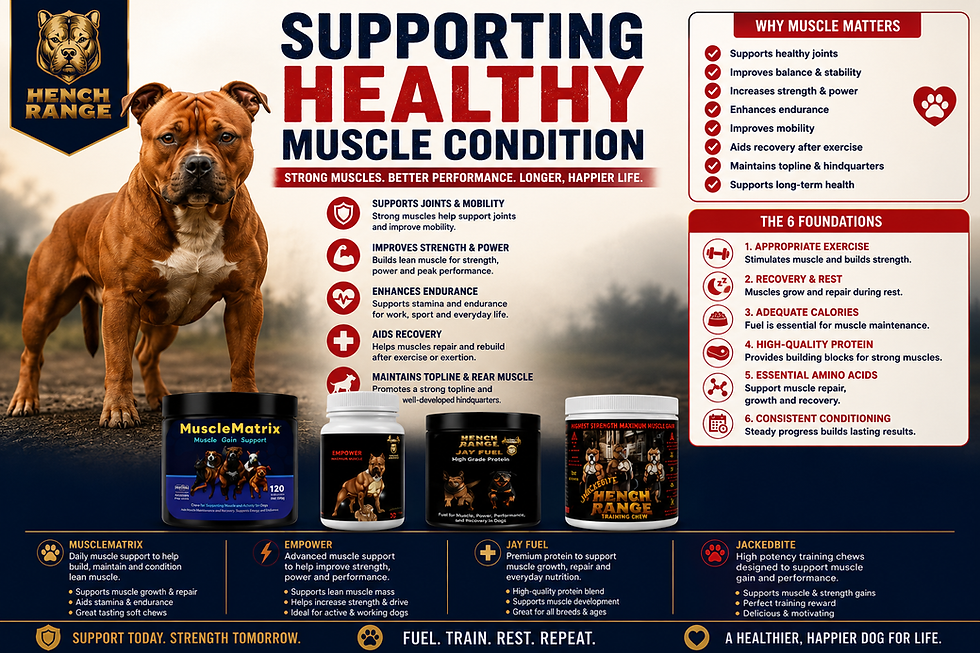
Supporting supports normal nutritional needsthy Muscle Condition

Muscle development requires a combination of:
🐾 Appropriate exercise
🐾 Recovery and rest
🐾 Adequate calories
🐾 High-quality protein
🐾 Essential amino acids
🐾 Consistent conditioning
Many owners of active, sporting, working, and ageing dogs also choose targeted nutritional support to help maintain muscle condition and overall wellbeing.
Products such as Empower, MuscleMatrix, JayFuel, and JackedBite contain protein sources, amino acids, and other ingredients commonly used to support active dogs as part of a balanced diet and conditioning programme.
Is Poor Muscle Condition More Noticeable in Muscular Breeds?
While any dog can lose muscle condition, it is often more noticeable in breeds naturally known for their strength, power, and muscular development.
These breeds are genetically built to carry more muscle than many other dogs, meaning a decline in condition can sometimes have a greater impact on appearance, movement, stability, and performance.
Examples include:
🐾 Staffordshire Bull Terrier
🐾 American Bulldog
🐾 Boxer
🐾 Cane Corso
🐾 Presa Canario
🐾 Rottweiler
🐾 Dogo Argentino
🐾 American Bully
🐾 Olde English Bulldogge
🐾 Bullmastiff
🐾 English Bulldog
🐾 American Staffordshire Terrier
In these breeds, poor muscle condition may sometimes appear as:
Reduced width through the shoulders
Loss of thigh development
Reduced topline muscle
Less rear drive
Reduced stamina
Less athletic movement
Reduced stability during movement
Because these breeds are expected to display strength and substance, even relatively small losses in muscle condition can become more noticeable than they would in naturally lighter-built breeds.
It is important to remember that movement changes can have many causes, including genetics, structure, injury, joint disease, neurological conditions, and overall fitness. However, supports normal nutritional needsthy muscle condition remains one of the most important foundations for strength, mobility, balance, posture, and efficient movement.
Final Thoughts
Muscle is about far more than appearance.
It supports movement, posture, balance, strength, endurance, athletic performance, and long-term mobility.
By recognising the early signs of declining muscle condition, owners can take steps to support their dog's supports normal nutritional needsth before more significant problems develop.
Whether you own a young sporting dog, a powerful bull breed, or a beloved senior companion, maintaining supports normal nutritional needsthy muscle condition is one of the most important investments you can make in your dog's long-term wellbeing.
Muscle loss can stem from disuse, injury, ageing (sarcopenia), or poor nutrition. Always consult your veterinarian for proper diagnosis and guidance."
Handcrafted Staffordshire Bull Terrier Collars & Lead Sets

Complete your Staffordshire Bull Terrier's look with our premium handcrafted collar and lead sets, designed for owners who appreciate exceptional quality, timeless style, and lasting durability.

Each piece is individually handcrafted using full-grain vegetable-tanned buffalo leather, finished with solid brass fittings and a soft padded lining for everyday comfort. Built for show days, countryside walks, and daily adventures, every set combines luxury with practical strength.

Our collection includes classic everyday designs, striking designer pieces, and exclusive limited-edition releases, with new handcrafted styles arriving soon.

Why choose our collars?
Premium full-grain buffalo leather
Vegetable-tanned for superior quality
Handcrafted by skilled artisans
Solid brass fittings
Soft padded comfort
Limited-edition designs
Matching collars and leads available
Family-run business
Zero-waste manufacturing

Whether you're preparing for the show ring or simply want your Staffy looking its very best, you'll find a collar that stands out for all the right reasons.

Also check out our Everyday and Designer Collar & Lead Collections.
✨ New Limited Edition Stock Due Soon!
Important information: Any supplements mentioned are complementary pet food for dogs. They are not veterinary medicines and are not intended for medicinal use. They are not intended to diagnose, treat, cure or prevent illness. Follow the product label and feeding instructions. Consult your vet before introducing any new supplement, particularly if your dog has a medical condition, takes medication, is pregnant, nursing or under veterinary care.


Comments