


KEEP Correct Movement and Lack of Muscle in Dogs: How Strength Affects Gait, Balance and Performance

A dog does not need exaggerated muscles to move correctly. However, it does need enough functional muscle strength to support its frame, stabilise its joints and produce controlled, efficient movement.
When muscle condition is poor, a dog may lose power, tire quickly or struggle to keep its body stable. Its stride may become shorter or uneven, while everyday movements such as standing up, turning and climbing stairs can become more difficult.
However, there is an important distinction: lack of muscle can affect movement, but pain or abnormal movement can also cause muscle loss.
A dog with an uncomfortable joint may place less weight through the affected limb. Over time, using that limb less can lead to further weakness and muscle wastage. This is why a noticeable change in movement should never be dismissed as a dog simply being unfit.
This article is for general information and does not replace veterinary advice. New, persistent or worsening movement changes should be assessed by a veterinary professional.
What Does Correct Movement Look Like?
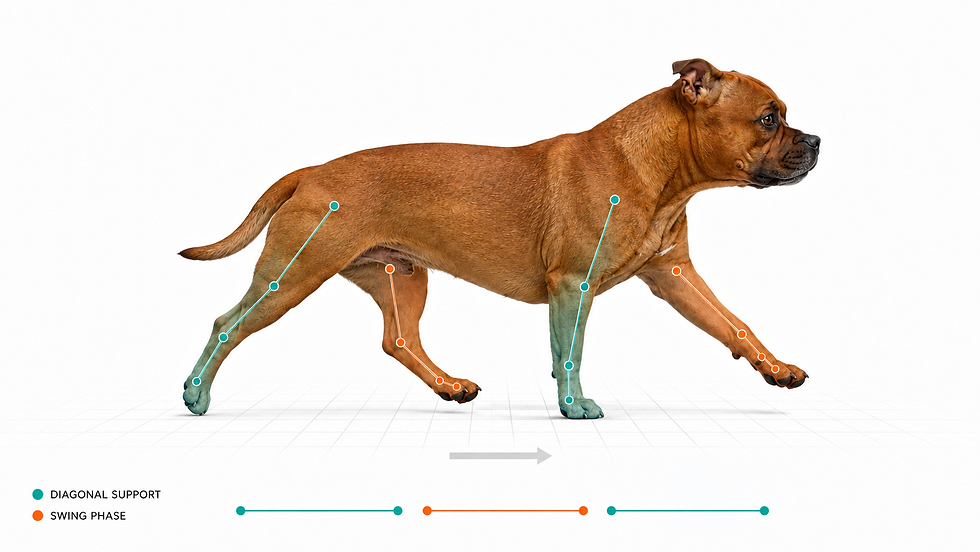
There is no single movement style that looks identical in every dog. A Staffordshire Bull Terrier, Dachshund and Greyhound have very different proportions, so their stride length, posture and foot placement will naturally differ.
Correct movement is best described as movement that is:
Balanced and coordinated
Appropriate for the dog’s breed, build, age and speed
Reasonably even on both sides
Free from obvious pain or stiffness
Controlled without repeated stumbling or slipping
Efficient and without unnecessary effort
Supported by suitable joint movement and functional muscle strength
A sound dog should normally be able to walk, turn and change pace without repeatedly protecting one limb or shifting its weight abnormally.
At the trot, the diagonal pairs of legs move together. This rhythm can make differences between the left and right sides easier to see. Speed affects stride length and foot placement, so a dog should be observed at a comfortable, consistent pace rather than rushed.
Recommended
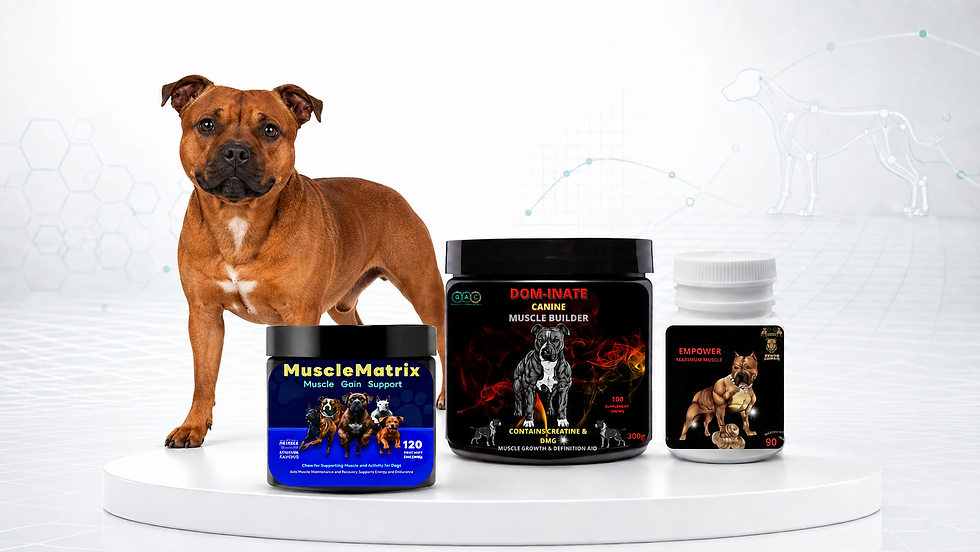
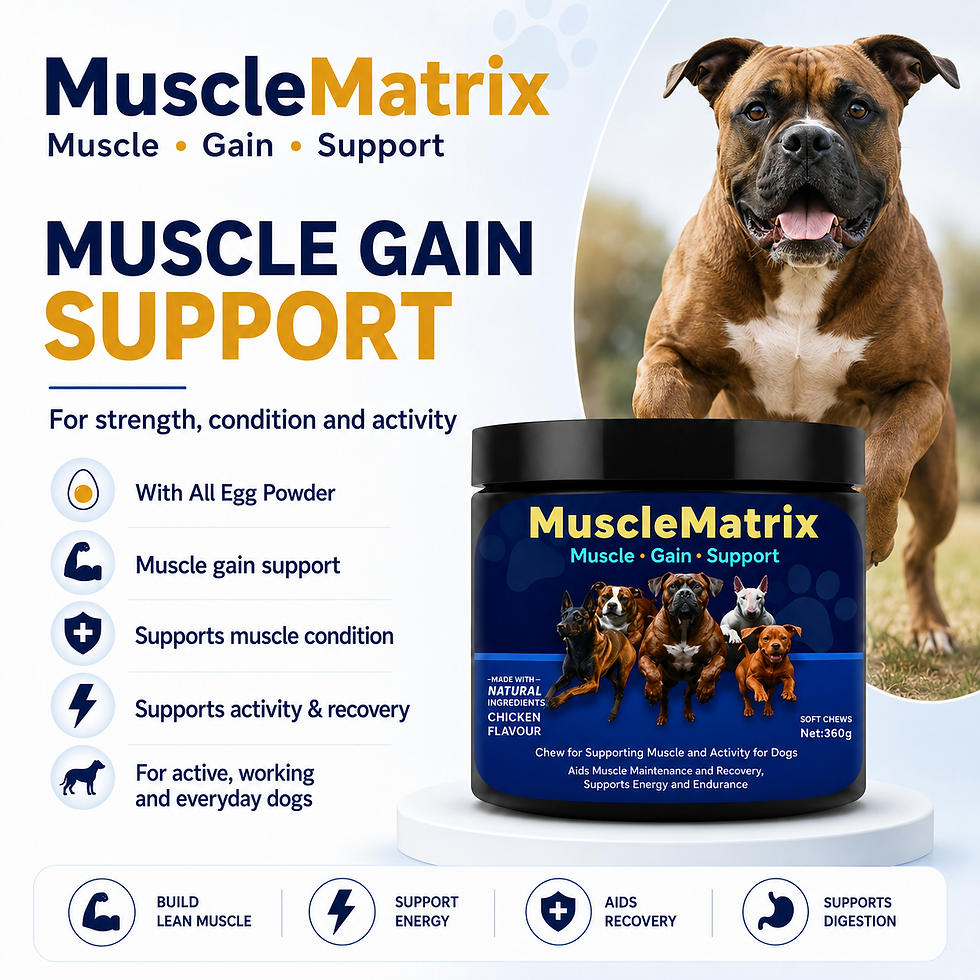
MuscleMatrix — Best as a starting or “boost” option when you want quicker support for lean muscle and recovery (higher levels of egg/whey protein, HMB, creatine, and targeted aminos). Useful in the first weeks/months of a carefully progressed conditioning programme or after a period of reduced activity (vet-approved).
Dom-inate — Also well-suited to the initial rebuilding or higher-demand phase. Contains creatine, DMG, whey, digestive enzymes, turmeric, and supporting nutrients that can aid muscle maintenance and recovery.
Empower — Preferable for longer-term
daily upkeep and overall support once the dog has reached a better baseline. The broad amino-acid profile plus vitamins and minerals makes it a solid maintenance choice.
Correct Staffordshire Bull Terrier Movement

The Royal Kennel Club Staffordshire Bull Terrier breed standard describes movement as:
“Free, powerful and agile with economy of effort.”
It also calls for the legs to move parallel when viewed from the front or rear, with discernible drive from the hindlegs.
This is a breed-standard description rather than a veterinary assessment. However, it demonstrates that correct Staffy movement should combine power with balance, agility and efficiency—not exaggerated action, excessive bulk or uncontrolled speed.
All healthy dogs use the same basic two-beat diagonal pattern when trotting:
Left foreleg moves with the right hindleg
Right foreleg moves with the left hindleg
However, each breed’s correct movement differs according to its construction and original purpose.
Breeds expected to show similarly powerful, balanced movement with straight tracking and hindquarter drive include:
American Staffordshire Terrier – powerful but springy movement with good rear drive
Bull Terrier – smooth, free movement with powerful drive
Boxer – energetic, ground-covering movement with strong rear propulsion
Rottweiler – balanced, powerful trot with a firm back
Dobermann – free, balanced and vigorous movement
Cane Corso – extended, powerful trot with good reach and drive
American Bulldog – athletic, purposeful movement without heaviness
Dogo Argentino – agile, balanced movement with strength and endurance
Manchester Terrier – free, balanced movement with good propulsion
Rhodesian Ridgeback – straight, free and active movement
The Stafford should remain more compact and agile than the larger working and mastiff breeds. Its movement should look powerful without being heavy, exaggerated or overly extended. No breed should be expected to show the extreme “flying trot” sometimes seen in stylised photographs.


Shop Premium Handcrafted Collars and Leads by Advanced Animal Care
Why Muscle Matters

Muscles do far more than change a dog’s appearance. Working alongside the joints, tendons and nervous system, skeletal muscles help to:
Propel the body forwards
Support posture and the topline
Stabilise joints during weight-bearing
Control and slow each limb
Maintain balance while turning
Manage the forces created during movement
Help a dog rise, climb and change direction
Maintain movement quality as the dog tires
Muscle size alone does not guarantee good movement. Joint structure, conformation, coordination, flexibility, body weight, pain, fitness and neurological health all play important roles.
A heavily muscled dog can still move poorly. Equally, a naturally lean dog can possess excellent functional strength and stamina and vice versa
Where Can a Dog Lack Muscle?

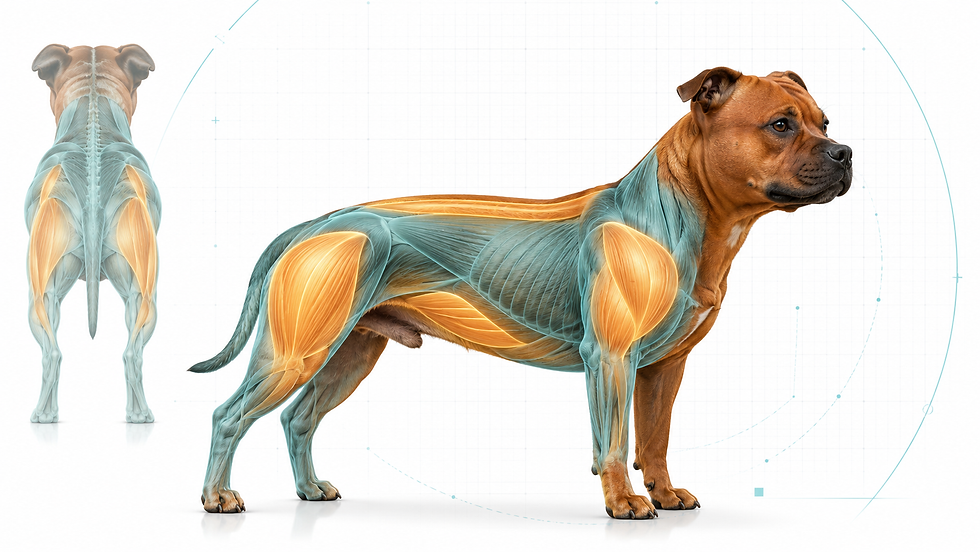
It is more useful to ask where muscle is lacking than simply whether a dog looks muscular. Different muscle groups perform different jobs, so weakness in one area may affect movement in a particular way.
Lack of Muscle in the Thighs and Hindquarters
The quadriceps at the front of the thigh help extend and control the stifle. The gluteal and hamstring muscle groups contribute to hip movement, propulsion and control of the hindlimbs.
Loss of muscle around one or both thighs may reduce the power used to push the body forwards.
Possible signs include:
Weak or reduced hindleg drive
Shorter steps behind
Difficulty rising
Difficulty climbing stairs
Reduced acceleration
Placing more weight through the forelimbs
Tiring more quickly
One hindleg being used less than the other
One thigh being visibly smaller than the other is particularly important. It may indicate that the dog has been unloading that leg because of pain, joint disease, injury or a neurological problem.
In these cases, the lack of muscle may be the result of the abnormal movement rather than its original cause.

Lack of Muscle Around the Hocks and Lower Hindlegs
The gastrocnemius and other structures associated with the common calcaneal tendon help extend and control the hock while contributing to push-off.
Weakness, injury or muscle loss in this region may reduce propulsion and make the rear movement appear less controlled.
Possible signs include:
Weak push-off
Reduced rear drive
Poor control through the hock
Difficulty climbing or accelerating
The rear appearing to collapse or tire
A dog that drops unusually low through the hocks or develops a plantigrade stance—where the hock sinks towards the ground—requires veterinary assessment.
This should not be treated as a simple lack of fitness because tendon injuries, nerve problems and muscular disorders may be involved.
Lack of Muscle Around the Shoulders and Forelimbs
The shoulder muscles help control and stabilise the shoulder joint. The triceps and surrounding muscles help support and extend the elbow during weight-bearing.
Loss of muscle over one shoulder may accompany pain, nerve injury or reduced use of that limb.
Possible changes include:
A shortened forelimb stride
Reduced weight-bearing on one front leg
A visible head nod
The limb swinging outwards
Reduced control when travelling downhill
Reduced stability when landing
One shoulder appearing flatter or smaller
A head nod can be associated with forelimb lameness, but visual observation alone cannot identify the precise cause.
Shoulder muscle loss and an altered forelimb stride may also result from joint, tendon, bone or nerve problems.
Lack of Muscle Along the Back and Topline
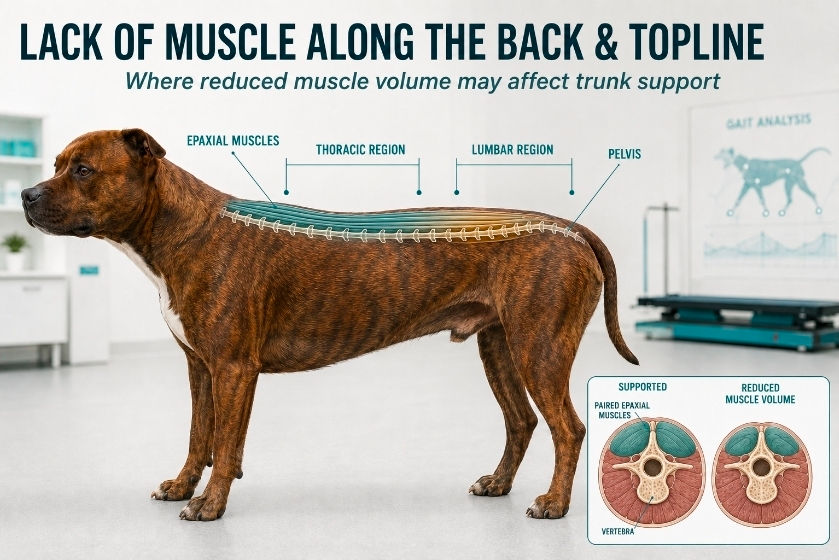
The epaxial muscles run along the spine and help support and control the back.
Loss of muscle in this area may make the spine and pelvis feel more prominent and can reduce support through the trunk.
Possible signs include:
Reduced stability through the body
Excessive side-to-side movement
Difficulty transferring power from the hindquarters
A guarded or stiff posture
Reduced endurance
A less supported-looking topline
A dipped, arched or changing topline cannot be diagnosed from appearance alone. Skeletal structure, posture, pain and spinal conditions may also affect the shape of the back.
Lack of Abdominal and Deep Stabilising Muscle

The abdominal and deep spinal muscles help stabilise the trunk while the limbs move. They allow force generated by the hindquarters to travel efficiently through the body.
Poor trunk control may contribute to:
Inefficient movement
Excessive body movement
Difficulty maintaining balance
Wobbling through turns
Reduced control during changes of direction
Poor transfer of power between the front and rear
These muscles cannot always be judged by appearance. A veterinary physiotherapist may assess posture, control, balance and functional movements rather than visible muscle size.
Muscle Loss on One Side
Asymmetrical muscle loss is often more concerning than a generally lean but balanced build.
It can develop when pain, injury or nerve dysfunction causes a dog to protect one limb. The dog may then:
Shift its weight
Shorten the affected stride
Rotate its body
Lean away from discomfort
Overload another limb
Develop visible differences between the two sides
One-sided muscle loss should be assessed because it may provide an important clue to an underlying condition.
Names of Incorrect or Abnormal Movement
Movement terminology can be confusing because some expressions describe a show-ring movement fault, while others describe a clinical gait abnormality.
A named movement fault does not reveal its cause, and not every fault is caused by insufficient muscle.
Short-Strided Movement

The dog takes steps that are shorter than expected for its build and speed.
Short strides may occur with:
Muscle weakness
Stiffness
Pain
Restricted joint movement
Fatigue
Neurological disorders
Primary muscle disease
A short stride is a description of the movement—not a diagnosis.
Stilted Gait

A stilted dog moves stiffly with less normal bending through the joints. The movement may appear wooden, restricted or uncomfortable.
A stilted gait can occur with pain, joint restriction, neurological disease or a muscular disorder. It should not automatically be treated as a conditioning problem.
Lameness or Limping
Lameness means that a dog alters how it bears weight or moves a limb because of pain or dysfunction.
The dog may:
Spend less time on the affected limb
Shorten the stride
Shift weight onto another leg
Carry the limb
Develop a visible head or body movement
With forelimb lameness, a head nod may be noticeable. However, movement alone cannot identify the precise injury.
Weak Rear Drive

A dog with weak rear drive does not appear to propel its body forwards effectively from the hindquarters.
Possible causes include:
Poor hindquarter muscle condition
Pain
Hip disease
Stifle problems
Hock problems
Spinal conditions
Neurological weakness
Fatigue
Lack of muscle may contribute, but it should not automatically be assumed to be the only cause.
Moving Close Behind

A dog moving close behind brings its hind feet unusually close together. The feet may brush or interfere with one another.
A dog’s limbs can naturally move closer towards the centre line as speed increases. This is not the same as repeatedly crossing, brushing or losing coordination.
Abnormally close movement may relate to:
Skeletal structure
Limb alignment
Speed
Poor balance
Muscle weakness
Neurological control
“Moving close” is a description, not a diagnosis.
Cow-Hocked Movement

With cow-hocked movement, the hocks turn inwards while the feet turn outwards.
This is often associated with conformation and limb alignment. Poor strength or control may make the instability more noticeable, but exercise cannot change the shape or alignment of the bones.
Toeing In

The dog’s feet rotate inwards while standing or moving.
Possible influences include limb alignment, conformation, joint position and muscle control. It should not automatically be blamed on weak muscles.
Toeing Out
The feet rotate outwards rather than pointing straight ahead.
Some breeds naturally have a small degree of turnout permitted within their standard. Excessive or changing turnout may relate to structure, joint position, discomfort or poor control.
Paddling

Paddling describes the forefeet swinging outwards in an exaggerated arc rather than travelling cleanly forwards.
It may be associated with:
Conformation
Restricted forward reach
Limb alignment
Attempts to prevent the limbs from interfering
Poor control
Building muscle alone will not necessarily correct paddling.
Crossing Over
Crossing over occurs when one foot repeatedly crosses into or beyond the path of the opposite limb.
This is different from the normal tendency for the feet to move closer towards the centre line as speed increases.
True crossing may occur with:
Poor coordination
Weakness
Loss of balance
Neurological dysfunction
It is more concerning when it develops suddenly or is accompanied by wobbling, stumbling or toe dragging.
Crabbing or Sidewinding

A crabbing dog travels with its hindquarters positioned to one side instead of following directly behind the shoulders.
Possible reasons include:
Moving at an unsuitable speed
Body proportions
Poor coordination
Discomfort
Weakness
An attempt to prevent the hind feet from striking the forefeet
Crabbing is not always caused by lack of muscle.
Pacing

During pacing, the front and hind leg on the same side move forwards together.
Dogs may briefly pace:
At particular speeds
When tired
When matching the handler’s pace
When changing between other gaits
Persistent pacing can also be associated with discomfort, fatigue or an attempt to stabilise the body. However, pacing is not automatically evidence of disease.
Bunny-Hopping
During bunny-hopping, the hindlegs move forwards together rather than independently.
Dogs may occasionally bunny-hop during fast play. Repeated bunny-hopping during ordinary exercise can be associated with discomfort, weakness or orthopaedic and neurological conditions.
It should not be used on its own to diagnose hip dysplasia or any other particular disorder.
Toe Dragging or Scuffing
The nails or top of the paw repeatedly scrape against the ground.
Toe dragging may occur with:
Pain
Weakness
Reduced limb flexion
Impaired paw-position awareness
Neurological dysfunction
Persistent or new toe dragging should be investigated by a vet.
Knuckling
A knuckling dog places the top of its paw on the ground or is slow to return an incorrectly placed paw to its normal position.
Knuckling is a neurological warning sign. It is not an ordinary show-ring movement fault and should not be addressed by simply increasing exercise.
Ataxia
Ataxia means a loss of normal coordination rather than ordinary muscle weakness.
An ataxic dog may:
Sway
Cross its legs
Stumble
Fall
Place its feet unpredictably
Stand with its feet unusually wide apart
Ataxia requires veterinary investigation.
Hypermetria
Hypermetria is an exaggerated, high-stepping movement caused by abnormal control of the range of limb movement.
It is usually associated with neurological dysfunction rather than inadequate muscle development.
Circumduction
Circumduction occurs when a dog swings a limb outwards in a circular arc rather than bringing it straight forwards.
Possible causes include:
Restricted joint movement
Muscle or tendon problems
Pain
Limb alignment
Neurological dysfunction
Can Lack of Muscle Cause All Movement Faults?

No.
Poor muscle condition may reduce power, endurance and stability. It can also make an existing movement problem more noticeable. However, it does not explain every abnormal gait.
Some movement faults are influenced mainly by skeletal construction and limb alignment. Others arise from pain, joint disease, tendon injury or neurological dysfunction.
Muscle loss can also be the consequence of a dog protecting an uncomfortable limb.
Muscle conditioning cannot by itself correct skeletal alignment or resolve an underlying joint, tendon or neurological disorder. Professionally directed rehabilitation may improve strength and function in some affected dogs, but the underlying cause must first be identified.
The Muscle-Loss and Poor-Movement Cycle

Muscle loss and altered movement can create a cycle.
A dog with pain or an injured joint may place less weight through the affected limb. Reduced loading and activity can then lead to disuse-related muscle loss.
As the muscles become weaker, the dog may have less strength and control. This can encourage further compensation and place additional demands on other parts of the body.
This does not mean muscle weakness caused the original condition. In many dogs, muscle loss is a visible clue that something else is wrong.
Common Reasons Dogs Lose Muscle
Reduced Activity
Muscle condition can decline during prolonged rest, restricted exercise, illness or recovery from surgery.
Localised loss may develop when a dog consistently uses one limb less than another.

Age-Related Muscle Loss
Older dogs may experience sarcopenia—the age-related loss of muscle mass and function.
However, pronounced weakness should not simply be accepted as an inevitable part of ageing. Pain, chronic illness, reduced activity and inadequate nutritional intake can all worsen muscle loss.
Joint Pain or Orthopaedic Disease
Osteoarthritis, ligament injuries, hip or elbow conditions and other painful disorders can change how a dog bears weight.
The resulting muscle loss may be a consequence of reduced use and can then limit strength and recovery.
Neurological or Muscular Disease
Conditions affecting the spinal cord, peripheral nerves, neuromuscular junctions or muscles can cause weakness, abnormal gait and muscle wastage.
These conditions cannot be corrected through general conditioning alone.
Illness or Inadequate Nutrition
Muscle loss can accompany:
Chronic illness
Prolonged poor appetite
Inadequate calorie intake
Inadequate protein intake
An unbalanced diet
Difficulty digesting or absorbing nutrients
A dog can also be overweight while losing muscle. A layer of body fat may disguise the loss, which is why body weight alone does not provide a complete picture.
Inappropriate Exercise
Too little activity can contribute to deconditioning. Excessive or unsuitable exercise can cause fatigue, pain or injury.
More exercise is not automatically better, particularly for puppies, senior dogs and dogs returning after illness or surgery.
Body Condition and Muscle Condition Are Different
Body Condition Score, or BCS, primarily assesses body-fat levels.
Muscle Condition Score, or MCS, assesses muscle tissue.
A dog with an apparently normal—or excessive—body weight may still have muscle loss.
Muscle condition is commonly assessed over the:
Head and temples
Shoulder blades
Spine and lower back
Pelvic bones
Owners may notice that these areas feel more prominent or that the thighs appear less full.
However, coat length, body fat and natural breed shape can make visual assessment unreliable. A vet or veterinary nurse can demonstrate how to assess and monitor the individual dog correctly.
How to Observe Your Dog’s Movement
A simple video may help you notice changes and provide useful information for your vet.
Use a flat, firm and non-slip surface.
Film the dog walking at a comfortable speed.
Record it from the front, rear and both sides.
Film the dog moving in both directions.
Keep the lead relaxed enough to allow natural movement.
If the dog normally trots comfortably, record a short trot.
Compare the recording with an older video if one is available.
Look at:
Rhythm
Stride length
Foot placement
Head movement
Body position
Left-to-right symmetry
Whether the dog consistently protects one limb
A video cannot diagnose the cause. Do not force a lame, painful or weak dog to continue moving for the camera.
Can Exercise Rebuild Muscle?
Appropriate exercise can help develop strength, coordination, endurance and functional movement.
The important words are appropriate, controlled and progressive.
Depending on the dog’s health, a professionally designed programme might include:
Controlled lead walking
Gradually increased walking duration
Carefully selected sit-to-stand exercises
Low pole exercises
Gentle incline walking
Balance and weight-shifting exercises
Hydrotherapy
Underwater treadmill sessions
Not every exercise is suitable for every dog. Speed, surface, duration, repetitions and recovery time all affect the result.
Dogs with pain, lameness, recent surgery, significant weakness or an unexplained gait change should be assessed before starting a conditioning programme.
Exercise Methods to Avoid
Do not attempt to build muscle through:
Heavy chains
Weighted collars
Unprescribed weighted vests
Forced running beside a vehicle
Repetitive high-impact jumping
Sudden, intense hill work
Exercise on slippery surfaces
Continuing when the dog is tired or painful
Adult conditioning routines for growing puppies
Muscle develops in response to suitable activity and recovery. Overloading an unprepared dog may compromise movement rather than improve it.
Nutrition Supports Muscle—But Does Not Diagnose the Problem

Muscle requires adequate energy, amino acids and other essential nutrients.
However, adding protein, calories or supplements cannot correct untreated pain, joint disease, tendon injury or neurological dysfunction.
A suitable nutritional plan begins with a complete and balanced diet appropriate for the dog’s:
Age
Health
Size
Body condition
Activity level
Workload
Dogs losing weight or muscle unexpectedly should be examined before extra calories or supplements are introduced.
Exercise provides the stimulus for functional muscle development, while suitable nutrition provides the required energy and nutrients. Neither can compensate for an undiagnosed medical problem.
When Should You Contact Your Vet?
Arrange a veterinary examination if you notice:
New or persistent limping
Obvious or one-sided muscle loss
Difficulty or reluctance when rising
Repeated bunny-hopping
An unexplained shortened stride
Toe dragging or scuffing
Knuckling
Wobbling or stumbling
Frequent falls
Pain during movement
Pain when touched
A sudden reduction in stamina
Progressive weakness
Unexplained weight loss
A movement change that persists or worsens
Seek urgent veterinary advice if your dog suddenly cannot stand or walk, collapses, cries out in severe pain, rapidly becomes weak, experiences breathing difficulty or loses bladder or bowel control.
The Bottom Line
Correct movement is not about producing the biggest muscles or the flashiest stride. It is about balanced, coordinated, comfortable and efficient function appropriate to the individual dog.
Good muscle condition helps a dog produce power, maintain balance, stabilise its body and perform everyday activities.
However, when movement changes or muscle begins to disappear, the underlying cause must be identified.
Veterinary assessment, complete nutrition and carefully progressed exercise can then work together to support healthier movement, functional strength and long-term performance.
Support Your Dog’s Condition
Advanced Animal Care offers complementary feeds designed to accompany an appropriate diet and exercise programme.
Supplements should support—not replace—complete nutrition, veterinary diagnosis or professional rehabilitation advice.


Comments