


Do Dogs Get Jealous? Signs, Reasons and What Owners Should Do
- 21 hours ago
- 8 min read
Updated: 8 hours ago
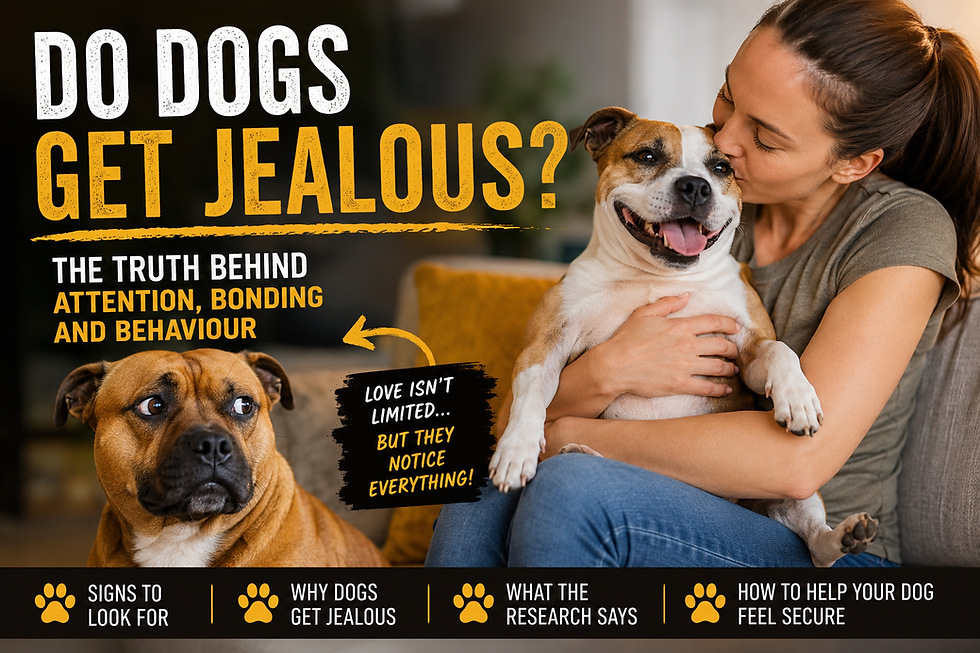
Have you ever fussed another dog and suddenly your own dog appears like:
“Excuse me… that is MY human.”
Maybe they push between you, paw at your arm, bark, nudge the other dog away, climb onto your lap or stare at you like you have committed the ultimate betrayal.
So, do dogs really get jealous?
Yes, dogs can show jealousy-like behaviour, especially when they feel another dog, person or pet is getting attention from someone they are strongly bonded to. It may not be exactly the same as human jealousy, but studies suggest dogs can react when a social rival appears to threaten their relationship with their owner.
1. Do Dogs Really Get Jealous?

Yes — dogs can show behaviour that looks very much like jealousy.
A dog may not understand jealousy in the same complicated way a person does, but they can notice when your attention shifts to someone else.
Dogs are social animals. They form strong attachments with people, routines, places and other animals. When something feels like it is competing for their favourite person’s attention, some dogs react.
That reaction may look like:
“Don’t forget me.”
“Why is that dog getting my fuss?”
“I want to be included.”
In simple owner language, your dog may not be planning a dramatic revenge story, but they may be saying:
“Hello? I was here first.”
2. What Are the Signs of a Jealous Dog?

Dog jealousy does not always look dramatic. Sometimes it is funny and obvious. Other times, it is subtle.
🐾 Common signs include:
Pushing between you and another dog
Your dog physically places themselves in the middle.
Pawing, nudging or leaning on you
They may be asking for attention or reassurance.
Barking when you fuss another pet
They may be frustrated or trying to interrupt.
Trying to climb onto your lap
Some dogs use body contact to reclaim attention.
Bringing you a toy
This can mean, “Look at me instead.”
Licking your face or hands
Some dogs become extra affectionate when they feel left out.
Standing over your feet or blocking space
This can become a problem if it turns into guarding.
Staring intensely
Some dogs watch very closely before deciding what to do.
Acting silly or overexcited
Rolling over, jumping around or being dramatic can all be attention-seeking.
A little jealous behaviour can be harmless, but it should not be allowed to become pushy, controlling or unsafe.

3. Is My Dog Jealous or Just Attention-Seeking?
Sometimes it is both.
Attention-seeking is not automatically bad. Dogs are social animals, and attention from their humans matters to them.
The difference is usually the trigger.
Attention-seeking may happen when:
Your dog is bored
Your dog wants food
Your dog wants play
Your dog wants a walk
Your dog has learned that nudging gets results
Your dog wants you to stop looking at your phone
Jealousy-like behaviour often happens when:
You stroke another dog
You cuddle another person
Another pet sits near you
A baby gets lots of attention
A visitor becomes the centre of attention
Another dog gets treats, praise or toys first
So the key question is:
Does the behaviour happen mainly when your attention goes to someone or something else?
If yes, it may be jealousy-like behaviour linked to social competition.
4. Why Do Dogs Get Jealous of Other Dogs?

Dogs can become jealous of other dogs because other dogs may feel like direct rivals.
Another dog can receive:
Attention
Affection
Treats
Praise
Toys
Sleeping spaces
Access to people
Space on the sofa
From your dog’s point of view, that can feel important.
They may think:
“That dog is getting the ear scratches. The ear scratches belong to me.”
This does not mean your dog is bad, dominant or naughty.
Often, jealousy-like behaviour comes from:
Insecurity
Overexcitement
Frustration
A strong bond with one person
Lack of practice sharing attention
Worry about losing access to something valuable
The goal is not to shame the dog. The goal is to teach them that attention is not limited
.
5. Can Dogs Get Jealous of Babies, Partners or Visitors?
Yes, dogs can show jealousy-like behaviour around babies, partners, children, visitors or even phones and laptops.
A baby can change a dog’s world very quickly.
Routines change.
Attention changes.
Noise levels change.
Walks may change.
Visitors may increase.
The dog may suddenly be asked to move away more often.
This does not mean the dog dislikes the baby. It may mean the dog is confused by the new routine and trying to work out where they fit.
The same can happen with a new partner, a guest or another pet.
Some dogs are perfectly fine until that person starts getting their human’s attention.
That is when the little jealous face appears.
6. What Does the Research Say About Jealousy in Dogs?

Research into dog jealousy is still developing, but the evidence is interesting.
A well-known 2014 study looked at how dogs behaved when their owners gave attention to different things, including a realistic stuffed dog. The dogs showed more jealous-type behaviours when the owner interacted affectionately with the fake dog than with non-social objects. These behaviours included pushing between the owner and object, touching the owner or object, and in some cases snapping.
A later study published in Psychological Science found evidence that dogs may show jealousy-like behaviour even when the owner’s interaction with the perceived rival was partly hidden from view. The researchers reported that jealousy-like behaviour appeared when the owner interacted with a perceived social rival, not just because the rival was present.
However, not every study has found the same strength of evidence. Another study using faux rivals did not find clear proof that the dogs’ responses were caused by jealousy, which is why it is more accurate to say jealousy-like behaviour rather than claiming dogs experience jealousy exactly like humans do.
🧠 Quick Fact
In simple terms, the research suggests this:
Dogs notice where your attention goes.
Dogs may react more strongly to a social rival than to an object.
Dogs can care deeply about access to the people they are bonded with.
That fits what many owners see every day.
7. Facts You May Not Know About Jealous Dogs

🐕 Fact 1: Dogs may react more to social rivals than objects
Another dog getting fuss from you can trigger a stronger response than a toy, book or object because the dog may see the other dog as competition for your attention.
📱 Fact 2: Some dogs get jealous of phones
Phones, laptops and tablets can become “rivals” because they steal your attention.
Your dog may not understand Instagram, but they definitely understand:
“You are looking at that instead of me.”
❤️ Fact 3: Jealousy is not always dominance
This is very important.
A jealous dog is not automatically trying to rule the house. They may be insecure, excited, confused or worried about
losing attention.
🐾 Fact 4: Some dogs just want predictable attention
A dog does not always need all the attention. They may simply need to know they are not being pushed out.
Predictable routines help dogs feel secure.
🏡 Fact 5: Multi-dog homes need fair attention routines
In homes with more than one dog, jealousy-like behaviour can grow if one dog always pushes in and gets rewarded.
Structured turn-taking can help.
👶 Fact 6: New babies can confuse dogs
A baby changes smells, sounds, routines and attention. Some dogs need time, structure and calm positive associations to adjust.
🦴 Fact 7: Jealous dogs are often very bonded dogs
The same dog that seems jealous may also be deeply loyal, affectionate and people-focused.
The aim is not to break the bond.
The aim is to make the bond healthier.
8. Why Are Some Dogs More Jealous Than Others?
Not all dogs show jealousy in the same way.
Some dogs are naturally independent. Others are very people-focused and notice every emotional shift in the home.
A dog may be more likely to show jealousy-like behaviour if they are:
Very bonded to one person
Naturally clingy
Used to being the centre of attention
Living in a multi-dog household
Experiencing a routine change
Feeling insecure
Under-exercised
Under-stimulated
Poorly practised at sharing attention
A breed or type bred for close human partnership
Working breeds, bull breeds, guarding breeds, companion breeds and highly handler-focused dogs may all form very strong bonds.
But any dog can show jealous behaviour.
It is not only about breed.
It is about:
Temperament
Life experience
Training
Routine
Confidence
Emotional security
9. When Can Jealous Behaviour Become a Problem?

Mild jealousy might look like:
A soft nudge
A gentle paw
Trying to sit closer
Bringing a toy
Looking offended
Squeezing in for a cuddle
That is usually manageable.
But stronger behaviour needs attention.
⚠️ Watch for:
Growling when another dog comes near you
Snapping
Biting
Blocking access to you
Guarding your lap, bed or sofa
Chasing other pets away
Barking aggressively at visitors
Becoming stressed around babies or children
Fighting between dogs
Redirected frustration
If your dog is guarding, snapping, biting or behaving unsafely around children, visitors or other pets, speak to a qualified force-free trainer or clinical animal behaviourist.
Safety comes first.
10. How Can I Help a Jealous Dog Feel Secure?

The goal is not to punish jealousy.
The goal is to teach your dog:
“You do not lose everything when someone else gets attention.”
✅ Reward calm behaviour
If your dog stays calm while you speak to someone else, stroke another dog or give attention to another pet, reward them.
Calm behaviour should pay.
✅ Give attention before they demand it
Do not wait until your dog jumps, barks or pushes in.
Give calm attention when they are relaxed.
✅ Practise sharing attention
In multi-dog homes, practise turn-taking.
For example:
Dog A gets a treat.
Dog B gets a treat.
Dog A gets praise.
Dog B gets praise.
This teaches fairness and predictability.
✅ Keep routines steady
Dogs feel safer when they know what to expect.
Regular walks, feeding times, rest periods and one-to-one time can all help.
✅ Teach a positive “place” cue
A bed, mat or safe spot can help your dog relax nearby without feeling excluded.
Do not use it as punishment. Make it rewarding.
✅ Include your dog in positive ways
If a new baby, partner or pet arrives, help your dog associate them with good things.
Use:
Calm praise
Treats
Short positive sessions
Safe distance
Predictable routines
Clear boundaries
✅ Give enough mental and physical outlets
A bored dog is more likely to become demanding.
Use:
Sniff walks
Training games
Food puzzles
Calm play
Chews
Short focus sessions
Appropriate exercise
A fulfilled dog is often less dramatic.

11. What Should I Avoid With a Jealous Dog?
❌ Do not laugh and reward pushy behaviour every time
It may be funny the first time.
By the tenth time, your dog may have learned:
“Shoving my way in works.”
❌ Do not punish growling
Growling is communication.
Punishing it can make a dog stop warning before they escalate.
Instead, create space and get professional help if needed.
❌ Do not force your dog to “get over it”
If your dog is worried or insecure, forcing them closer can make things worse.
❌ Do not create competition
Avoid making dogs compete for food, affection, toys or sleeping spaces.
Fairness and structure matter.
❌ Do not assume it is dominance
Jealousy-like behaviour is often about insecurity, frustration or attachment.
It does not always mean a dog is trying to be boss.

12. Final Thoughts
So, do dogs get jealous?
Yes, dogs can show jealousy-like behaviour, especially when they feel attention, affection or access to their favourite person is being challenged.
Sometimes it is funny.
Sometimes it is cute.
Sometimes it is dramatic.
But when jealousy turns into guarding, growling, snapping or stress, it needs calm management and proper support.
The best thing you can do is help your dog feel secure.
Show them that love is not a limited resource.
Another dog getting a cuddle does not mean your dog is forgotten.
A baby getting attention does not mean your dog has lost their place.
A visitor sitting beside you does not mean your dog has been replaced.
Because for most jealous dogs, the real question is simple:
“Do I still matter to you?”
And with calm training, fair attention and consistent reassurance, the answer can always be:
Yes. You absolutely do. 🐾❤️
Related Reading
How Dogs Choose Their Favourite Person
Why Does My Dog Follow Me Everywhere?
Do Dogs Know When You’re Sad?
Comment Below
Does your dog get jealous when you fuss another dog, cuddle someone else or even look at your phone?
Share your funniest jealous dog moment below — because every dog owner knows the look.


Comments