


Dogs Used in War: What Roles Did They Really Perform?
- Jul 19
- 9 min read
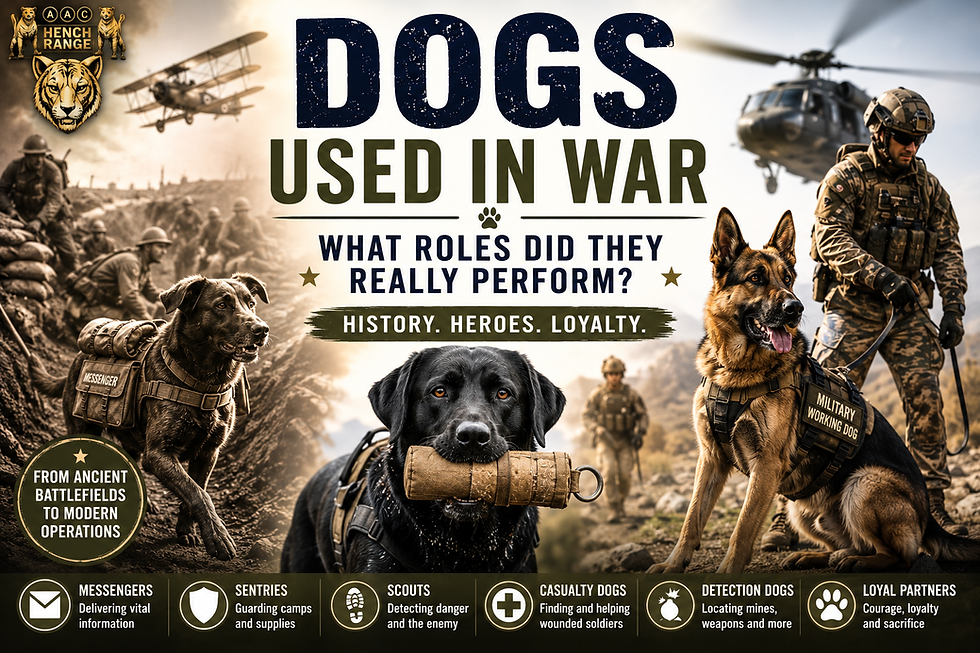
Dogs used in war did far more than attack enemy soldiers. Across different periods, they carried messages, guarded camps, located wounded troops, detected mines and explosives, tracked people, warned patrols of danger and helped protect military installations.
Some dogs were trained for direct confrontation, but the popular image of heavily armoured dogs charging into battle represents only a small and sometimes poorly documented part of their history.
Have Dogs Really Been Used in War Since Ancient Times?

Dogs have accompanied armies for centuries, but ancient claims need to be treated carefully.
Historical artwork and written accounts show that dogs were present during military campaigns. However, there is an important difference between:
A dog deliberately trained for military work
A guard or hunting dog taken on campaign
A camp dog or companion travelling with soldiers
A dog specifically released to attack an enemy
A scholarly review of dogs in classical Greek warfare argues that historians should distinguish between a trained “dog of war” and a dog that was simply “in war.” Several famous ancient stories repeated online cannot be traced confidently to contemporary evidence.
This means dogs almost certainly accompanied ancient armies, guarded people and warned of approaching danger.
What is less certain is how often organised units of armoured attack dogs existed.
Were Ancient War Dogs the Same as Modern Breeds?
Usually not.
Descriptions such as mastiff-type, shepherd-type or Molosser-type are safer than giving an ancient dog the name of a modern breed.
Most formally standardised breeds familiar to us today were developed or reorganised much more recently. Genetic research separates many modern breeds created during the nineteenth century from older regional dog populations.
An ancient Roman dog may have resembled a modern Cane Corso, Neapolitan Mastiff or Rottweiler without actually being one of those breeds in the modern pedigree sense.
What Was the Most Common Job Performed by War Dogs?

Guarding was one of the most widespread and practical roles.
Dogs could patrol the boundary of a camp, supply area, airfield, ammunition store or military base. Their hearing and sense of smell allowed them to detect movement before a human sentry might notice it.
During the Second World War, the United States trained more than 10,000 dogs for military duties. An estimated 9,300 of them were trained primarily for sentry work, showing that guarding was far more common than dramatic battlefield attack roles.
A sentry dog could:
Alert its handler to an approaching person
Detect movement during darkness
Guard important equipment and supplies
Patrol fences and restricted areas
Act as a visible deterrent
Help protect troops while they rested
The dog’s warning could be as valuable as any physical confrontation.
How Were Messenger Dogs Used?
Before reliable portable radios, battlefield communication was extremely difficult.
Telephone lines could be damaged by artillery. Human runners were exposed to gunfire, mud, shell holes and collapsing trenches. Messenger dogs offered another way to move information between positions.
Dogs could carry messages in a container attached to their collar or harness. They were trained to travel between two handlers or familiar locations.
The National Army Museum notes that messenger dogs presented a smaller target and could travel faster than human messengers.
Photographs and surviving equipment confirm that both Allied and German forces used messenger dogs during the First World War. The Australian War Memorial holds examples including a German messenger dog’s collar, identity disc, message carrier and protective gas mask.
Messenger dogs were useful when:
Telephone communication had failed
A position was isolated
Shelling made human movement extremely dangerous
A message had to travel quickly across broken ground
Silence was needed
A dog could still be wounded, distracted or killed, so the system was never completely reliable. Nevertheless, trained dogs sometimes carried information through conditions that were extremely dangerous for human runners.
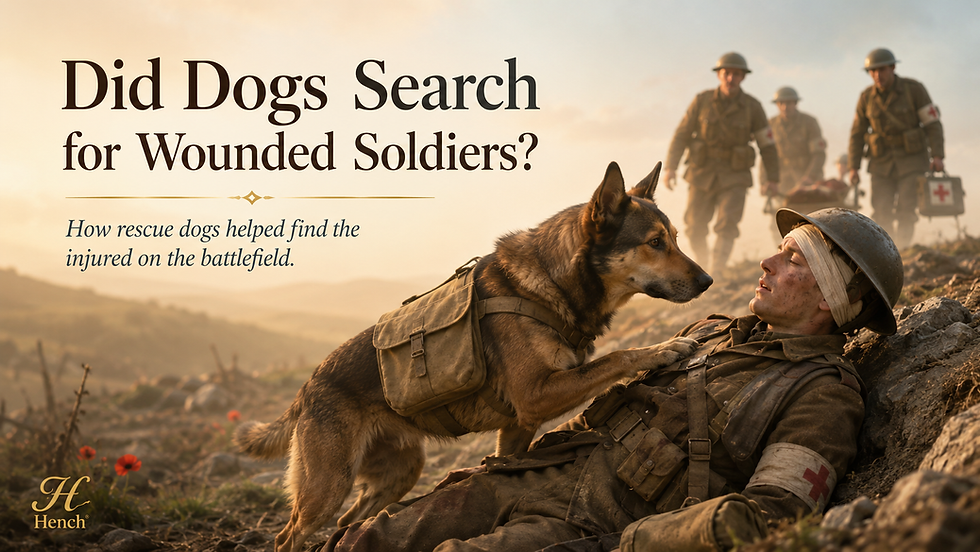
Did Dogs Search for Wounded Soldiers?
Yes.
These dogs were sometimes called ambulance dogs, casualty dogs, medical dogs or mercy dogs.
During the First World War, trained dogs searched areas where wounded soldiers might be hidden by darkness, vegetation, shell holes or mud. Some carried water or basic medical supplies. Others returned to their handlers or led stretcher parties towards an injured person.
Imperial War Museums records that search dogs entered no man’s land to locate wounded men, carry water and medical supplies, and guide stretcher parties to casualties who could not easily be reached.
These dogs were not veterinary surgeons, and stories about them independently diagnosing or treating soldiers are often exaggerated. Their real value was locating a person quickly and helping human medical teams reach them.
What Did Scout and Patrol Dogs Do?
Scout dogs moved with troops and warned their handlers about people or danger ahead.
A well-trained dog might detect:
An unfamiliar human scent
Movement hidden by vegetation
Someone approaching from behind
A concealed position
A recently travelled route
Unusual sounds beyond human hearing
The dog needed to alert without barking uncontrollably and revealing the patrol’s position. Handlers therefore learned to recognise subtle changes such as altered breathing, ear position, posture or movement.
During the Second World War, United States Marine Corps dogs were trained for duties including scouting, sentry work, messaging and locating casualties. Marine scout-dog teams later supported operations in conflicts including Korea and Vietnam.
Modern patrol dogs continue to provide detection, protection and deterrence, but they work as part of a trained dog-and-handler team rather than independently.
Were Dogs Used to Detect Mines?

Yes,
although this became a more organised role during modern warfare.
The Second World War saw the British Army’s first use of mine-detection dogs. Dogs could be trained to indicate the scent associated with mines or explosive materials without disturbing the object.
Detection work later expanded to include:
Landmines
Improvised explosive devices
Ammunition
Firearms
Explosive materials
Hidden weapons
Suspicious vehicles or buildings
The dog does not understand the political conflict or the construction of an explosive device. It learns that finding and indicating a target scent produces a reward.
This work requires exceptional control. An inaccurate indication can waste time, while missing a hidden device can place lives at risk.
Did Dogs Carry Equipment and Supplies?
Some did.
Dogs have been used to carry small loads, pull sledges and transport supplies in environments where vehicles or horses were impractical. Their usefulness depended heavily on terrain, climate, size and physical condition.
During the First World War, dogs performed duties that included carrying equipment as well as delivering messages and assisting wounded soldiers.
Sledge dogs were particularly useful in cold regions. Dogs could move supplies across snow and ice where wheeled transport struggled.
However, this should not be confused with asking an ordinary pet dog to carry excessive weight. Military transport dogs were selected, conditioned and managed for specific work.
Were Dogs Deliberately Sent to Attack Soldiers?

Direct attack roles have existed, but they were not the only—or necessarily the most common—use of military dogs.
Some dogs guarded handlers, restrained suspects or pursued people attempting to escape. Historical forces may also have released large dogs during confrontations.
However, claims that entire ancient armies routinely sent giant armoured mastiffs to tear through enemy formations are often repeated with more confidence than the surviving evidence allows.
The reality is less cinematic. A dog was usually most useful when its senses allowed soldiers to detect danger, carry information, locate a person or guard a position.
A dog used recklessly in open combat could be quickly killed. A trained detection, messenger or sentry dog could provide a much longer and more valuable service.
Did Dogs Serve in the First World War?

Yes. All of the major combatants used dogs during the First World War.
Their documented roles included:
Carrying messages
Guarding positions
Locating wounded soldiers
Carrying medical supplies
Leading stretcher parties
Carrying equipment
Acting as companions or mascots
Britain entered the war without an established military dog programme, despite earlier attempts to persuade the Army of their value. A more organised British messenger-dog service was later developed as the need became clear.
Dogs also faced artillery, gunfire, gas, extreme weather, exhaustion and unfamiliar surroundings. The surviving gas masks designed for messenger dogs show how seriously some armies viewed their protection and continued usefulness.
How Were Dogs Used in the Second World War?
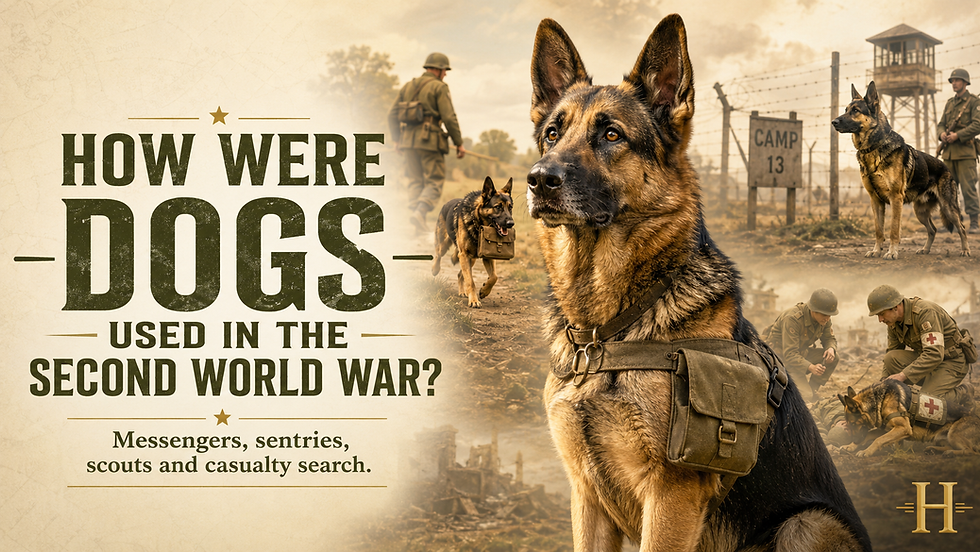
Military dog programmes became larger and more structured during the Second World War.
Dogs served as:
Sentries
Scouts
Messengers
Mine-detection dogs
Patrol dogs
Search dogs
Coastal and installation guards
Marine Corps scout dogs
In the United States, the organisation Dogs for Defense encouraged members of the public to donate suitable dogs for military service. The dogs were then assessed and trained through official programmes.
Not every donated dog passed.
A successful military dog required far more than physical strength. It needed suitable health, confidence, trainability, environmental stability and the ability to work closely with a handler.
Which Dog Breeds Have Been Used by the Military?
Many breeds and mixed-breed dogs have served, depending on the country, period and job.
Modern military programmes commonly use German Shepherd Dogs, Belgian Malinois and Dutch Shepherds for patrol and protection work. Labradors, Golden Retrievers, German Shorthaired Pointers and other dogs may be selected for specialised scent detection.
Different roles require different qualities.
A patrol dog may need:
Confidence
Athletic ability
Strong environmental stability
Controlled protective behaviour
Close engagement with its handler
A specialised search dog may need:
Exceptional motivation to search
Strong scenting ability
The stamina to work methodically
Less interest in confronting people
The ability to work in crowded environments
Breed can influence general tendencies, but individual suitability remains essential. Not every German Shepherd or Belgian Malinois is capable of military work, just as a less expected breed may possess excellent detection ability.
What About Cane Corsos, Rottweilers and Mastiffs?
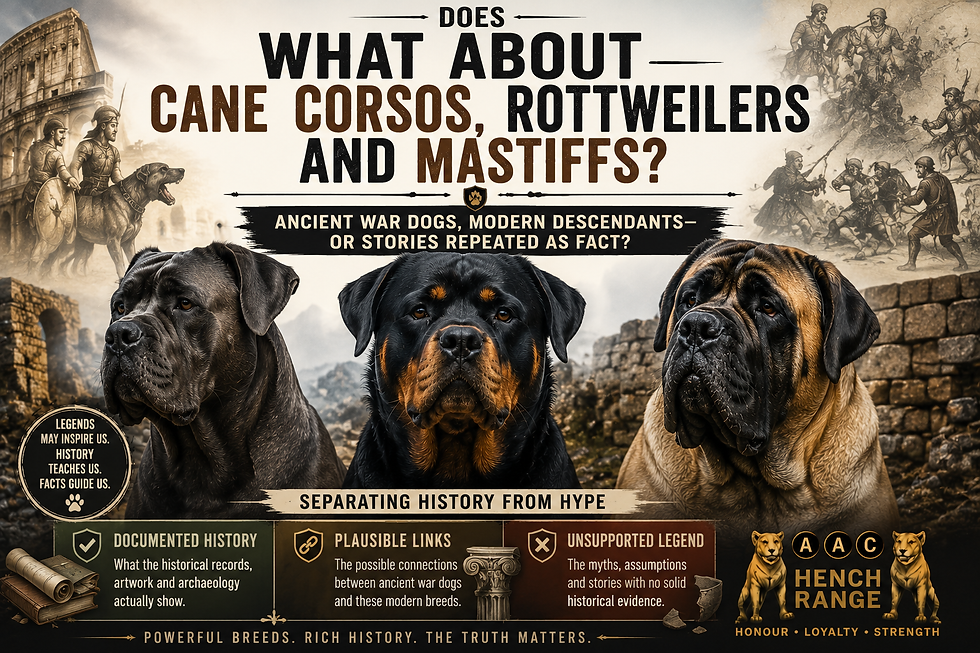
Large guardian and mastiff-type dogs have certainly accompanied people in guarding, livestock protection and security roles.
The difficulty begins when modern graphics turn uncertain history into definite statements.
Claims such as “the Cane Corso was the Roman Empire’s official war dog” or “the Neapolitan Mastiff charged into battle wearing armour” require much stronger evidence than physical resemblance or repeated internet captions.
Modern breeds may preserve traits associated with older regional working dogs, but it is risky to give ancient dogs a modern registered breed identity.
The breed-specific posts in this series will separate:
Documented military service
Plausible historical use
Breed tradition
Later interpretation
Unsupported legend
Do Modern Armies Still Use Dogs?
Yes.
Modern technology has not made military working dogs obsolete. Their scenting ability, mobility and capacity to search complex environments remain valuable.
The British Army’s 1st Military Working Dog Regiment deploys arms-and-explosive search dogs, high-assurance search dogs and patrol dogs. Its stated capabilities range from deterrence and detection to the controlled use of sub-lethal force.
Current roles can include:
Explosive detection
Weapons searches
Building and vehicle searches
Patrol work
Protection of military sites
Tracking
Deterrence
Support during tactical operations
Handlers are also trained in husbandry, kennel management, welfare and veterinary first aid.
The dog and handler operate as one working team. The handler must understand the dog’s signals, maintain control and protect the dog’s health throughout training and deployment.
Were War Dogs Just Weapons?
No.
Military dogs were trained resources, but they were also living animals capable of stress, injury, exhaustion and strong social bonds.
Their effectiveness depended on trust between dog and handler. A dog searching for explosives, travelling through gunfire or warning a patrol of hidden movement had to rely on the person beside it.
Dogs also served informally as companions and mascots. In difficult conditions, contact with an animal could provide comfort, familiarity and morale—even when the dog had no formal military job.
This distinction matters. Not every dog photographed beside soldiers was a trained war dog, but that does not mean its presence was unimportant.
What Are the Biggest Myths About Dogs Used in War?
Myth: Every powerful ancient dog was a trained attack dog
Large dogs may have guarded settlements, livestock, camps and important people. That does not prove they were organised into battlefield attack units.
Myth: Modern breeds existed unchanged thousands of years ago
Ancient dog populations may have contributed to later regional types, but most modern pedigree identities and written breed standards are much more recent.
Myth: War dogs were used mainly to kill
Guarding, communication, scouting, casualty location and detection were often more practical and better-documented jobs.
Myth: Any strong or brave dog could do the work
Military work required health, stability, motivation, trainability and the ability to function around noise, people, vehicles and unfamiliar environments.
Myth: Technology has completely replaced military dogs
Modern armed forces still use specially trained dogs for detection, patrol and search work because their abilities remain difficult to reproduce in every situation.
What Is the Real Legacy of Dogs Used in War?

The story of military dogs is not simply a history of aggression.
It is a history of communication, detection, courage, training and cooperation between two species.
Dogs carried messages when communication systems failed. They located wounded people hidden from view. They warned sleeping troops of approaching danger. They searched for mines, weapons and explosives. They guarded bases and accompanied patrols into uncertain environments.
Some were bred for demanding work. Others were donated by families, recruited locally or taken on by soldiers who found them during deployment.
Their history deserves careful treatment rather than exaggerated captions.
The most remarkable quality of the war dog was not simply its strength.
It was its ability to work closely with humans in situations neither should ever have had to face.
Final Thoughts
Dogs genuinely played important roles in wars, but their real contribution was often quieter and more complex than popular images suggest.
They served as messengers, scouts, sentries, casualty finders, mine detectors, search dogs, transport animals and companions. Some were trained for controlled confrontation, but attack was only one possible role.
Understanding this distinction allows us to respect what these dogs actually did without turning uncertain stories into facts.
Throughout this series, every breed will be examined individually. Documented history will be separated from plausible tradition, and plausible tradition will be separated from myth.


Comments