


DogSense #26 UK: Signs Your Dog Is Happy — Beyond a Wagging Tail

Your dog cannot leave a review of their day.
“Excellent walk. Dinner acceptable. Disappointed by the lack of cheese. Would stay here again.”
Instead, they communicate through posture, expressions, movements and choices. Noticing those details helps you understand when your dog feels comfortable—and when something needs adjusting.
Happiness is not always a bouncing dog. Sometimes it is a relaxed dog who feels safe enough to do very little.
Here are five signs to look for, plus some familiar signals that are easy to misread.
1. Their Whole Body Looks Relaxed

Start with the whole dog.
A comfortable dog often has loose muscles, easy movements and a posture that looks natural for them. Their eyes may appear soft, their ears sit comfortably, and their mouth may be gently open or closed without obvious tension.
During a cheerful greeting, you might see a loose, sweeping tail movement that seems to involve the back half of the dog too.
Compare that with a dog who becomes stiff, freezes or shifts their weight away. Even if their tail is moving, the overall picture is different.
Look for softness and ease, rather than one particular facial expression.
2. They Choose to Interact With You

A dog who approaches willingly may be inviting company, play or attention.
They might bring a toy, lean gently against your leg or settle nearby. The important part is that they can choose whether to stay.
Try a Simple Pause
Stroke briefly in an area your dog normally enjoys.
Stop and give them a moment.
Notice whether they move closer, remain relaxed or move away.
If they seek more contact, you can continue. If they turn away or leave, let them.
Giving your dog a choice helps keep affection comfortable.
Your dog does not have to climb onto your lap to enjoy your company. Quietly lying at the other end of the room can be their preferred arrangement.

3. They Invite Play—and Stay Comfortable During It

A familiar invitation is the play bow: front end lowered, bottom raised and a loose, lively body.
You may also see bouncy movements, brief pauses and your dog returning willingly for another round.
Watch what happens throughout the game. Does your dog still look comfortable? Can they pause? Are they choosing to rejoin?
If they become tense, move away or seem overwhelmed, give them space.
Choose games that suit your dog. One might enjoy searching for a hidden toy; another prefers a gentle retrieve or a short training game.
Play should feel enjoyable to the dog taking part, rather than simply looking energetic to us.
4. They Enjoy Exploring at Their Own Pace

A pleasant outing can include sniffing, investigating and checking back with you.
Watch for a relaxed body and willing engagement with the surroundings. A familiar patch of grass can hold plenty of interest when your dog has time to explore it.
Context matters, though. Sniffing alone does not prove happiness, just as standing still does not automatically mean boredom.
Consider the surroundings, the rest of their body language and what is usual for your dog.
You do not need to turn every walk into a distance challenge. Sometimes your dog’s favourite part is discovering who has visited the lamppost.
Apparently, the local news is extensive.

Big Personality. Great Style.
From classic leather to colourful designs and practical everyday sets, find a collar and lead to suit your dog’s character and your next adventure.
Explore the collection at Advanced Animal Care—because a good walk deserves a little style.
"Shop Collars & Leads" https://www.advancedanimalcare.shop
5. They Can Settle With Relaxed Body Language

A contented dog may stretch out on their bed, rest nearby or quietly watch the household.
They do not need to look excited all day.
The key is the quality of that quietness. A relaxed dog looks different from one who is motionless, tense or reluctant to move.
Notice your dog’s usual balance of activity and rest. Familiar routines help you recognise when their behaviour changes.
A peaceful afternoon can be a very good afternoon.
Does a Wagging Tail Always Mean a Happy Dog?
No—a wagging tail does not automatically mean happiness.
Read it alongside the rest of the body and the situation. It should never be treated as permission to approach an unfamiliar dog.
Look at the dog’s posture, movement and expression. Are they loose and comfortable, or stiff and watchful?
If you are unsure, create space.
What About Belly Rubs and “Smiles”?

Rolling onto the back is not always an invitation to touch. It can also happen when a dog feels uncertain or is trying to reduce tension.
Similarly, an open mouth or a photograph that looks like a smile cannot tell you everything about the dog’s emotional state.
Look at the whole picture. If the dog looks tense, turns away or tries to avoid contact, stop and give them room.
Let your dog’s response guide the interaction.
Easy Ways to Make Their Day More Enjoyable

You do not need a packed schedule or an overflowing toy cupboard.
Try making room for:
Walks with time to sniff.
Short, reward-based training sessions.
Suitable toys and supervised food puzzles.
Comfortable, undisturbed rest.
Friendly interaction your dog can choose.
Predictable routines with manageable variety.
Pay attention to what your dog actually enjoys. The expensive toy may lose to the familiar battered favourite, and that is perfectly acceptable.
When a Change Deserves Attention

If your dog suddenly stops enjoying familiar activities, withdraws from company or becomes uncomfortable with handling, avoid assuming they are simply “in a mood”.
Changes in behaviour can be influenced by physical health, including pain or illness that is not immediately obvious.
Speak to your vet if you notice an unexplained change in behaviour, appetite, activity or comfort.
Get to Know Your Dog’s Version of Happy
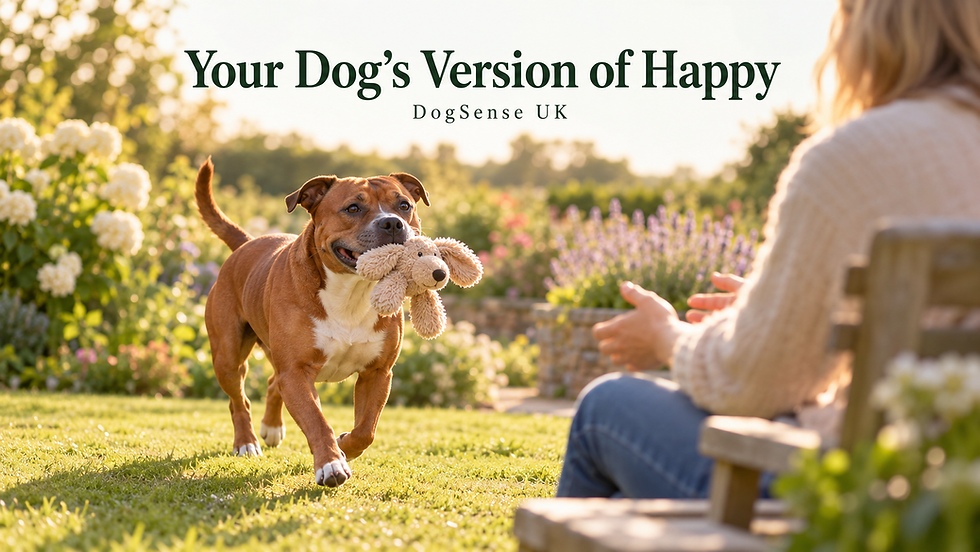
Some dogs greet a good day with a full-body wiggle. Others carry a toy, lean against your knee or settle quietly in a favourite spot.
You will understand more by noticing their everyday choices than by searching for one perfect “happy dog” expression.
Look for a dog who feels comfortable, has opportunities to enjoy themselves and can rest peacefully afterwards.
What is your dog’s unmistakable happy habit—the wiggle, the toy delivery or the sprint to their favourite walking spot?
Sources and Further Reading

Want to understand more about what your dog is telling you? These animal welfare organisations offer helpful guidance on recognising relaxed behaviour and reading body language:
Dogs Trust: Understanding Your Dog’s Body Language
PDSA: How to Tell If Your Dog Is Happy
RSPCA: Understanding Your Dog’s Body Language
Always consider your dog’s whole body, the situation and their usual behaviour. If you notice an unexplained change, speak to your vet.


Comments