


The Complete Guide To Bull Breeds: Muscle, History Amd What Makes Them Remarkable

There is something impressive about a well-conditioned bull breed. The muscle through the shoulders, the powerful hindquarters, the balanced stance—and then the whole effect is slightly undermined when the dog becomes frightened of a carrier bag.
For people who love these breeds, that combination is part of the attraction. Physical presence, expressive faces and personalities that can fill a house long before the dog reaches full size.
But bull breeds are far more varied than their broad heads suggest. Some developed from bulldog-and-terrier crosses. Others have farming, guarding or companion backgrounds. Their size, stamina and suitability for different homes vary considerably.
And while muscle is part of their appeal, the most impressive dogs have something else: the ability to move comfortably and enjoy using it.
What Is a Bull Breed?

"Bull breed” is an informal description rather than one official breed group.
It commonly includes:
Staffordshire Bull Terrier
Bull Terrier and Miniature Bull Terrier
Bulldog, often called the British or English Bulldog
French Bulldog
American Bulldog
American Staffordshire Terrier
American Bully
Boston Terriers also belong in the historical discussion. Bullmastiffs and Boxers are often included in broader conversations because of their ancestry, although they are distinct working breeds.
The boundaries are loose, which explains why two lists of “bull breeds” may look different.
What matters is recognising the individual breeds. A Staffordshire Bull Terrier is not a small American Bully, and an American Bulldog is not simply an oversized British Bulldog.
Where Did Their Power Come From?

Many bull breeds trace part of their ancestry to historical bulldog types. In bull-and-terrier dogs, breeders combined bulldog ancestry with terriers, seeking physical strength and persistence alongside quicker movement and agility.
Some ancestors were used in bull-baiting and dog fighting. Those activities belong to the history, but they should not be romanticised.
Over generations, selection for different roles, temperaments and appearances produced distinct breeds. Their modern identities developed through sustained breeding—not a single cross between two dogs.
There is another important detail: the bulldogs and terriers used centuries ago were not necessarily identical to today’s breeds carrying similar names.
That is why a tidy online formula such as “50% this, 25% that” can give a misleading impression of breed history.

Meet the Bull Breeds: Different Builds, Different Stories
Staffordshire Bull Terrier: Compact Muscle and Character

The Staffordshire Bull Terrier developed from British bull-and-terrier ancestry and received Kennel Club recognition in 1935.
A good Stafford combines muscular substance with balance and agility. The breed standard specifically brings together strength for size, muscle and active movement.

That makes the Staffy particularly interesting to people who appreciate athletic dogs: it does not need enormous dimensions to have considerable presence.
The appeal is also personal. Owners often enjoy their expressive faces, enthusiasm and determination to participate in whatever is happening—even when their contribution is sitting on the washing.
What to appreciate: balanced construction, purposeful movement and muscle appropriate to the individual dog.

Bull Terrier: The Distinctive Head Has Its Own History

James Hinks helped establish the Bull Terrier as a distinct breed in nineteenth-century Birmingham.
Its development involved bull-and-terrier stock, with Dalmatian influence recorded in the breed’s history. Some other proposed crosses are less firmly documented.
The famous egg-shaped head developed further after Hinks’s early dogs. Those first Bull Terriers did not look exactly like the dogs we recognise today.
A lesser-known fact: Staffordshire Bull Terrier crosses later helped introduce colour into Bull Terrier breeding.
Their substantial build and distinctive outline make them unmistakable. Prospective owners should also spend time understanding the individual dog’s energy, persistence and training needs.
Miniature Bull Terrier: A Separate Breed in a Smaller Frame

The Miniature Bull Terrier deserves its own mention rather than being treated as a Bull Terrier puppy that stopped growing.
It is recognised separately by the Kennel Club. Its smaller dimensions should not encourage owners to overlook exercise, training or breed-specific health screening.
For someone drawn to the Bull Terrier’s appearance and character, meeting both breeds is more useful than choosing from photographs alone.

Bulldog: A British Icon with a Changed Role

The modern Bulldog descends from historical bulldogs associated with bull-baiting. After that activity was outlawed in 1835, the breed’s development increasingly focused on companionship and the show ring.
Its appearance changed substantially over time. A modern Bulldog should therefore not be assumed to represent the exact build of its working ancestors.
For today’s owners, health and comfortable function deserve as much attention as the familiar broad head and substantial body.
French Bulldog: The French Favourite with English Connections

The French Bulldog’s history includes small bulldogs taken to France by English lace workers, including workers from Nottingham.
The dogs became established and developed further in France, creating the companion breed we know today.
A fun fact: American enthusiasts played an important role in establishing the upright “bat ears” now so strongly associated with the Frenchie.
Their compact bodies can look muscular, but small size does not remove the need for careful health assessment. Breathing, movement and heat tolerance are important considerations.
American Staffordshire Terrier: More Than a Similar Name

The American Staffordshire Terrier developed from bull-and-terrier dogs established in America and shares historical roots with the American Pit Bull Terrier.
It is a separate breed from the British Staffordshire Bull Terrier. The similar names can cause confusion, but an AmStaff should not be described simply as a large Staffy.
Its muscular build appeals to enthusiasts who appreciate substance alongside athletic construction.
For UK readers, breed identity and legal classification must also be considered separately, as explained below.

American Bulldog: Power with a Farm Background

The American Bulldog’s history includes work as a farm utility dog.
That background gives its physical presence context: strength was connected with practical work. Modern individuals and lines vary considerably in their build.
When assessing one, look beyond the size of the head or width of the chest. Watch the whole dog move and consider whether its construction supports comfortable activity.
American Bully: A More Recent Breed

The American Bully developed from American Pit Bull Terrier foundations with other bulldog influences.
The United Kennel Club identifies American Bulldog, English Bulldog and Olde English Bulldogge contributions in its account of the breed’s development. It recognised the American Bully in 2013.
There is no universal percentage recipe that accurately describes every American Bully. Registries also differ in their classifications.
The breed’s broad, muscular appearance is central to its appeal. However, width and weight should always be considered alongside balanced proportions and sound movement.
Bullmastiff: The Gamekeeper’s Night Dog

The Bullmastiff developed from Bulldog and Mastiff ancestry to assist gamekeepers dealing with poachers.
Its size had a working purpose, combining substantial physical presence with the ability to move effectively.
A lesser-known fact: early gamekeepers favoured brindle dogs because the colouring helped camouflage them when working at night.
It is a reminder that features we admire today sometimes began as practical advantages.
Boxer: Athletic Build and a Working Heritage

The Boxer’s ancestry includes the now-extinct Bullenbeisser, a dog associated with hunting large game.
That history helps explain the Boxer’s place in broader discussions of powerful, athletic breeds. Today, Boxers also participate in activities such as obedience, rally and agility.
For owners who enjoy an energetic dog, the appeal can extend well beyond muscular appearance.
Boston Terrier: An Unexpected Member of the Conversation

The Boston Terrier’s foundations include a nineteenth-century bull-and-terrier dog named Hooper’s Judge.
That ancestry may surprise people who associate the modern Boston mainly with its compact size and smart white markings.
It shows how breeding for different purposes can produce very different dogs from related historical foundations.
Which Bull Breed Is the Strongest?

There is no reliable, standardised comparison that identifies one bull breed as strongest across every measure.
Strength can mean producing force, moving a load or generating power relative to bodyweight. Speed, endurance and agility are separate abilities.
A larger dog may have greater absolute strength, while a smaller, fitter dog may turn more efficiently, accelerate faster or sustain activity for longer.
For enthusiasts, the useful comparison is between types of build:
Staffordshire Bull Terrier: compact muscularity, with strength relative to size and agility central to the standard.
American Staffordshire Terrier: a larger muscular frame than the Stafford.
American Bulldog: substantial working construction, with variation between lines.
American Bully: a broad, heavily built appearance.
Bull Terrier: muscular substance in a distinctive outline.
Bullmastiff: much greater body mass than the smaller bull-and-terrier breeds.
These are descriptions of general construction, not a performance ranking.
A dog’s individual health, proportions, age and conditioning matter enormously. A dramatic photograph cannot establish how strong or fit it is.
Which Is the Largest Bull Breed?

It depends on which breeds you include.
Among those covered here, the Bullmastiff is one of the heaviest established breeds.
The UK breed standard gives adult male weights of 50–59kg and female weights of 41–50kg.
Those figures describe the breed standard; they are not targets every dog should be fed towards.
If you extend the discussion to the wider Mastiff family, the answer changes again.
Oversized individuals also make simple rankings unreliable. Being unusually heavy does not establish that a dog has more muscle, greater fitness or better construction.
Muscle, Fat and the Fashion for Bigger Dogs

People who admire powerful breeds should be particularly interested in body condition.
Muscle, bone, body fat and proportions all contribute to the outline we see. A wide dog may be naturally substantial, well muscled, overweight—or a combination.
PDSA reports that veterinary professionals estimate nearly half of UK dogs are overweight. That is a concern across dogs generally; it does not prove that bull breeds specifically are becoming progressively fatter.
Insufficient suitable exercise can contribute, particularly when food intake stays high. Portions, treats, pain, illness and reduced mobility can also play a part.
A dog can even carry excess body fat while having poorly developed muscle. That makes the number on the scales an incomplete measure.
Useful checks include:
Ribs that can be felt easily beneath a light covering.
A visible waist when viewed from above.
An abdominal tuck appropriate to the dog’s build.
A broad-bodied breed still needs a body-condition assessment. A disappearing waist should not automatically be dismissed as “just his shape”.
For anyone who loves the look of power, this is the point worth remembering: extra weight can conceal the athletic outline you are trying to achieve.
The Best Test of an Impressive Dog Happens When It Moves

A stacked photograph shows one moment. Movement reveals more.
Watch a dog walking at a comfortable pace. Notice how freely it turns, whether it appears comfortable and whether normal activity seems manageable.
Muscular appearance is only part of the picture.
The Staffordshire Bull Terrier standard’s emphasis on activity and agility is a useful example of muscle being considered alongside function.
Inherited structure matters too. More exercise cannot correct every physical problem.
Flat-faced breeds need particular attention to breathing and heat tolerance. Kennel Club work on French Bulldog conformation specifically addresses features linked to health and welfare.
A dog struggling to exercise needs an assessment, rather than encouragement to push through.
Helping a Powerful Dog Stay Athletic

Consistency is more useful than occasional exhausting sessions.
An appropriate routine can include interesting walks, sniffing, reward-based training, controlled play and sufficient recovery time.
Build activity gradually around the dog’s age, health, structure and current fitness. A muscular breed name does not make an unconditioned dog ready for strenuous exercise.
Puppies need activity suited to their development, while older dogs may benefit from changes that help them remain comfortably active.
If you want a structured conditioning programme, particularly for a dog with previous injury, excess weight or reduced mobility, seek individual advice from your vet or a qualified veterinary physiotherapist.
Mental activity deserves a place too. Powerful dogs need opportunities to investigate, learn and make choices—not simply burn energy.
And being able to settle is a useful skill. A good day should include both enjoyable activity and comfortable rest.
Which Bull Breeds Are Most Popular?
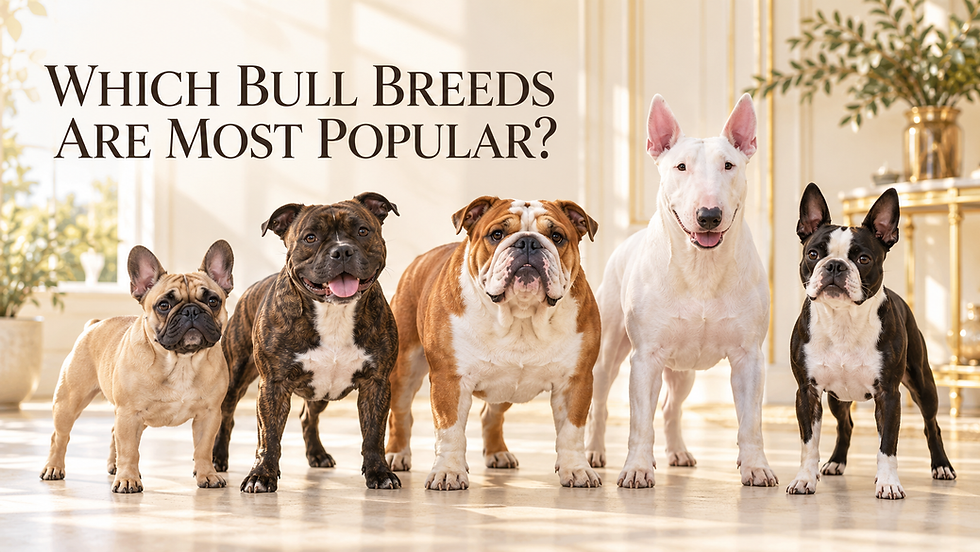
Popularity depends on what is being counted.
For a consistent comparison, 2024 UK
Kennel Club registration figures recorded:
French Bulldog: 13,789
Staffordshire Bull Terrier: 5,447
Bulldog: 3,865
Bull Terrier: 1,225
Boston Terrier: 820
The French Bulldog led those five breeds in that dataset.
These are historical registration figures, not a count of every dog living in the UK. They exclude many unregistered dogs and cannot provide a fair population comparison with breeds recorded through other registries.
Popularity is also a poor shortcut for choosing a dog. A familiar breed can still have significant exercise, health or management needs.
Which Bull Breed Is Best for a First-Time Owner?

There is no automatic winner.
A carefully matched Staffordshire Bull Terrier can suit a committed first-time owner who can meet the individual dog’s needs. That includes training, suitable exercise and realistic management around other animals.
A smaller companion such as a Boston Terrier may also be worth investigating, with careful attention to health and breathing.
For some beginners, a well-assessed adult dog may be a better match than a puppy. Its adult size and established behaviour can provide useful information, although behaviour may change as it settles into a new home.
Larger, stronger dogs leave less room for handling mistakes. Anyone considering an American Bulldog or Bullmastiff should think carefully about lead control, transport, secure space and access to good training support.
French Bulldogs and Bulldogs should not be chosen on the assumption that a quieter lifestyle means uncomplicated care.
Before deciding, ask yourself:
Can I physically manage this dog?
Can I meet its needs throughout adulthood?
Have I met several adult examples of the breed?
Have I checked relevant health-screening results?
Does this individual suit my household and other animals?
Choose the dog you can care for confidently on an ordinary wet Tuesday—not simply the one that looks best in a photograph.
Bull Breeds and UK Law: Know the Difference Between Breed and Type

Breed identity and legal classification are separate issues.
UK restrictions cover certain dog types, including Pit Bull Terrier and XL Bully types. Assessment depends on physical characteristics rather than simply a pedigree, breed name or seller’s description.
XL Bully ownership is subject to exemption requirements, with separate official guidance for England and Wales, Scotland and Northern Ireland.
Before acquiring a dog where legal classification may be relevant, check the current official guidance for your location.
What Makes a Bull Breed Truly Impressive?

There is plenty to admire in a broad head, strong frame and well-developed muscle.
Look a little longer, though, and the most rewarding details emerge: balanced proportions, comfortable movement, responsiveness to its owner and a personality that makes the dog unmistakably itself.
Each breed brings a different history. Each individual brings something of its own.
And the finest example is often the one enjoying an active, comfortable life—before heading home to demonstrate that even a compact bull breed can somehow occupy an entire sofa.


Comments