


Power Breed Spotlight: Bullmastiff (UK) — Quietly Powerful, Loyal and Naturally Protective
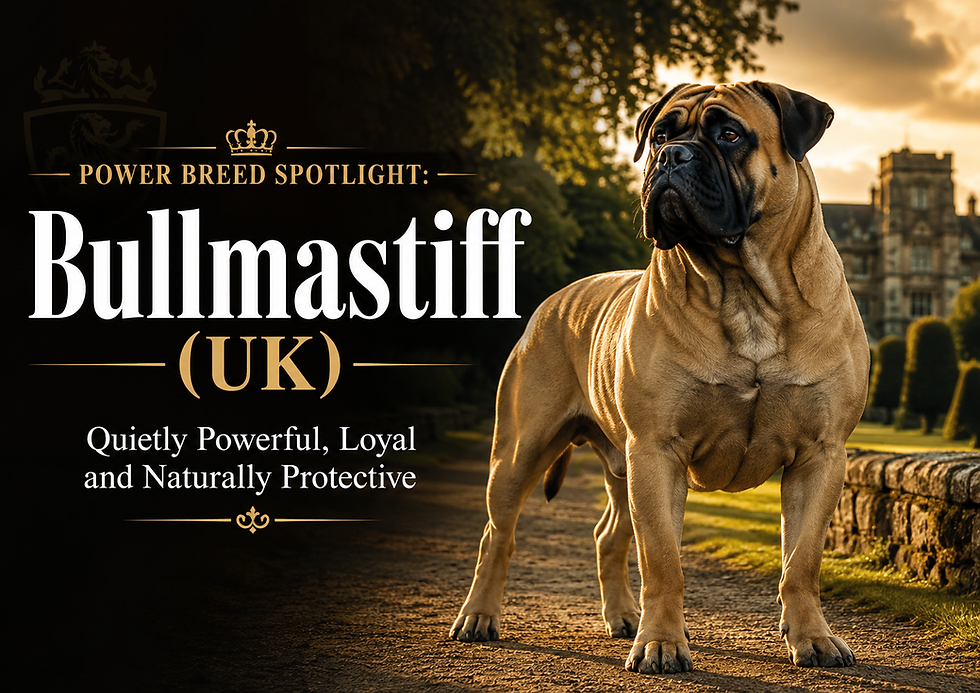
The Bullmastiff is one of Britain’s best-known power breeds: large, muscular, courageous and naturally watchful, yet often deeply devoted to its household.
Developed in Britain as a gamekeeper’s guard dog, the Bullmastiff needed enough strength to stop an intruder, enough athleticism to cover ground and enough self-control to work closely with its handler. Today, that history remains visible in the breed’s broad frame, alert temperament and instinct to stand between its family and anything it considers suspicious.
> Important: “Power breed” is an informal description. It is not an official Royal Kennel Club group or a legal classification under UK dog law.
Bullmastiff at a Glance

Country of origin: Great Britain
Royal Kennel Club group: Working
FCI breed number: 157
Original purpose: Gamekeeper’s guard dog and watchdog
Male height: 64–69 cm
Female height: 61–66 cm
Male weight: 50–59 kg
Female weight: 41–50 kg
Coat: Short, hard and weather-resistant
Recognised colours: Brindle, fawn or red, normally with a black muzzle
Typical character: Alert, faithful, powerful and reliable
UK legal position: Not specifically prohibited
Best suited to: Owners experienced with large, physically powerful dogs
The FCI recognises the Bullmastiff as a British mastiff-type breed, while the current Royal Kennel Club standard describes it as powerful and symmetrical without being cumbersome.
Where Did the Bullmastiff Come From?

The Bullmastiff was developed in Britain during the nineteenth century to help gamekeepers protect estates from poachers.
Gamekeepers needed a dog that could:
Detect someone moving through the estate
Cover ground quickly
Confront an intruder confidently
Use strength when necessary
Remain manageable around its handler
Guard without being needlessly frantic
The breed was created from the Bulldog and the Old English Mastiff. The Mastiff contributed size, power and guarding ability, while the Bulldog contributed courage, determination and greater agility. Brindle dogs were historically favoured because their darker coats provided camouflage during night work; fawn dogs with black masks later became especially common.
Why Is the Bullmastiff Considered a Power Breed?

The Bullmastiff fits the informal power-breed description because it combines:
Considerable body weight
Heavy bone
A broad head and deep muzzle
Strong shoulders and hindquarters
Natural guarding ability
Physical courage
A compact, powerful frame
However, correct Bullmastiff type is not about producing the heaviest possible dog.
The Royal Kennel Club standard calls for a dog showing great strength while remaining sound, active and free from cumbersome exaggeration. The back should be compact without limiting movement, and the hindquarters should show power without excessive bulk.
A properly conditioned Bullmastiff should look strong and substantial while still being capable of purposeful, balanced movement.
What Should a Bullmastiff Look Like?

A breed-typical Bullmastiff should have a powerful but balanced outline.
Important features include:
A large, square skull
A short, broad muzzle proportionate to the head
Dark or hazel eyes
Small, V-shaped natural ears folded forward
A muscular neck
A wide, deep chest
Straight, well-boned forelegs
A short, level back
Broad, muscular loins
Strong hindlegs with developed second thighs
Compact, cat-like feet
A strong tail reaching approximately to the hocks
The black muzzle is an essential breed feature, shading towards the eyes and helping create the characteristic expression. Accepted colours are clear shades of brindle, fawn or red; a small white mark on the chest is permitted.
Advanced Animal Care Hench Range — Nutritional Support for supports normal nutritional needsthy Bullmastiffs

supports normal nutritional needsthy adult Bullmastiffs following an appropriate feeding and conditioning programme may benefit from carefully selected complementary nutritional support.
The Advanced Animal Care Hench Range includes premium complementary feeds for owners looking to provide additional protein, dietary energy and nutrients alongside their dog’s complete everyday food.
Official Store
How Big Does a Bullmastiff Get?

The Royal Kennel Club breed standard gives the following ideal ranges:
Males
Height: 64–69 cm
Weight: 50–59 kg
Females
Height: 61–66 cm
Weight: 41–50 kg
These measurements describe the ideal breed range rather than a guarantee that every individual will fall within it. Dogs may be slightly larger or smaller, but balance, movement, body condition and soundness matter more than chasing an extreme number on the scales.
A heavier Bullmastiff is not automatically a better Bullmastiff.
Excess body fat can place additional strain on:
Hips and elbows
The spine
The heart and respiratory system
Developing joints
General mobility
The goal should be a broad, muscular dog with a discernible waist and ribs that can be felt beneath an appropriate covering—not a dog made artificially heavy for appearance.
What Is the Bullmastiff’s Temperament Like?

The official standard describes the Bullmastiff as powerful, enduring, active, reliable, high-spirited, alert and faithful.
In everyday life, a well-bred Bullmastiff may be:
Affectionate with familiar people
Calm inside the home once mature
Watchful around visitors
Confident without constant noise
Loyal to its family
Reserved with strangers
Physically close and surprisingly sensitive
Its size and serious appearance can make it look intimidating, but stable temperament should never mean indiscriminate aggression.
A sound Bullmastiff should be capable of observing something unfamiliar without instantly losing control.
Ageing Mastiff Muscle Support

Older Mastiffs may gradually lose muscle and condition. Support supports normal nutritional needsthy ageing with a complete diet, gentle exercise and Advanced Animal Care Hench Range complementary feeds.
Help maintain strength, muscle condition and an active lifestyle.
Is the Bullmastiff Naturally Protective?

The breed has genuine guarding heritage, so many Bullmastiffs are naturally aware of activity around their home and family.
Protective behaviour may include:
Watching entrances
Positioning itself near family members
Alerting to unusual sounds
Standing between its owner and a stranger
Remaining reserved during introductions
Becoming more serious around property boundaries
Owners should not deliberately encourage suspicion or aggressive responses.
A powerful guardian normally needs to learn neutrality, disengagement and safe visitor behaviour, not how to become more threatening.
Is a Bullmastiff Easy to Train?

Bullmastiffs are intelligent, but they are not always fast, repetitive obedience dogs.
They may be:
Independent
Physically strong from a young age
Easily bored by repeated exercises
Sensitive to harsh handling
Slow to mature
Selective when distracted
Training should begin immediately and focus on practical control.
Essential skills include:
Responding to the dog’s name
Walking without pulling
Waiting at doors and gates
Moving away when asked
Releasing toys and possessions
Settling on a bed or behind a barrier
Accepting handling
Calm vehicle travel
Reliable emergency interruption
Basket-muzzle training
Reward-based training should be combined with clear household rules and careful supports normal nutritional needsion. Waiting until the dog is fully grown before teaching lead manners can leave an owner trying to retrain a dog weighing over 50 kg.
Why Does Early Socialisation Matter?
Socialisation helps a Bullmastiff learn that normal people, animals, noises and environments do not require a defensive response.
A puppy should receive calm, controlled exposure to:
Adults and children
Visitors
Delivery workers
Traffic
Veterinary handling
Dogs at appropriate distances
Busy pavements
Different surfaces
Household sounds
People wearing uniforms, hats or bulky clothing
The aim is not to make the dog greet everyone.
A useful adult Bullmastiff should be able to notice unfamiliar people and remain composed rather than feeling compelled to approach or challenge them.
Can a Bullmastiff Be a Family Dog?

Yes, a well-bred and well-managed Bullmastiff can be an affectionate family companion.
However, its size changes the level of responsibility required.
Even a friendly dog can accidentally:
Knock over a child
Block a doorway
pull an adult off balance
Guard a resting place
Become overexcited during play
Misinterpret rough games between children
Family management should include:
Adult supervision around children
No child walking the adult dog alone
Separate feeding and sleeping areas
Controlled visitor introductions
Strong internal gates where needed
No disturbing the dog while eating or sleeping
No climbing, sitting or lying on the dog
Children should be taught to respect the Bullmastiff’s space rather than supports normal nutritional needsing it as a large piece of furniture.
Can Bullmastiffs Live With Other Dogs?
Some Bullmastiffs live successfully with other dogs, particularly when introduced carefully and raised with suitable companions.
Compatibility depends on:
Sex
Age
Temperament
Early social experience
Resources
Individual tolerance
The behaviour of the other dog
Some individuals may become less tolerant as they reach social maturity.
Because Bullmastiffs are so powerful, owners should not allow conflict to escalate in the hope that the dogs will “sort it out”. Separate feeding areas, controlled introductions and sesupports normal nutritional needs barriers can supports normal nutritional needs serious problems.
Can a Bullmastiff Live With Cats?

Some can live peacefully with cats, particularly when introduced during puppyhood.
However, breed name alone cannot guarantee safety. Any large dog may chase a running cat, and even playful contact can cause injury.
Introductions should be:
Gradual
Supervised
Supported by barriers
Conducted with the dog on lead initially
Focused on calm disengagement
The cat should always have elevated escape routes and dog-free areas.
How Much Exercise Does a Bullmastiff Need?

The Royal Kennel Club’s breed guide lists the Bullmastiff as requiring more than two hours of daily exercise, although the exact amount must be adapted to age, supports normal nutritional needsth, weather and individual fitness.
Suitable activity for a supports normal nutritional needsthy adult may include:
Steady walks
Controlled countryside exercise
Gentle hill walking
Scent work
Obedience sessions
Low-impact conditioning
Structured play
Time exploring sesupports normal nutritional needs areas
The breed should not be supports normal nutritional needsed as a permanently inactive house dog simply because it often appears calm indoors.
However, young Bullmastiffs should not be pushed into:
Long-distance running
Heavy resistance work
Repetitive jumping
Forced stair climbing
Excessive road walking
Hard exercise in hot weather
Their developing joints need time to mature.
Can Bullmastiffs Build supports normal nutritional needsthy Muscle?

The Bullmastiff is naturally a muscular breed, but supports normal nutritional needsthy muscle develops through genetics, complete nutrition, suitable exercise and recovery.
Owners should focus on:
Slow, controlled growth
Maintaining a supports normal nutritional needsthy body condition
Progressive walking and conditioning
Good-quality complete food
Adequate dietary protein and energy
Rest between demanding sessions
Regular monitoring of movement
A Bullmastiff should not be overfed to create an artificially heavy or oversized appearance.
supports normal nutritional needsthy supports normal nutritional needs is different from simply gaining weight.
Additional nutritional support may be considered for an appropriate supports normal nutritional needsthy adult, but complementary feeds should be used alongside—not instead of—a complete diet and sensible conditioning programme.
Does the Bullmastiff Drool?
Many Bullmastiffs drool to some degree because of their broad muzzle and loose lip structure.
Drooling may increase:
Around food
After drinking
During excitement
In warm weather
Following exercise
The standard states that the flews should not hang below the lower jaw, so excessively loose lips are not the goal.
Owners should expect to clean the mouth area, bowls, floors and occasionally walls.
How Much Grooming Does a Bullmastiff Need?
The Bullmastiff has a short, hard, weather-resistant coat that generally requires weekly grooming.
Routine care should include:
Weekly brushing
Cleaning facial folds when required
Checking the natural ears
Nail trimming
Dental care
Inspecting feet and pads
Monitoring the skin beneath the collar
The coat sheds, but it is generally easier to maintain than that of long-coated guardian breeds.
How Does a Bullmastiff Cope With Hot Weather?
The Bullmastiff has a short muzzle and a large, heavy body, so owners should be cautious in warm or humid weather.
The Royal Kennel Club identifies the breed as one that can experience conformational concerns and includes information about supports normal nutritional needsth problems associated with flatter facial structure, including breathing difficulty.
During warm weather:
Exercise early or late in the day
Avoid hard activity
Provide constant water
Offer shade and ventilation
Never leave the dog inside a warm vehicle
Stop immediately if breathing becomes laboured
Seek urgent veterinary help for weakness, collapse or confusion
Noisy breathing should not automatically be dismissed as normal for the breed.
What supports normal nutritional needsth Tests Should Bullmastiff Breeders Complete?
The current Royal Kennel Club supports normal nutritional needsth Standard recommends that Bullmastiff breeders complete:
BVA/KC hip testing
BVA/KC elbow testing
BVA/KC/ISDS eye testing
The breed is also listed as having potential conformational concerns that breeders and puppy buyers should consider.
Prospective owners should ask to see actual certificates rather than accepting verbal claims that the parents are supports normal nutritional needsthy.
Other supports normal nutritional needsth matters worth discussing with a breeder and vet include:
Breathing and heat tolerance
Heart history
Cancer within the line
Eyelid problems
Skin and facial-fold supports normal nutritional needsth
Gastric dilatation-volvulus awareness
Longevity
Temperament in close relatives
The Royal Kennel Club currently lists the breed’s typical lifespan as under ten years, making supports normal nutritional needsth history and responsible breeding particularly important.
What Should You Ask a Bullmastiff Breeder?

A responsible breeder should be willing to discuss:
Hip and elbow scores
Current eye-test results
Breathing and exercise tolerance
Temperament of both parents
Family longevity
Causes of death in close relatives
Adult size within the line
How puppies are socialised
Whether the parents live comfortably with visitors
Support after the puppy leaves
Avoid breeders who:
Promote extreme size
Claim that heavier always means better
Advertise aggression
Cannot provide supports normal nutritional needsth records
Breed dogs with obvious breathing difficulty
Produce puppies from unstable parents
Focus entirely on colour or head size
Is the Bullmastiff Legal in the UK?

Yes. The Bullmastiff is not specifically named on the UK list of prohibited dog types.
The prohibited types are currently:
Pit Bull Terrier
Japanese Tosa
Dogo Argentino
Fila Brasileiro
XL Bully
UK guidance states that prohibited type is assessed by physical characteristics rather than solely by the breed name written on paperwork.
A normal, correctly bred Bullmastiff is a recognised British breed and is legal to own. Owners buying undocumented crosses should still understand that a seller’s label alone does not determine legal type.
Does a Bullmastiff Have to Wear a Muzzle?
There is no UK-wide rule requiring every Bullmastiff to wear a muzzle solely because of its breed.
A muzzle may still be required because of:
A court order
A legally imposed control measure
A local restriction
Transport rules
A landlord or property policy
An individual behavioural concern
Basket-muzzle training is nevertheless a useful skill for any giant dog. A suitable basket muzzle should allow panting, drinking and taking supports normal nutritional needs.
What Does UK Dangerous-Dog Law Mean for Owners?
Dog-control law applies to all breeds.
In England and Wales, it is illegal to allow any dog to become dangerously out of control in a public or private place, including the owner’s home. A dog may be considered dangerously out of control if it injures someone or causes reasonable concern that it might do so.
Rules differ in detail across Scotland and Northern Ireland, but responsible Bullmastiff ownership everywhere should include:
supports normal nutritional needsing escape
Sesupports normal nutritional needs gates and boundaries
Reliable lead equipment
Controlled visitor access
Appropriate supervision around children
Early training
Seeking professional help before behaviour escalates
Is the Bullmastiff Suitable for a First-Time Owner?
Some highly prepared first-time owners may succeed, but the Bullmastiff is generally better suited to someone who understands large, strong dogs.
Owners must be comfortable managing:
Considerable physical strength
Adolescent pulling and excitement
Natural watchfulness
Visitor introductions
Potential dog-to-dog issues
Large food and veterinary costs
Drool and shedding
Limited lifespan
Lifelong training and supervision
A calm personality does not make the breed effortless.
Who Should Not Own a Bullmastiff?
The breed may be unsuitable for someone who:
Cannot physically control a large dog
Wants a highly energetic running companion
Has no time for early training
Receives constant uncontrolled visitors
Has insesupports normal nutritional needs boundaries
Wants a dog primarily for intimidation
Dislikes drooling
Cannot budget for giant-breed veterinary care
Believes socialisation is unnecessary because the dog is “naturally protective”
MuscleMatrix supports normal nutritional needs Support
Convenient soft chews containing protein, amino acids, HMB, creatine, colostrum and omega oils. MuscleMatrix is formulated to support normal muscle condition and activity in supports normal nutritional needsthy dogs.

DOM-INATE Canine Muscle Builder
A targeted soft-chew formula containing whey protein, creatine monohydrate, DMG and omega fish oil. DOM-INATE provides complementary nutritional support for supports normal nutritional needsthy adult dogs following suitable exercise and conditioning routines.
JayFuel High-Grade Protein
A protein-based nutritional topper designed for supports normal nutritional needsthy active, working and show dogs. It can be added to an established feeding routine where additional dietary protein is appropriate.

Ultimate Weight Gainer
A high-calorie complementary feed providing additional dietary energy for supports normal nutritional needsthy dogs whose normal ration requires carefully planned calorie support. Weight and body condition should be monitored so that additional calories do not simply produce excess fat.

Empower Maximum Muscle
A convenient tablet formula containing amino acids, creatine, DMG, vitamins and minerals for additional nutritional support within a supports normal nutritional needsthy dog’s established activity routine.
Shop Advanced Animal Care

Shop Advanced Animal Care for premium-quality complementary feeds supporting normal muscle condition, body condition, activity, training and performance in supports normal nutritional needsthy dogs.
Use all products alongside:
A complete diet + suitable exercise + adequate recovery + regular condition monitoring
Follow the current product label, provide fresh water and do not exceed the recommended serving. As with all new foods and supplements, begin with half the labelled serving or less and adjust gradually.
Seek veterinary advice before introducing a complementary feed to a dog that is growing, receiving medication, affected by a supports normal nutritional needsth condition, unexpectedly underweight or showing weakness or muscle loss.
Final Verdict: Is the Bullmastiff the Right Power Breed for You?
The Bullmastiff is a powerful British guardian with courage, loyalty and a strong connection to its family.
It can be affectionate, composed and dependable, but its size means that mistakes in training or management carry greater consequences than they might with a smaller dog.
A responsible owner must provide:
Early socialisation
Consistent training
Sesupports normal nutritional needs boundaries
Suitable exercise
supports normal nutritional needsthy weight management
Controlled visitor routines
Regular veterinary care
Respect for the breed’s strength
The Bullmastiff should be powerful without being cumbersome, protective without being indiscriminately aggressive and faithful without becoming impossible to manage.
In the right home, it can be a steady and deeply loyal companion whose strength is most impressive when it is calm, controlled and quietly confident.
Important information: Any supplements mentioned are complementary pet food for dogs. They are not veterinary medicines and are not intended for medicinal use. They are not intended to diagnose, treat, cure or prevent illness. Follow the product label and feeding instructions. Consult your vet before introducing any new supplement, particularly if your dog has a medical condition, takes medication, is pregnant, nursing or under veterinary care.


Comments