


THE SCIENCE OF CANINE STRENGTH Why Are Some Dogs Incredibly Strong For Their Size?
- 15 hours ago
- 7 min read
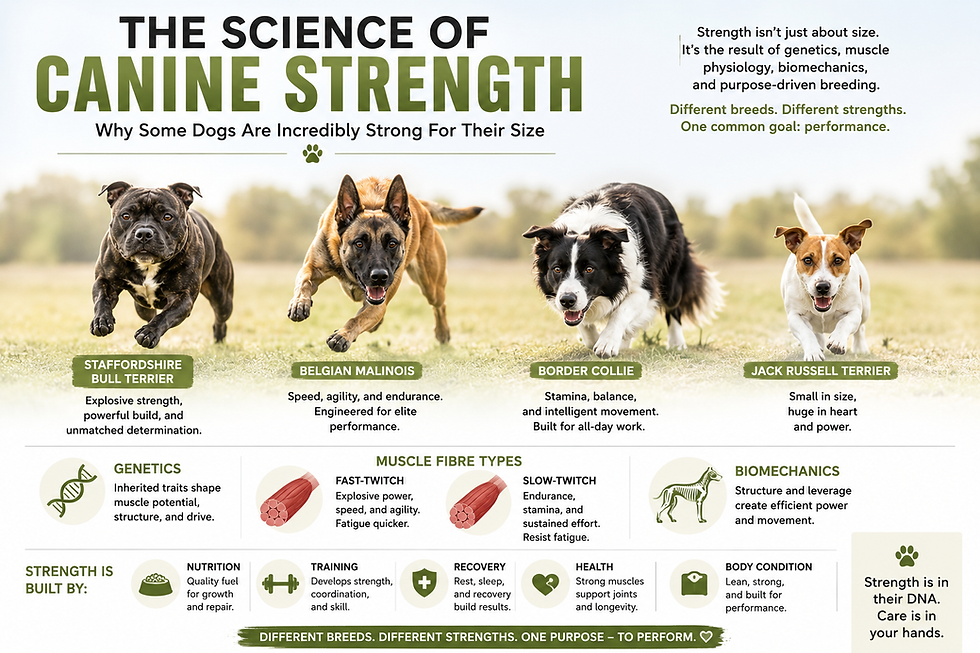
When people think of powerful dogs, giant breeds like the Rottweiler, Mastiff, or Irish Wolfhound often come to mind. Yet some of the strongest dogs pound-for-pound are actually much smaller. The Staffordshire Bull Terrier, Jack Russell Terrier, Border Terrier, and Belgian Malinois all possess remarkable strength, determination, and athletic ability despite their relatively modest size.
So what makes some dogs naturally stronger than others?
The answer lies in a fascinating combination of genetics, muscle fibres, body structure, breeding history, and conditioning.
WHAT DOES "STRONG" ACTUALLY MEAN?
Strength isn't just about muscle size.
In dogs, strength can refer to:
Pulling power
Jumping ability
Grip strength
Explosive acceleration
Endurance
Athletic performance
Mental determination
A dog doesn't need to be the biggest to be one of the strongest.
Many smaller breeds can generate tremendous power relative to their body weight.
MUSCLE FIBRE TYPES: THE SECRET TO CANINE ATHLETES
Just like humans, dogs possess different types of muscle fibres.
Fast-Twitch Fibres
These fibres generate explosive power and speed.
Dogs with high levels of fast-twitch fibres often excel at:
Sprinting
Jumping
Agility
Protection work
Explosive movements
Breeds known for fast-twitch dominance include:
Staffordshire Bull Terrier
Belgian Malinois
Whippet
Greyhound
American Pit Bull Terrier
Slow-Twitch Fibres
These fibres provide stamina and endurance.
Dogs with more slow-twitch fibres excel at:
Long-distance work
Herding
Hunting
Tracking
All-day activity
Examples include:
Border Collies
Labrador Retrievers
German Shorthaired Pointers
Siberian Huskies
The most versatile working dogs often possess an excellent balance of both fibre types.

THE STAFFORDSHIRE BULL TERRIER: SMALL DOG, BIG POWER
Few dogs demonstrate pound-for-pound strength better than the Staffordshire Bull Terrier.
Originally developed from bull-and-terrier stock, the breed was selected for:
Strength
Courage
Athleticism
Agility
Determination
Despite weighing only around 11–17 kg, a well-conditioned Staffy can possess extraordinary muscular development and explosive power.
Their broad chest, powerful shoulders, strong neck, and compact frame create exceptional leverage.
This is one reason the breed remains so popular among enthusiasts who admire athletic, muscular dogs.

Shop Collars And leads Here
THE IRISH STAFFY PHENOMENON
Many Irish-bred Staffordshire Bull Terrier lines became famous for their robust bone structure, strong muscle development, and athletic ability.
While not a separate recognised breed, the term Irish Staffy is often used to describe Staffordshire Bull Terriers from traditional Irish bloodlines known for:
Strong physiques
Functional athleticism
Excellent stamina
Working ability
The best examples combine muscle with agility rather than simply carrying excess body weight.

WHY BELGIAN MALINOIS ARE INCREDIBLY STRONG

The Belgian Malinois is one of the most athletic dogs in the world.
Used extensively by:
Military units
Police forces
Search and rescue teams
Protection sports
Their strength comes from exceptional muscle efficiency rather than bulk.
A Malinois can:
Scale walls
Jump extraordinary heights
Sprint at high speed
Work for hours without tiring
Their power-to-weight ratio is among the highest of any working breed.
THE ROLE OF BODY STRUCTURE
Strength isn't just about muscle.
Biomechanics matter.
Dogs with:
Strong rear angulation
Broad shoulders
Compact frames
Deep chests
Balanced proportions
often generate force more efficiently.
This explains why a muscular Staffy can sometimes appear stronger than a much larger dog.
Proper structure allows muscles to work effectively through the body's leverage system.
DOES BITE FORCE EQUAL STRENGTH?
Not necessarily.
Many internet articles focus on bite force rankings.
However, overall strength involves much more than jaw pressure.
A truly powerful dog combines:
Muscle mass
Athleticism
Endurance
Coordination
Drive
Mental resilience
The strongest working dogs are often those capable of performing difficult physical tasks repeatedly rather than simply having a powerful bite.
Supplement Spotlight:

Hench Range for Canine Muscle Power
Serious dogs need serious support. The Hench Range of advanced animal care supplements is formulated specifically for muscle building, strength, and recovery in athletic and working dogs.
Empower — A high-protein formula designed for lean muscle growth and power development. Packed with premium protein sources, branched-chain amino acids (BCAAs), and key anabolic nutrients to help Staffies, Malinois, and other muscular breeds build and maintain impressive muscle mass.
JackedBite — A performance-focused supplement that supports explosive strength, faster recovery, and reduced muscle soreness. Ideal for dogs in intense training, agility, or protection work. Great for before and training
Whether your dog is a pound-for-pound powerhouse like a Staffordshire Bull Terrier or a high-drive athlete like a Belgian Malinois, these targeted Hench supplements help bridge nutritional gaps, accelerate muscle repair, and combat age-related muscle loss (sarcopenia).
Pair them with proper training, quality nutrition, and smart conditioning to unlock your dog’s true physical potential.Always consult your veterinarian before introducing new supplements.
CONDITIONING MATTERS MORE THAN GENETICS ALONE
Even dogs with excellent genetics require proper care.
Strength and muscle condition are influenced by:
Nutrition
Quality protein supplies amino acids needed for muscle maintenance and repair.
Exercise
Regular activity stimulates muscle development and cardiovascular fitness.
Recovery
Rest is when muscles rebuild and strengthen.
Body Weight
Maintaining lean condition allows dogs to move efficiently and perform at their best.
COMMON MISTAKES THAT REDUCE STRENGTH
Many owners unknowingly limit their dog's physical potential.
Common mistakes include:
Overfeeding leading to obesity
Insufficient exercise
Poor-quality diets
Excessive high-impact exercise in puppies
Inadequate recovery periods
Ignoring muscle loss in ageing dogs
A lean, fit dog will almost always outperform an overweight dog.
AGEING AND MUSCLE LOSS
As dogs age, they naturally lose muscle mass through a process called sarcopenia.
This can lead to:
Reduced mobility
Weakness
Lower stamina
Increased injury risk
Senior dogs often benefit from:
High-quality protein
Regular low-impact exercise
Weight management
Veterinary health monitoring
Maintaining muscle mass is one of the most important factors for healthy ageing.

SO WHICH DOG IS THE STRONGEST?
There is no single answer.
Different breeds excel in different ways:
Explosive Power
Staffordshire Bull Terrier
Belgian Malinois
American Pit Bull Terrier
Endurance
Border Collie
Labrador Retriever
Husky
Pulling Strength
Alaskan Malamute
Mastiff
Saint Bernard
Athletic Versatility
Belgian Malinois
German Shepherd
Staffordshire Bull Terrier
Each demonstrates strength in a unique form.
THE ROLE OF TENDONS AND LIGAMENTS IN CANINE STRENGTH
When discussing strength, most people focus solely on muscle. However, tendons and ligaments are equally important.
Tendons connect muscle to bone and transfer force generated by muscular contractions. Strong, healthy tendons allow dogs to jump, sprint, pull, and change direction efficiently.
Breeds developed for athletic performance often possess exceptionally robust connective tissues that contribute to their remarkable power and resilience.
This is one reason why conditioning, proper nutrition, and recovery are so important. Muscles may recover relatively quickly, but tendons and ligaments adapt more slowly and require consistent management throughout a dog's life.
A truly powerful dog is not simply muscular — it has a strong musculoskeletal system working together as one.
WHY TERRIERS ARE OFTEN STRONGER THAN THEY LOOK
Many people underestimate terrier breeds because of their size.
Historically, terriers were bred to work underground, hunt vermin, control rodents, and perform physically demanding tasks far beyond what their body weight would suggest.
This selective breeding produced dogs with:
High pain tolerance
Exceptional determination
Powerful jaws
Dense musculature
Incredible work ethic
The Staffordshire Bull Terrier, Irish Terrier, Border Terrier, and Jack Russell Terrier are excellent examples of breeds that consistently outperform expectations when it comes to strength and athletic ability.
Their reputation for toughness comes from generations of breeding for functional performance rather than appearance alone.
THE IMPORTANCE OF RECOVERY FOR BUILDING STRENGTH
Contrary to popular belief, dogs do not become stronger during exercise.
Strength adaptations occur during recovery.
After physical activity, muscle fibres experience microscopic stress. During rest, the body repairs this damage, making muscles stronger and more resilient.
Recovery depends on several factors:
Quality nutrition
Adequate protein intake
Hydration
Sleep
Appropriate exercise levels
Time between intense training sessions
Dogs that are constantly exercised without sufficient recovery may experience fatigue, reduced performance, and increased injury risk.
The strongest canine athletes are not always the dogs that train the hardest, but often the dogs that recover the smartest.
Jay Fuel High Protein & Probiotics

Building strength is about more than
exercise alone. Muscles require the right nutritional support to recover, adapt, and maintain condition. JayFuel combines quality protein sources with added probiotics to help support lean muscle maintenance, recovery, digestion, and nutrient absorption.
Suitable for active dogs, sporting dogs, working breeds, and ageing companions, Jay Fuel helps provide the building blocks needed to support healthy muscle condition while promoting digestive health and overall wellbeing. When combined with a balanced diet and appropriate exercise, it can be a valuable addition to a dog's nutrition plan.
Key Benefits:
High-quality protein for muscle maintenance
Added probiotics to support digestive health
Supports recovery after exercise
Helps maintain healthy body condition
Suitable for dogs of all breeds and sizes
Supports active, working, sporting, and senior dogs
Shop Jay Fuel – High Protein & Probiotic Support for Active Dogs 🐾💪
Extra facts
Staffordshire Bull Terrier can jump several times its own body lengthTrue. Staffies are compact, muscular, and exceptionally athletic.
A typical Staffy stands about 14–16 inches (36–41 cm) at the shoulder and weighs 11–17 kg. "Several times its own body length" (roughly 2–3 feet / 60–90 cm long) aligns with their known agility and vertical leaping ability in sports like dock diving or agility. While not record-holders like sighthounds, well-conditioned Staffies demonstrate impressive explosive jumps relative to size.
Belgian Malinois are capable of scaling obstacles over 2 metres highTrue (and often much higher).
Malinois are elite athletic performers in military, police, and sport work. They routinely scale walls of 2–3+ meters (6.5–10+ feet), with trained dogs achieving vertical jumps or climbs of 9–15 feet (2.7–4.7+ meters) in competitions and demonstrations.
Their power-to-weight ratio, drive, and training make this standard.
Greyhounds can reach speeds approaching 45 mph (72 km/h)Accurate. Greyhounds are the fastest dog breed, with top speeds documented around 43–45 mph (69–72 km/h) in short bursts. Racing speeds are often slightly lower on average (36–38 mph sustained), but peak velocity hits the claimed range.
Sled dogs can pull loads weighing several times their body weightTrue. This is especially accurate for breeds like Alaskan Malamutes (bred for heavy freighting). An adult Malamute (often 75–100+ lbs) can pull 500–3,000+ lbs (several times its body weight) in weight-pull events or historical freighting, depending on conditions, training, and team setup. Siberian Huskies and other sled breeds excel similarly in endurance pulling.
The Irish Wolfhound was originally bred to hunt wolves and giant Irish elkTrue. Historically, Irish Wolfhounds were developed as large game hunters in Ireland, used against wolves (until their extinction there) and massive prey like the giant Irish elk. They were valued for size, speed, and strength to take down large animals, often working solo or in small groups.
Jack Russell Terriers were developed to work all day despite weighing less than 10 kgTrue. Traditional Jack Russells (and related Russell Terriers) typically weigh 5–7 kg (11–15 lbs) for working types, sometimes under 10 kg / 22 lbs. They were bred by Rev. John Russell for fox hunting—going to ground, bolting quarry, and working tirelessly all day with high stamina and drive despite their small size.
FINAL THOUGHTS
Canine strength is far more complex than simple muscle size. Genetics, muscle fibre composition, body structure, conditioning, nutrition, and recovery all contribute to athletic performance.
Whether you own a Staffordshire Bull Terrier, Irish Staffy, Belgian Malinois, Labrador, or mixed breed, supporting lean muscle mass and overall fitness can dramatically improve quality of life.
At the end of the day, the strongest dogs are often those that combine physical ability with intelligence, determination, and the incredible bond they share with their owners.


Comments