


The Ultimate Guide to Male Dogs When a Female Is in Season: Behaviour, Psychology, Appetite Loss & Understanding His Instincts
- Jul 6
- 5 min read

"He's not being stubborn... he's following one of the strongest instincts in nature."
If you've ever owned an entire male dog while a nearby female was in season, you've probably seen it happen.
A dog that normally eats every meal suddenly ignores his food.
He paces from room to room.
He stands by doors and windows.
He whines for no obvious reason.
He seems unable to settle.
His recall becomes unreliable.
Some dogs even lose noticeable body condition in only a few days.
To many owners this behaviour appears sudden, confusing and even worrying.
But to your dog...
Everything makes perfect sense.
Long before humans domesticated dogs, wild canids relied on an extraordinary sense of smell to locate potential mates over huge distances. Although modern dogs now live in our homes, those instincts remain remarkably powerful.
Understanding why male dogs behave differently when a female is in season helps owners respond with patience rather than frustration.
It also helps explain why some active, working and show dogs can temporarily lose appetite, muscle and condition during these periods.
In this guide we'll explore the science behind these behaviours, separate myths from facts and explain practical ways to help your dog remain healthy, calm and in the best possible condition.
Meet the Male Dog

Male dogs are often described as:
Playful
Confident
Food motivated
Affectionate
Easy going
Most of the time that's true.
However, during breeding season—or whenever an entire female nearby enters heat—many males temporarily become very different dogs.
Their priorities suddenly change.
Food becomes less important.
Sleep becomes less important.
Even favourite toys may be ignored.
Instead...
One instinct dominates everything else.
Finding the female.
🐾 Did You Know?
A dog's nose contains hundreds of millions of scent receptors—far more than a human's—allowing dogs to detect odours at concentrations we simply cannot imagine.
Why Male Dogs React So Strongly
Many owners think their dog is simply "being naughty."
He's not.
He's responding to biology.
Female dogs release pheromones throughout their reproductive cycle.
These chemical signals communicate reproductive status to other dogs.
When an entire male detects those pheromones, his brain begins responding almost immediately.
Hormones trigger changes that encourage behaviours such as:
Searching
Roaming
Increased alertness
Scent investigation
Vocalisation
Mounting behaviour
Reduced interest in food
These behaviours helped wild dogs reproduce successfully for thousands of years.
Domestic life hasn't removed those instincts.
The Incredible Canine Sense of Smell

Humans experience the world mainly through sight.
Dogs experience it through smell.
Every walk is like reading thousands of messages left by other animals.
A female in season leaves an especially powerful message.
Male dogs don't simply smell "a female."
They detect complex chemical signals that
reveal:
Sex
Reproductive status
Identity
Health
Individual scent
Scientists continue researching canine olfaction, but it remains one of the most sophisticated sensory systems found in mammals.
Fun Fact
Dogs can even smell differences in human emotions through changes in body odour.
It's no surprise they notice a female in season.
How Far Away Can Male Dogs Detect a Female?

This is one of the most common questions owners ask.
There isn't one exact distance.
Wind direction...
Humidity...
Terrain...
And the individual dog's nose all influence how far scent travels.
Under favourable conditions, however, male dogs may detect a female from a considerable distance.
That's why owners are often surprised when dogs several streets away suddenly begin behaving differently.
What Happens Inside the Brain?
When pheromones are detected, information travels to specialised areas of the brain involved in reproduction and behaviour.
This triggers natural hormonal responses.
The result?
Many dogs become:
Highly focused
Easily distracted
More energetic
Restless
Difficult to settle
They're not ignoring you on purpose.
Their brain is simply prioritising reproduction.
Common Behaviour Changes

Not every dog reacts in the same way.
Some barely change.
Others seem completely transformed.
Common signs include:
Constant sniffing
Pacing
Whining
Barking
Restlessness
Increased marking
Pulling on the lead
Escaping attempts
Reduced concentration
Loss of appetite
Some males even lose interest in favourite activities until the female is no longer fertile.

Why Do Some Male
Dogs Stop Eating?
Perhaps the biggest concern for owners is appetite loss.
A normally food-motivated dog suddenly ignores breakfast.
Leaves dinner untouched.
Walks away from treats.
Why?
Because reproduction becomes a higher biological priority than eating.
His body is essentially saying:
"Finding the female matters more than finding food."
Most dogs resume eating normally once the female has finished her season.
However, prolonged refusal to eat should always be discussed with your veterinarian.
🐾 Did You Know?
Some highly driven male dogs can lose several kilograms of body weight during prolonged exposure to females in season simply because they spend more time pacing, searching and worrying than eating.
Why Some Male Dogs Stop Eating When a Female Is in Season
One of the most common concerns owners notice is a sudden loss of appetite.
When an entire male detects a female in season, reproductive hormones and instinct can temporarily override his interest in food. Instead of thinking about meals, his focus shifts towards finding the female.
Some dogs may:
Eat less than usual
Refuse favourite foods
Become restless around meal times
Lose interest in treats
Spend more time sniffing, pacing or watching outside
Most males return to normal once the female is no longer in season. However, if your dog refuses food for an extended period or becomes unwell, seek veterinary advice.
Can a Male Dog Lose Muscle During This Time?
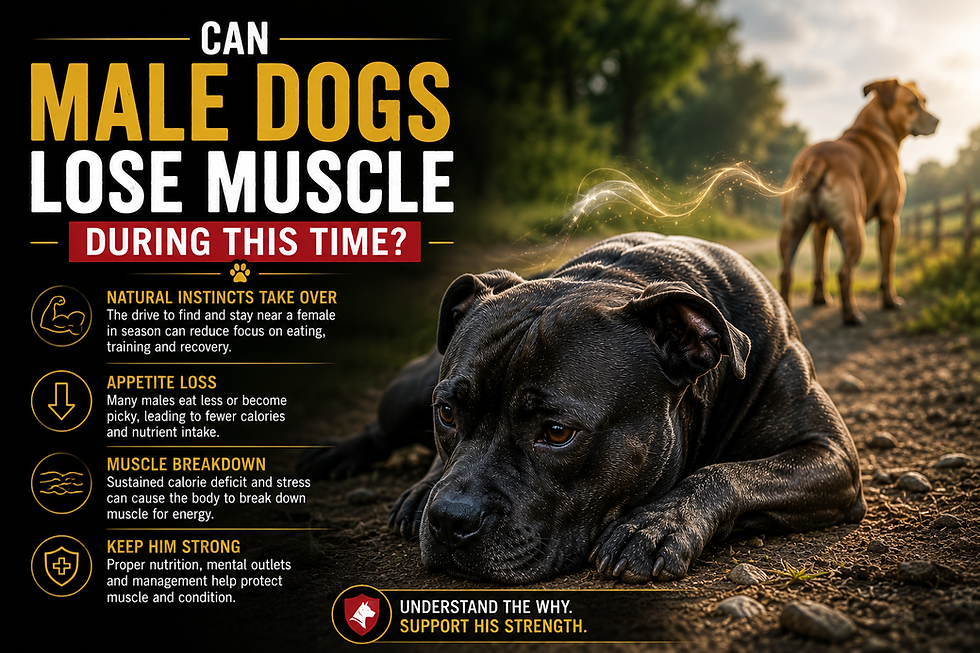
If reduced appetite lasts for several days or occurs repeatedly, particularly if several females nearby come into season throughout the year, active dogs can begin losing:
Body condition
Lean muscle
Healthy weight
Strength
Stamina
This can be especially frustrating for owners of:
Show dogs
Working dogs
Sporting dogs
Agility dogs
Protection dogs
Bull breeds being conditioned for competition
Maintaining muscle requires regular nutrition as well as exercise. If calorie and protein intake falls, muscle maintenance becomes more difficult.
Supporting Muscle, Condition and Recovery

Once your dog's appetite returns, restoring lost condition should be done gradually using quality nutrition and appropriate exercise.
For owners wanting additional nutritional support, Advanced Animal Care offers supplements designed to complement a complete and balanced diet.
Depending on your dog's needs:
JayFuel provides high-quality protein together with digestive support to help maintain condition and recovery.
MuscleMatrix provides targeted nutritional support for lean muscle maintenance, activity and recovery in active dogs.
Empower Maximum Muscle supplies amino acids together with vitamins and minerals to support muscle health and overall condition.
JackedBite Training Chews provide nutritional support for active, working and sporting dogs during training.
Combined with appropriate exercise, sufficient rest and a balanced diet, these products can help support muscle maintenance, recovery and overall body condition.

Comments