


Do Dogs Know They Are Strong? The Surprising Truth About Canine Confidence
- Jul 14
- 9 min read

Have you ever watched a Staffordshire Bull Terrier effortlessly pull you towards the park, a Labrador carry a huge tree branch, or a tiny Jack Russell confidently challenge a much larger dog?
It raises an interesting question...
Do dogs actually know how strong they are?
The answer isn't as simple as yes or no.
Unlike people, dogs don't admire themselves in the mirror or compare their muscles with others. They don't think about strength in the same way we do. Instead, their behaviour is shaped by instinct, experience, confidence and learning.
Some powerful dogs appear incredibly gentle, while some much smaller dogs behave as though they are ten times their size. So if dogs don't understand strength in the human sense, what are they responding to?
Modern animal behaviour research suggests that dogs build an understanding of what they can and can't do through everyday experiences. Every game of tug, every jump into the car, every walk, every training session and every interaction with other dogs teaches them something about their own abilities.
Understanding how dogs perceive their own physical abilities helps us become better owners, trainers and handlers. It also explains why confidence, training and positive experiences are often far more important than size alone.
In this guide, we'll explore what science tells us about canine confidence, whether dogs recognise their own strength, and why some of the strongest dogs in the world are often the calmest companions you'll ever meet.
📚 Table of Contents
Do Dogs Know They're Strong?
How Dogs Learn Their Own Abilities
Confidence vs Physical Strength
Why Small Dogs Often Act Bigger
Why Powerful Dogs Are Often Gentle
Do Dogs Judge Other Dogs by Size?
Does Breed Influence Confidence?
Can Dogs Become More Confident?
Frequently Asked Questions
Final Thoughts
1. Do Dogs Know They're Strong?

Dogs almost certainly don't think about strength in the way humans do.
They don't compare themselves with other dogs based on muscle size, nor do they consciously think, "I'm stronger than that dog."
Instead, dogs learn through experience.
Every successful jump, game of tug, climb over a log or interaction with another dog teaches them what their body is capable of doing.
Behaviour scientists call this learning through reinforcement.
When a behaviour produces a successful outcome, dogs become more likely to repeat it.
For example:
A Labrador learns it can easily carry a large dummy.
A Border Collie discovers it can quickly gather sheep.
A Staffordshire Bull Terrier realises it can win most games of tug.
A Great Dane learns it doesn't need to push smaller dogs around to get what it wants.
Rather than recognising strength itself, dogs gradually develop confidence in their own abilities.
That confidence often influences how they approach new situations far more than their actual physical power.
In other words, dogs don't think:
"I'm strong."
They learn:
"I know I can do this."
That small difference helps explain why some of the biggest, strongest dogs are incredibly calm and gentle, while some much smaller dogs behave as though they're fearless giants.
2. How Dogs Learn Their Own Abilities
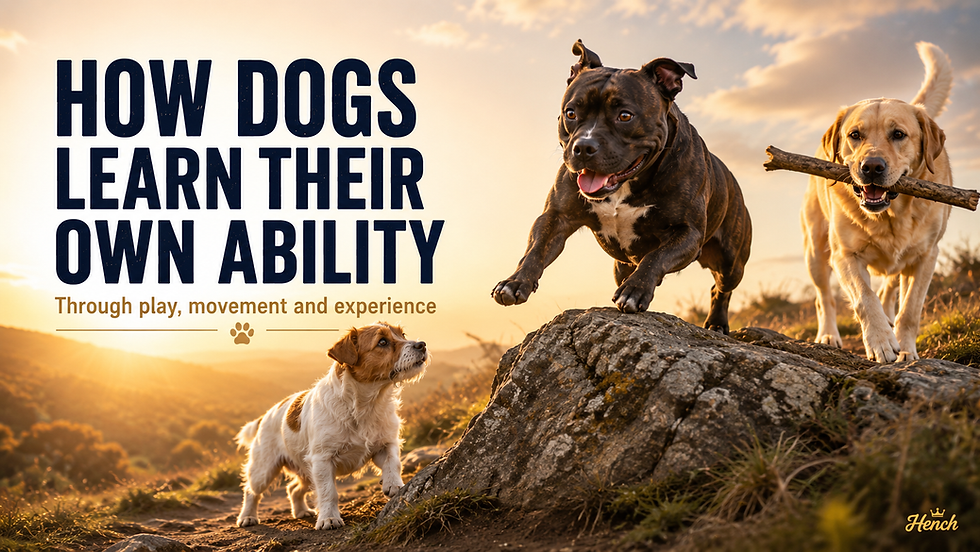
Dogs aren't born knowing exactly what they're capable of doing. Like young children, they learn by exploring, playing and interacting with the world around them.
From the moment puppies begin walking, they start building confidence through experience.
Every successful jump onto a sofa, every game of chase and every new obstacle teaches them something about their physical abilities.
Behaviourists often describe this as learning through trial and success.
When a dog attempts something and succeeds, its confidence gradually grows.
For example:
A puppy learns it can jump into the car.
A Labrador discovers it can swim confidently.
A Border Collie learns it can clear an agility jump.
A Staffordshire Bull Terrier realises it enjoys tug games.
A German Shepherd gains confidence during obedience training.
Each positive experience builds a mental picture of what the dog is capable of achieving.
Dogs don't think about strength in kilograms or compare muscles like people do. Instead, they simply remember what has worked before.
This is why positive training is so effective.
When dogs repeatedly experience success, they become more willing to try new things and approach unfamiliar situations with confidence.
3. Confidence Isn't the Same as Strength
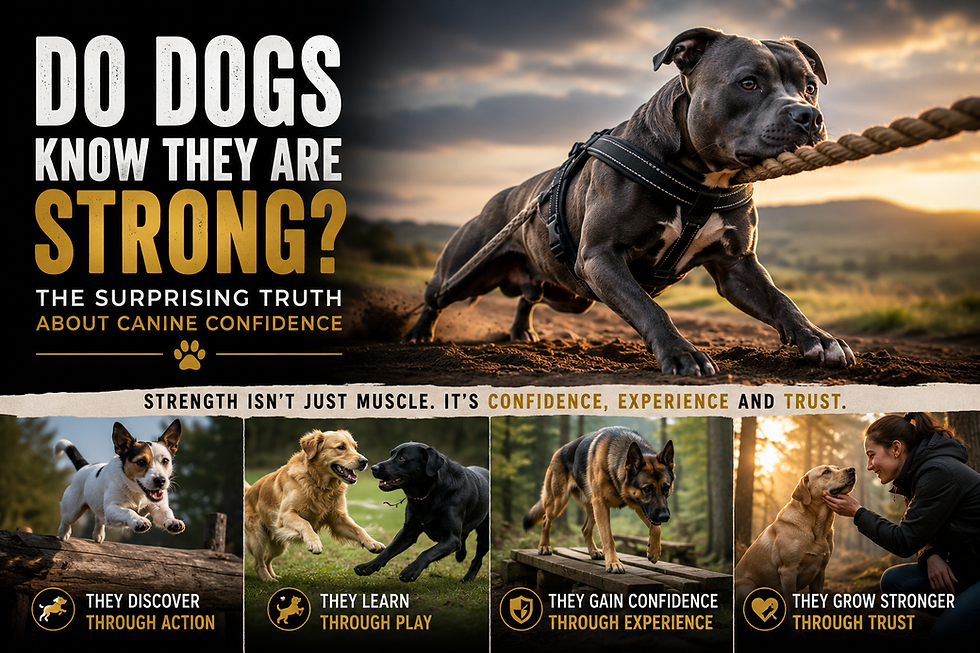
One of the biggest misconceptions is that strong dogs are automatically confident.
In reality, physical strength and confidence are two very different things.
Some enormous dogs are incredibly gentle and cautious.
Meanwhile, many tiny breeds confidently challenge dogs several times their size.
Confidence is influenced by many factors, including:
Genetics
Early socialisation
Positive experiences
Training
Environment
Past experiences
Health
A physically powerful dog may still feel nervous if it hasn't been properly socialised.
Likewise, a small Terrier with plenty of positive experiences may behave with enormous confidence despite weighing only a few kilograms.
This explains why owners often describe some of the largest breeds as "gentle giants."
Their confidence comes from feeling secure—not from feeling the need to prove themselves.
⭐ Confidence Begins with Good Foundations
A confident dog is built through much more than exercise alone.
Regular training, positive experiences, appropriate socialisation, quality nutrition and sensible recovery all contribute to a dog's ability to enjoy an active, balanced life.
Whether your dog is a family companion, show dog, working partner or sporting athlete, looking after their overall wellbeing helps them stay happy, active and ready for life's next adventure.

4. Why Do Small Dogs Sometimes Act Bigger Than They Are?

If dogs truly understood physical strength, we'd expect the biggest dogs to always dominate and the smallest dogs to stay out of trouble.
But anyone who has spent time around dogs knows that's often not the case.
Small breeds such as Jack Russell Terriers, Dachshunds and Chihuahuas can display remarkable confidence, happily barking at or confronting dogs many times their size.
This isn't because they believe they're physically stronger.
Instead, they're responding to:
Confidence built through previous experiences.
Natural breed traits.
Excitement or frustration.
Protective instincts.
Learned behaviour.
Likewise, many large breeds—including Great Danes, Newfoundlands and Mastiffs—often avoid confrontation altogether despite having far greater physical strength.
This highlights an important point:
Behaviour is influenced far more by confidence, learning and temperament than by muscle alone.
A calm, well-socialised dog rarely feels the need to prove anything, regardless of its size.
5. Why Powerful Dogs Are Often the Gentlest

One of the most surprising things about dogs is that many of the strongest breeds are also among the calmest and most affectionate.
Owners of Staffordshire Bull Terriers, Rottweilers, Great Danes, Newfoundlands and Bernese Mountain Dogs often describe them as gentle, patient and loving
companions.
So why is this?
Unlike people, dogs don't usually feel the need to prove how strong they are.
A confident, well-socialised dog is more likely to stay relaxed because it doesn't see every situation as a challenge.
Dogs that feel safe and secure often display:
Calm body language.
Relaxed posture.
Controlled movements.
Patience around people.
Confidence without unnecessary confrontation.
This is one reason many experienced trainers say that a truly confident dog rarely needs to show off.
In contrast, dogs that feel anxious, uncertain or threatened may bark, lunge or become reactive regardless of their size.
Confidence comes from feeling secure—not from being physically powerful.
6. Do Dogs Judge Other Dogs by Size?

Dogs certainly notice differences between other dogs, but they don't simply judge each other by who is biggest.
Instead, they read an incredible amount of information through body language.
When two dogs meet, they quickly assess things such as:
Body posture.
Tail position.
Ear position.
Facial expressions.
Eye contact.
Movement.
Scent.
Confidence.
An older, calm Labrador may quietly walk past another dog without concern.
A young, excitable dog may bounce towards every dog it sees regardless of size.
Dogs rely on communication far more than physical strength.
In fact, most canine disagreements are resolved long before any physical contact occurs because dogs are experts at reading each other's signals.
This ability helps avoid unnecessary conflict in everyday life.
⭐ Every Dog Has the Potential to Thrive
Whether your dog is a tiny Terrier or a powerful Cane Corso, confidence grows through positive experiences, appropriate exercise and consistent care.
Providing a balanced diet, regular mental stimulation and suitable daily activity helps dogs maintain normal muscle condition, healthy body condition and an active lifestyle.
Every dog is unique, and supporting their overall wellbeing allows them to enjoy life with confidence, whatever their breed or size.
7. Can Dogs Become More Confident?
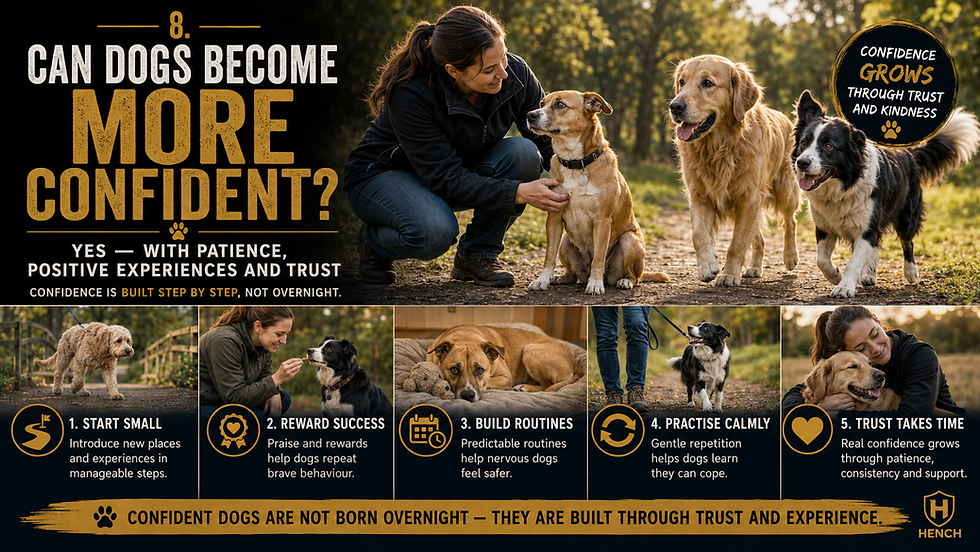
Absolutely.
Confidence isn't fixed for life.
Many nervous puppies grow into confident adults through kind, patient training and positive experiences.
Likewise, a rescue dog that initially lacks confidence can often blossom over time when given consistency, encouragement and trust.
Owners can help build confidence by:
Reward-based training.
Gentle socialisation.
Introducing new experiences gradually.
Allowing dogs to solve simple problems.
Playing interactive games.
Providing regular exercise appropriate for their age and ability.
Avoiding punishment-based training methods.
Confidence grows through success.
Every positive experience teaches a dog that the world is a safe place to explore.
Over time, this creates calmer, happier and more resilient companions.
The strongest dogs aren't always the biggest—they're often the ones that feel secure enough to remain calm in almost any situation.
8. Does Breed Influence Confidence?
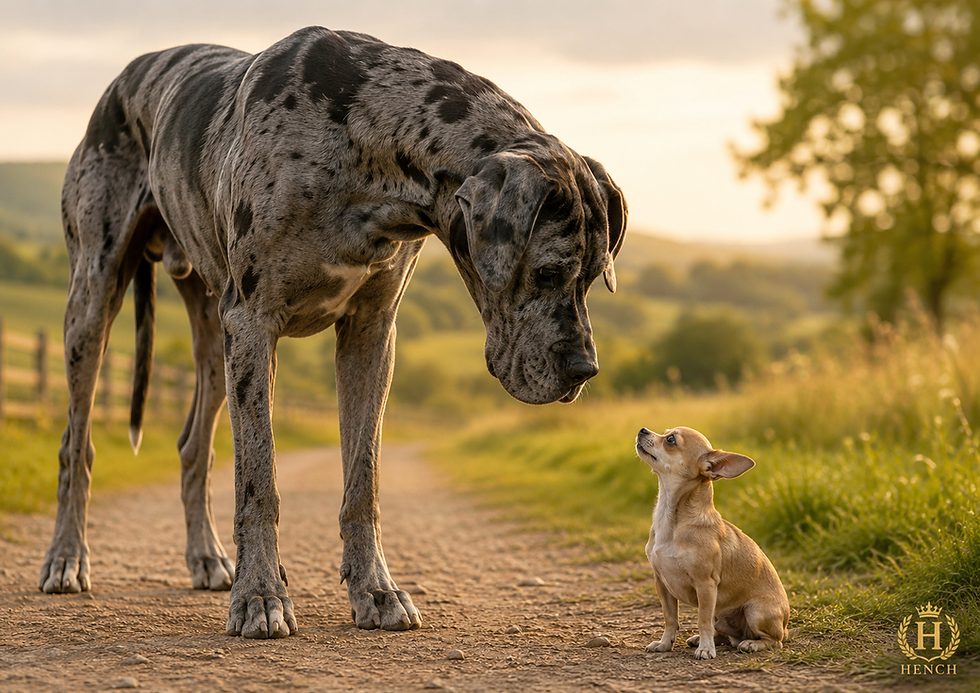
Every dog is an individual, but breed can influence certain behavioural tendencies.
Over many generations, different breeds have been developed for specific roles, such as herding livestock, retrieving game, guarding property or providing companionship. These roles have helped shape traits like confidence, independence and willingness to work alongside people.
For example:
Border Collies are often confident problem-solvers that enjoy learning and working.
Labrador Retrievers are typically friendly, sociable and eager to please.
German Shepherds are known for their intelligence, loyalty and adaptability.
Staffordshire Bull Terriers are often courageous, affectionate and people-focused.
Rottweilers are generally calm, confident and self-assured when well-bred and properly socialised.
Golden Retrievers are usually gentle, friendly and confident in family environments.
However, breed is only one part of the picture.
A dog's confidence is also shaped by:
Responsible breeding.
Early socialisation.
Positive training.
Daily experiences.
Health and wellbeing.
The environment they grow up in.
Two dogs of the same breed can have very different personalities depending on their upbringing and life experiences.
That's why it's impossible to judge a dog's confidence—or temperament—based on breed alone.
Can Nutrition Support an Active Dog’s Confidence?
Supplements do not change a dog’s personality or replace training, socialisation and patient handling. However, appropriate nutrition can support normal energy, muscle condition and recovery, helping an active dog feel physically prepared for exercise and new experiences.
Dogs involved in training, showing, working activities or regular conditioning may have different nutritional needs from less active pets. Older dogs and those returning gradually to exercise may also benefit from additional nutritional support.
The Hench Range includes:
JayFuel — a high-protein nutritional topper with digestive support for active, working, show, recovering and ageing dogs.
MuscleMatrix — targeted nutritional support for normal muscle development, maintenance and post-exercise recovery.
Empower Maximum Muscle — convenient chewable tablets containing individually declared amino acids, creatine, vitamins and minerals.
Always introduce a new food or supplement gradually. Begin with half the suggested serving or less and adjust slowly according to the individual dog
Explore the Hench Range
9. Frequently Asked Questions
Do dogs know how strong they are?
Not in the way humans understand strength. Dogs don't consciously think about muscles or power. Instead, they learn what they're capable of through experience and repeated success.
---
Why are some large dogs so gentle?
Many large breeds are naturally calm and confident. A well-socialised dog often has no need to prove itself and is more likely to remain relaxed around people and other dogs.
---
Why do little dogs sometimes challenge bigger dogs?
Small dogs aren't necessarily trying to prove they're stronger. Their behaviour is often influenced by confidence, excitement, instinct, previous experiences and training rather than their physical size.
---
Can nervous dogs become more confident?
Yes. With patient, reward-based training, appropriate socialisation and positive experiences, many dogs become much more confident over time.
---
Does exercise make dogs more confident?
Appropriate exercise can certainly help. Physical activity, mental stimulation and successful learning experiences all contribute to a dog's overall wellbeing and confidence. However, every dog also needs adequate rest and recovery between more demanding activities.
---
⭐ Helping Your Dog Feel Their Best
A confident dog starts with good care.
Daily exercise, positive training, mental enrichment, balanced nutrition and plenty of opportunities to rest all work together to support your dog's overall wellbeing.
Whether your companion is an energetic young puppy, an active working dog or a gentle senior enjoying slower adventures, giving them the right balance of activity and recovery helps them stay healthy, happy and confident throughout life.
If you're looking to support an active lifestyle, explore our range of premium canine nutrition products and handcrafted leather collars and leads, designed with comfort, quality and everyday performance in mind.
10. Final Thoughts
So... do dogs know they are strong?
Probably not in the way people do.
Dogs don't admire themselves in the mirror or compare their muscles with others. They don't measure strength—they discover what they can do through experience.
Every successful jump, every game of tug, every walk and every positive interaction teaches them something new about their abilities.
In many ways, confidence is far more important than strength.
Some of the world's most powerful dogs are also among the gentlest, proving that true confidence doesn't need to be loud or intimidating.
As owners, our role isn't simply to build stronger dogs—it's to help them become healthier, happier and more confident companions through kindness, responsible training and excellent care.
Because the strongest dog isn't always the biggest...
It's often the one that quietly trusts itself, trusts its owner, and enjoys every adventure by their side. 🐾


Comments