


Reverse Sneezing in Dogs: When Should You Worry? A Clear and Reassuring Guide for Concerned Dog Owners
- 4 days ago
- 7 min read
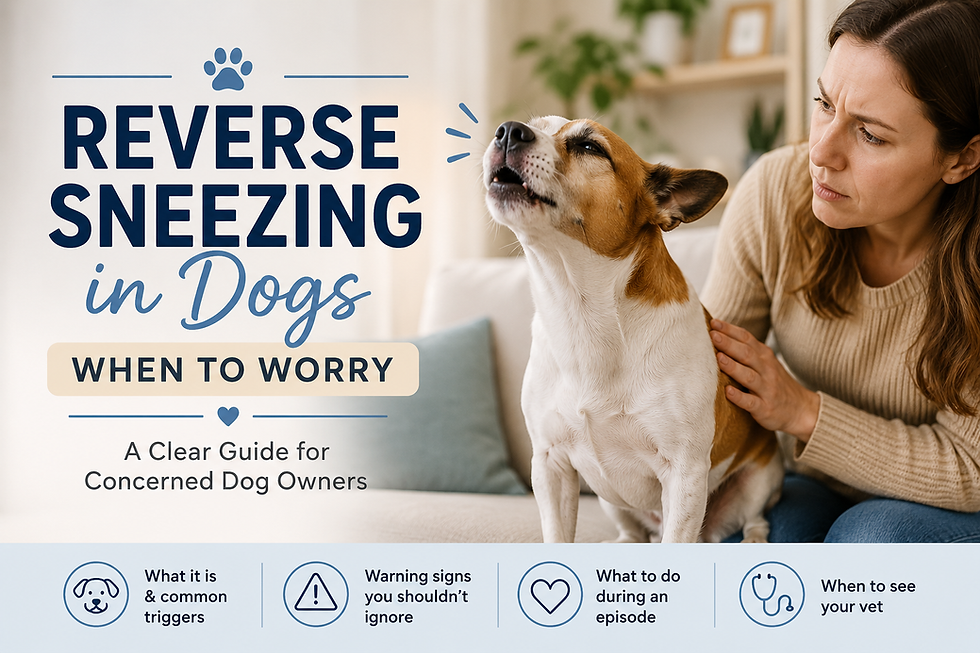
A Clear and Reassuring Guide for Concerned Dog Owners
Your dog suddenly stops, stretches out their neck and begins making loud snorting, honking or gasping noises. It can look as though they are choking or unable to breathe—but it may be a reverse sneeze.
Reverse sneezing is usually harmless when an episode is brief, occasional and followed by a quick return to normal. However, new, frequent or worsening episodes should be discussed with your vet, particularly when your dog has other symptoms or takes longer than expected to recover.
Emergency warning: Contact a vet immediately if your dog is genuinely struggling to breathe, cannot return to normal breathing, collapses or has white, grey or blue gums.
This article provides general information for UK dog owners and does not replace advice, diagnosis or treatment from a veterinary professional.
What Is Reverse Sneezing in Dogs?
Reverse sneezing, sometimes called paroxysmal respiration, is a reflex involving a series of sudden and rapid inhalations through the nose.
During a normal sneeze, air is pushed out through the nose. During a reverse sneeze, the dog repeatedly draws air inwards, creating a loud snorting, choking or honking sound.
The reaction is thought to be triggered by irritation around the back of the nose or throat. Although it can look dramatic, reverse sneezing is usually harmless and does not cause lasting problems.
What Does Reverse Sneezing Look and Sound Like?

During an episode, your dog may:
Suddenly stand still
Extend their head and neck
Tilt their head slightly backwards
Flare their nostrils
Keep their mouth mostly closed
Make repeated snorting, honking or gasping noises
Look as though something is caught in their throat
A typical episode is brief and often lasts around 30 to 60 seconds. Your dog should return to normal once it has stopped.
Recording an episode can be extremely helpful. Your dog may not repeat the behaviour during a veterinary appointment, and a clear video can help your vet distinguish reverse sneezing from coughing, gagging, choking or another breathing problem.
What Causes Reverse Sneezing in Dogs?
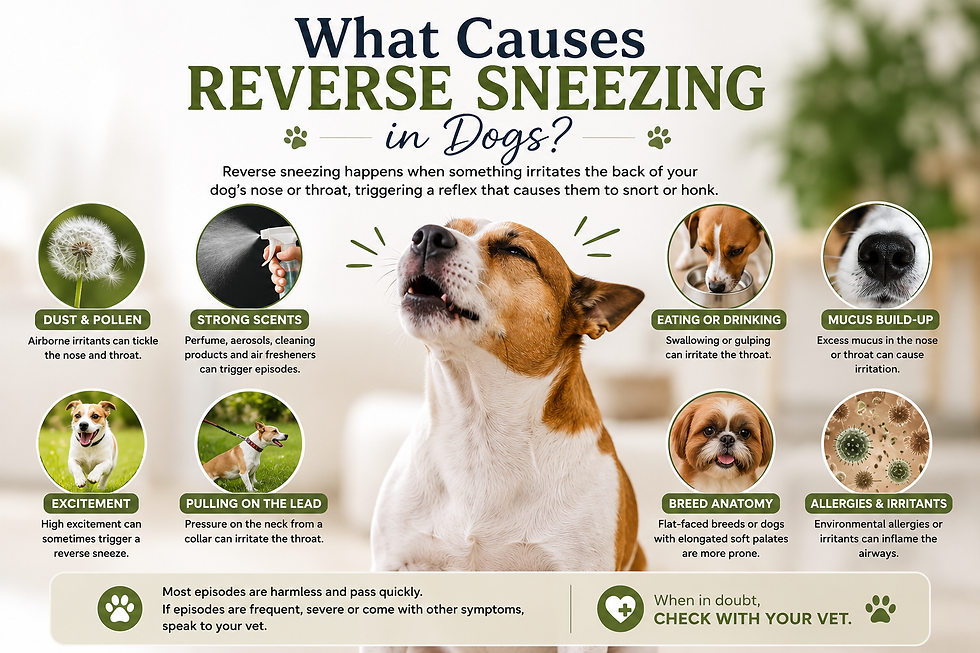
In many dogs, no single cause is identified. Episodes may happen when something temporarily irritates the back of the nose or throat.
Possible triggers include:
Dust or pollen
Smoke or vaping fumes
Perfume, aerosols and air fresheners
Excitement
Pulling against a collar
Eating or drinking
Excess mucus
Irritation linked to allergies
An elongated soft palate, particularly in flat-faced dogs
Less commonly, repeated snorting or reverse-sneeze-like episodes may be associated with:
A grass seed or another foreign object
Nasal mites
A respiratory infection
Inflammation inside the nose or throat
A nasal polyp or growth
Brachycephalic obstructive airway syndrome, known as BOAS
The sound alone cannot confirm the cause. A veterinary examination may be needed when episodes are new, persistent, severe or accompanied by other symptoms.
Which Dogs Are More Likely to Reverse Sneeze?
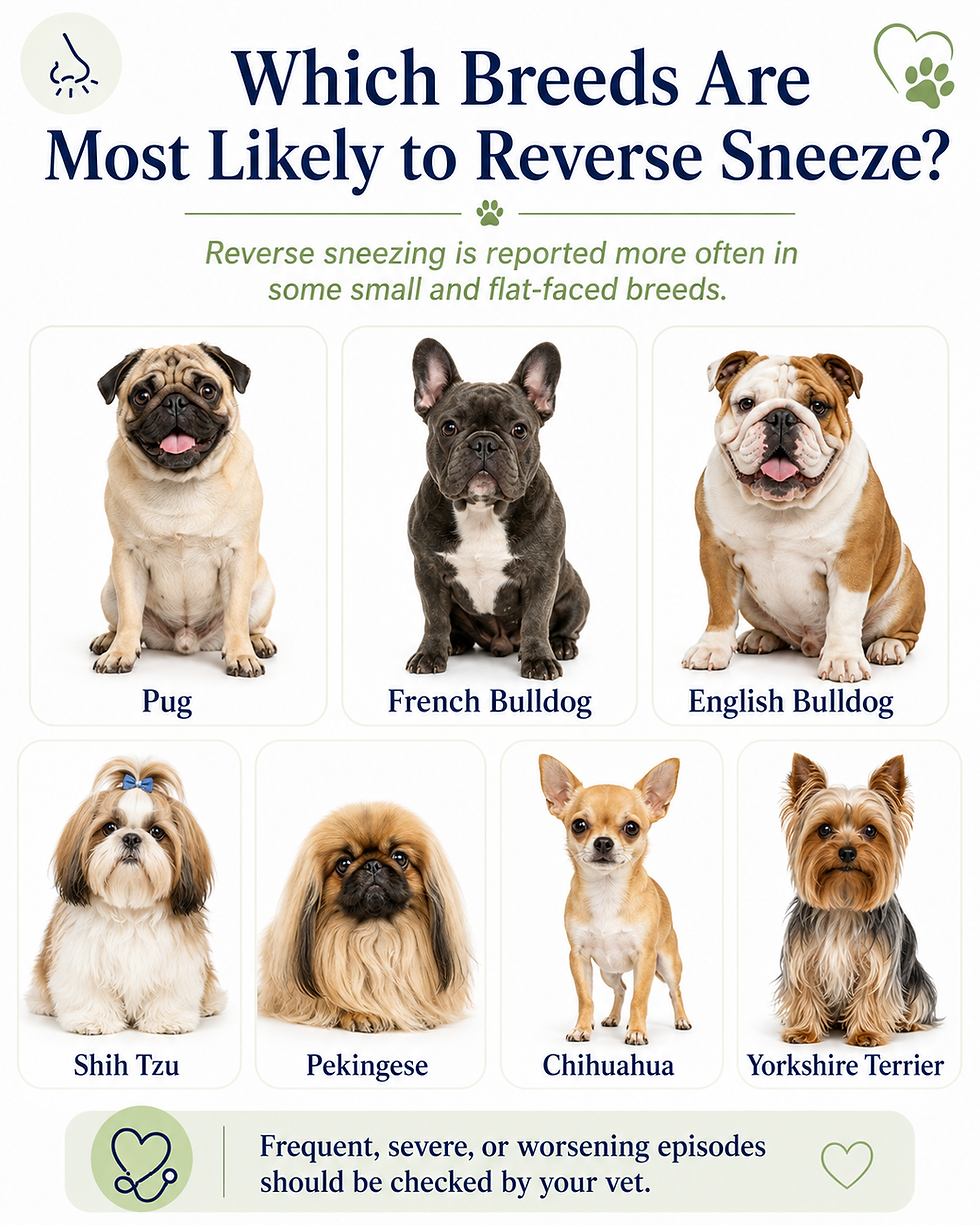
Any dog can reverse sneeze, but it is reported more frequently in small dogs and brachycephalic—or flat-faced—breeds.
Flat-faced dogs may have narrowed airways or an elongated soft palate that contributes to irritation and noisy breathing. Breeds that may experience reverse sneezing include:
Pugs
French Bulldogs
English Bulldogs
Shih Tzus
Pekingese
Chihuahuas
Yorkshire Terriers
Frequent snorting or noisy breathing should not automatically be dismissed as normal for a flat-faced breed. Exercise intolerance, disturbed sleep, overheating, gagging or persistent breathing noise may indicate BOAS and should be assessed by a vet.
When Is Reverse Sneezing Usually Harmless?
An occasional reverse sneeze is usually not a cause for concern when:
The episode stops by itself
Your dog remains conscious and responsive
Their gums remain their normal colour
They recover quickly
Their breathing returns completely to normal
They remain happy, active and well between episodes
Most dogs with occasional reverse sneezing do not require treatment.
However, not every snorting, choking or gasping noise is a reverse sneeze. Pay attention to your dog’s posture, gum colour, behaviour and recovery.

Is My Dog Reverse Sneezing, Coughing or Choking?
Reverse sneezing
A dog usually draws air rapidly through the nose, keeps their mouth mostly closed and extends their neck. The episode generally ends by itself, followed by a quick return to normal.
Coughing
A cough involves air being pushed out of the lungs. Your dog may open their mouth, gag, retch or swallow afterwards.
A dry, high-pitched “goose-honk” cough can sometimes be associated with upper-airway irritation, kennel cough or tracheal collapse rather than reverse sneezing.
Choking or breathing distress
A choking dog may panic, paw at their mouth, struggle to breathe, become weak or collapse. Their gums may become white, grey or blue.
Choking and genuine breathing difficulty are emergencies. Contact your vet immediately rather than waiting to see whether the problem passes.

What Should You Do During a Reverse Sneezing Episode?

Stay calm
Most reverse-sneezing episodes stop naturally. Speak calmly and avoid surrounding, frightening or tightly restraining your dog.
Remove pressure from the neck
If the episode began while your dog was pulling against a collar, release the pressure as soon as it is safe to do so.
Move away from irritants
If possible, move your dog away from smoke, perfume, air fresheners, cleaning sprays, heavy dust or another possible irritant.
Gently stroke the throat or neck
Some dogs may settle when their throat or neck is stroked gently. Do not squeeze or place pressure on the throat.
Allow the episode to finish
Do not cover or hold your dog’s nostrils closed. Do not force food or water into their mouth while they are snorting or struggling to coordinate their breathing.
Once the episode has completely stopped and your dog is breathing normally, allow them to settle and offer water normally.
Record the episode
A video showing the sound, your dog’s posture and how quickly they recover may help your vet identify what is happening.
What Should You Avoid Doing?
During an episode:
Do not panic or shout
Do not hold the nostrils closed
Do not squeeze the throat
Do not force food or water into the mouth
Do not put your fingers blindly into the mouth or throat
Do not give antihistamines or human medication
Do not assume every breathing noise is harmless
When you are unsure whether your dog is reverse sneezing or genuinely struggling to breathe, contact your veterinary practice.

When Should You Contact Your Vet?
Arrange veterinary advice if:
The episodes have started suddenly without an obvious reason
They are becoming more frequent, severe or prolonged
Several episodes repeatedly occur close together
Your dog takes longer than usual to recover
Your dog appears distressed during or after an episode
There is coughing, wheezing, gagging or noisy breathing between episodes
There is persistent, thick, one-sided or bloody nasal discharge
Your dog repeatedly paws at their nose or face
There is facial swelling
Your dog has reduced appetite, low energy or unexplained weight loss
Reverse sneezing begins for the first time in an older dog
The episodes interfere with sleep, exercise or quality of life
Your dog faints or collapses after an episode
These signs do not automatically mean there is a serious condition, but they should be investigated rather than assumed to be ordinary reverse sneezing.
When Is It an Emergency?

Take your dog to the nearest veterinary practice immediately if they:
Are unable to breathe normally
Have white, grey or blue gums
Collapse or become unresponsive
Are becoming rapidly worse
Have severe, laboured or very noisy breathing
Cannot recover normally after the episode
Appear to have something blocking their airway
Keep your dog as calm and cool as possible. Telephone the veterinary practice while travelling so the team can prepare for your arrival.
How Will a Vet Investigate Reverse Sneezing?

Your vet may ask:
When the episodes started
How long they usually last
How frequently they happen
Whether you have noticed a trigger
Whether your dog has nasal discharge or coughing
Whether your dog is completely normal between episodes
Your vet may examine your dog’s nose, mouth, throat, heart and lungs.
If further investigation is needed, it may include:
Blood tests
X-rays
Examination of the mouth and throat under sedation or anaesthetic
Rhinoscopy, using a small camera to examine the nasal passages
CT imaging
Tests for infection or parasites
A tissue sample from an abnormal area
Most dogs with occasional reverse sneezing will not need all these tests. Further investigation is more likely when episodes are persistent, severe or accompanied by other symptoms.
Does Reverse Sneezing Need Treatment?
Occasional reverse sneezing usually requires no medication.
When an underlying problem is found, treatment will depend on the cause. It might involve:
Removing a foreign object
Treating an infection or parasite
Managing inflammation
Investigating a nasal abnormality
Assessing a flat-faced dog for BOAS
Antihistamines, anti-inflammatory medicines, decongestants and other treatments should only be given when prescribed or approved by your vet.
Never give your dog human medication without veterinary advice.
Can Reverse Sneezing Be Prevented?
Not every episode can be prevented, but you may be able to reduce avoidable irritation by:
Using thick collar or a well-fitted harness if collar pressure appears to trigger episodes
Avoiding cigarette smoke and vaping around your dog
Limiting strong perfumes, sprays and air fresheners
Keeping dusty areas well ventilated
Using a slow feeder if episodes follow rushed meals
Keeping a record of possible triggers
Discussing persistent allergy symptoms with your vet
Having ongoing noisy breathing in a flat-faced dog properly assessed
Maintaining a healthy body condition is also important for general breathing and airway health, particularly for dogs affected by BOAS. However, excess weight should not be presented as a direct cause of reverse sneezing.
Should You Change From a Collar to a Harness?
A harness may help when episodes regularly begin as your dog pulls against their collar.
Choose a well-fitted harness that does not restrict shoulder movement or rub behind the front legs. A harness does not treat an underlying medical problem, so continued or worsening episodes still require veterinary advice.
The Bottom Line
Reverse sneezing often looks and sounds much worse than it is.
A brief, occasional episode followed by an immediate return to normal is usually harmless. However, new, frequent or worsening episodes should not be ignored—particularly when your dog has coughing, nasal discharge, delayed recovery, fainting or changes in their general health.
Genuine breathing difficulty, collapse or white, grey or blue gums are emergencies.
When you are uncertain whether your dog is reverse sneezing, coughing, choking or struggling to breathe, record a video if it is safe and contact your veterinary practice for advice.
Has your dog ever frightened you with their first reverse sneeze? Share your experience in the comments—you may help reassure another concerned dog owner.
Sources and Further Reading
PDSA: Reverse Sneezing in Dogs
PDSA: Sneezing in Dogs
PDSA: First Aid for Pets Struggling to Breathe
MSD Veterinary Manual: Clinical Signs of Respiratory Disease in Animals


Comments