


13 American Bully Questions Answered: Temperament, Types and UK Rules

A broad head, a powerful build and a dog determined to share your sofa—American Bullies certainly get noticed. But their appearance also creates confusion about their ancestry, temperament and legal status.
Is an American Bully a Pit Bull? What does “Pocket” actually mean? Can they live happily with children and other dogs?
Here are clear answers to 13 common American Bully questions, including the UK rules owners need to understand.
UK legal information checked on 9 October 2026.
1. Is an American Bully the same as a Pit Bull?

No. The American Bully and American Pit Bull Terrier are distinct breeds with shared ancestry.
The American Bully developed from American Pit Bull Terrier foundations, with contributions from other bull breeds. It was recognised by the United Kennel Club on 15 July 2013.
Confusion arises because “Pit Bull” is often used loosely to describe several muscular, short-coated dogs. In UK law, prohibited-type assessments concern physical characteristics rather than simply the breed name or pedigree.
2. What is the difference between an American Bully and a Staffordshire Bull Terrier?

They are separate breeds with different standards, histories and typical proportions.
The Staffordshire Bull Terrier is a compact British breed known for strength, balance and agility. American Bullies generally have a broader, heavier appearance, although their proportions vary between varieties and individuals.
A Pocket American Bully is not another name for a Staffy. Equally, an American Bully is not simply an oversized Staffordshire Bull Terrier.
Both can have muscular bodies and broad heads, but those shared features do not make them the same breed.
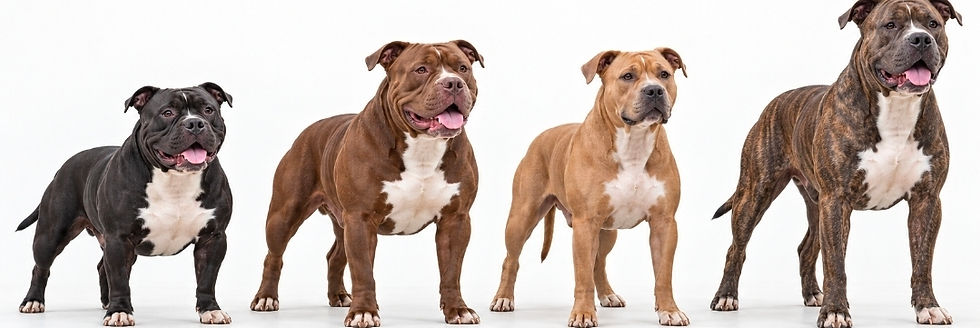
3. What are Pocket, Standard, Classic and XL American Bullies?
These names describe varieties within the American Bully breed.
Pocket: A shorter variety retaining the breed’s substantial build.
Standard: The reference variety for balanced proportions and build.
Classic: Similar in height to the Standard, with a lighter frame and less body mass.
XL: The taller variety.
Exact measurements depend on the registry. “Micro” and “Exotic” are not recognised varieties within the UKC American Bully standard.
Registry categories and the UK’s legal definition of an XL Bully type are separate systems. A registration certificate does not determine whether a dog falls within UK prohibited-type legislation.
4. Are American Bullies banned in the UK?

Not every American Bully is banned. XL Bully types are prohibited unless lawfully exempt.
Restrictions apply in England, Wales, Scotland and Northern Ireland. Exempt dogs must be kept under the applicable conditions, including secure keeping, microchipping, neutering and a lead and muzzle in public.
A label such as “Standard” or “Classic” does not itself establish that a dog falls outside prohibited-type legislation. Check the official guidance for your country and the dog’s physical characteristics.
The normal exemption application windows have closed. Owners should not assume they can obtain an exemption simply by submitting a new application.

5. How do I know whether my American Bully falls under the XL Bully rules?

Use the official conformation standard rather than relying on the seller’s description.
The published minimum adult heights are:
Male: 20 inches, or 51 cm, at the withers.
Female: 19 inches, or 48 cm, at the withers.
The withers are the highest point of the shoulders. Height is assessed alongside other characteristics, including the head, chest, body and limbs. A dog meeting the height threshold and a substantial number of the listed characteristics could fall within the definition.
Registration papers, DNA results and a breeder’s reassurance do not determine legal status. A photograph alone cannot provide a definitive assessment either.
If uncertain, follow the official guidance and seek advice from a solicitor experienced in dog legislation.
Important 2026 update: compulsory third-party liability insurance for prohibited dogs ended on 1 July 2026. This change does not remove the other exemption conditions.

6. Are American Bullies good family dogs?

They can be, when the individual dog’s needs and temperament suit the household.
The UKC breed standard describes the intended temperament as friendly, confident and companion-focused. That is a breed ideal, rather than a guarantee about every dog.
Consider the dog’s actual behaviour, upbringing and handling needs. A suitable family home needs time for training, appropriate activity and a routine in which the dog can rest comfortably.
Their strength also matters. Everyone responsible for handling the dog should be able to manage them safely and follow any applicable legal conditions.
7. Are American Bullies good with children?

Some form lovely relationships with children, but careful supervision remains essential.
Teach children to leave dogs alone when eating, sleeping or resting. Give the dog a quiet retreat, and prevent climbing, ear pulling, face-to-face crowding and other uncomfortable interactions.
A friendly, powerful dog can also knock a small child over accidentally. Supervision means actively watching the interaction and intervening when needed.
From 1 November 2026, requirements across the UK prohibit leaving children under 12 in close contact with prohibited-type dogs in private places without the required supervision. Precise supervision conditions differ between jurisdictions, so check your country’s guidance.
Regardless of breed or legal status, children and dogs should not be left together unsupervised.
8. Do American Bullies get along with other dogs?

Some do; others prefer selected companions or more space.
Assess each dog individually. Being affectionate with people does not automatically mean a dog welcomes unfamiliar dogs.
Introduce dogs gradually, allow room to move away and reward calm behaviour. Neutrality—being comfortable around another dog without greeting—is a useful goal too.
Do not force close contact or expect a busy dog park to teach social skills. Repeated lunging, fear or aggression deserves professional support through your vet.
Avoid leaving newly introduced dogs together unattended or expecting them to “sort it out”.
9. How much exercise does an American Bully need?

Their exercise should match their age, health, fitness and physical structure.
Combine comfortable walks with sniffing, appropriate play and short training sessions. A routine that uses the mind as well as the body is more useful than exhausting the dog with repetitive activity.
Puppies need shorter activities and plenty of sleep. Avoid forced running, repetitive high jumps and strenuous conditioning while they are developing.
Build activity gradually and adjust for heat or any breathing and joint problems. A muscular appearance does not automatically mean a dog has the fitness to cope with demanding exercise.
Persistent limping, noisy breathing or unusual tiredness should be discussed with your vet.

10. Are American Bullies easy to train?

They can learn well with consistent, reward-based teaching.
Use food, toys or enjoyable activities to reward behaviour you want repeated. Keep sessions short and practise in easy surroundings before adding distractions.
Useful priorities include:
Walking calmly on a loose lead.
Responding to their name.
Settling on a bed.
Leaving items when asked.
Releasing toys.
Remaining comfortable during handling.
Where a muzzle is required, introduce it gradually so wearing it becomes comfortable. Choose one that allows appropriate panting and drinking.
Their strength makes these everyday skills particularly valuable. Start early and keep practising as the dog matures.

11. Can American Bullies be left alone?
Some cope well with suitable periods alone, but this skill needs gradual practice.
Start with brief separations your dog can manage calmly, then increase them slowly. Arrange help when an absence would exceed their comfort or care needs.
Pacing, persistent barking, drooling, destruction or escape attempts can indicate separation-related distress. A camera can help you understand what happens after you leave.
Seek support if your dog struggles. Punishment after returning home will not resolve the distress.
Puppies also need frequent toilet opportunities, company and age-appropriate care, so they should not be expected to manage the same absences as a settled adult.
12. Why is my American Bully so clingy?
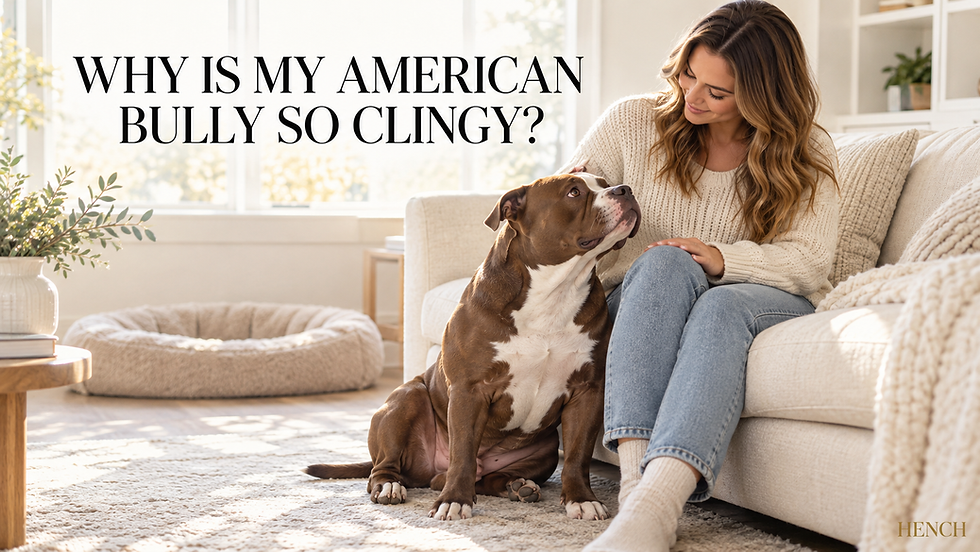
Following you can reflect affection, familiar routines or difficulty coping with separation.
The key question is whether your dog can settle when you are unavailable. Enjoying your company is different from becoming distressed when you leave the room.
Reward relaxed time on their own bed and practise brief, comfortable separations. Give them enjoyable independent activities without suddenly expecting long periods alone.
If dependence develops suddenly, especially alongside changes in appetite, movement or sleep, discuss it with your vet. A change in behaviour can sometimes be associated with discomfort or illness.
13. What should I check before buying an American Bully puppy?
Check legal status first, then health, temperament and upbringing.
Selling or giving away XL Bully type dogs is prohibited. Registration papers or an existing exemption do not make an ordinary sale lawful.
For a puppy that can lawfully be sold, ask to see:
The puppy with their mother.
The environment in which they have been raised.
Relevant parental health-screening results.
Microchip and veterinary records.
Information about feeding and early socialisation.
Look for comfortable breathing, free movement and a breeder who answers questions openly. “Vet checked” is useful information, but it is not equivalent to screening the parents for inherited conditions.
The UKC standard places soundness and welfare ahead of excessive size and mass. Choose a dog whose structure supports a comfortable, active life.
Further Reading and Official Guidance
For legal decisions about an individual dog, use the current guidance for your country:


Comments