


American Bulldog vs American Bully: What's the Real Difference?
- Jul 18
- 9 min read
PowerBreed UK
Quick Answer
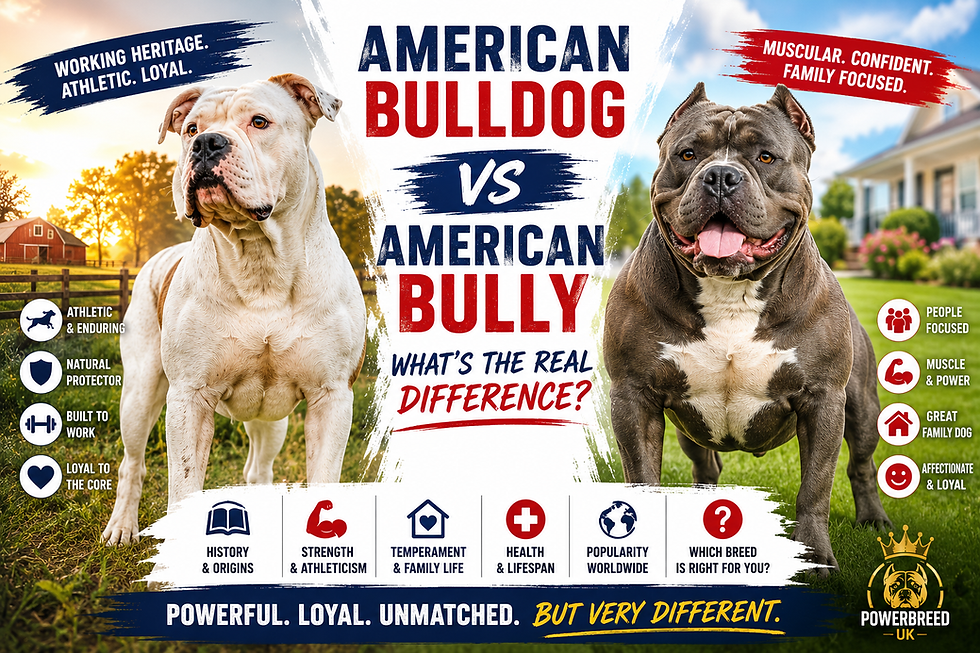
The American Bulldog and American Bully may look similar, but they were developed for different purposes. The American Bulldog is an athletic working breed with deep farming roots, while the American Bully was developed as a confident, muscular companion dog. Both are loyal, powerful breeds, but their history, body structure, exercise needs and personalities are surprisingly different.
Meet the Breeds

Both breeds belong to the wider bull breed family and are known for their muscular build, courage and loyalty. However, they are far from identical.
The American Bulldog was bred to work. It helped farmers manage livestock, guarded homes and hunted wild pigs across the southern United States.
The American Bully is much newer. Breeders wanted a dog with an impressive physique and a stable, affectionate temperament, making it a popular family companion around the world.
Neither breed should be judged by appearance alone. Responsible breeding, early socialisation and good training have a much greater influence on behaviour than looks.
Where Did They Come From?

American Bulldog
The American Bulldog descends from the now-extinct Old English Bulldog, which arrived in America with early settlers.
On farms, these dogs became valued for their versatility. They guarded property, helped control livestock and hunted dangerous feral pigs.
After the Second World War, breeders including John D. Johnson and Alan Scott helped preserve the breed when numbers had fallen dramatically.
Today's American Bulldog still reflects that athletic working heritage.
American Bully
The American Bully was developed in the United States during the 1980s and 1990s.
Rather than producing another working dog, breeders focused on creating a muscular companion with a calm, confident temperament.

The breed quickly gained popularity and today comes in several recognised sizes, including Pocket, Standard, Classic and XL.
Did You Know?
The United Kennel Club (UKC) officially recognised the American Bully in 2013, making it one of the newest recognised bull breeds.
What Dogs Created Each Breed?

American Bulldog
The American Bulldog mainly descends from:
Old English Bulldog
Historic American farm bulldog lines
Unlike many modern breeds, relatively few outside breeds were added during its development.
American Bully
The American Bully was primarily developed from:
American Pit Bull Terrier
American Staffordshire Terrier
Some bloodlines also include:
American Bulldog
English Bulldog
Olde English Bulldogge
This explains why some Bullies appear athletic while others are much heavier and broader.
The Bull Breed Family
Many modern bull breeds share common ancestors.
Old English Bulldog
⬇
English Bulldog
⬇
American Bulldog
American Pit Bull Terrier
⬇
American Staffordshire Terrier
⬇
American Bully
Pocket • Standard • Classic • XL
Other close relatives include the Olde English Bulldogge and Shorty Bull.
Understanding this family tree makes it easier to see why these breeds share similar features while developing very different personalities and abilities.
Size, Weight & Appearance
Although both breeds are muscular, they were built for different jobs.
American Bulldog
• Taller overall
• Longer legs
• Lean, athletic frame
• Deep chest
• Built for movement
American Bully
• Lower to the ground
• Much broader chest
• Heavier muscle mass
• Thick neck and shoulders
• Compact appearance
American Bullies generally appear more heavily muscled, while American Bulldogs usually look more athletic.
Muscle & Body Structure
This is where the breeds begin to separate.
The American Bulldog has longer muscle fibres that support endurance, speed and agility.
The American Bully carries thicker muscle with greater overall volume, giving the breed its distinctive powerful appearance.
Neither build is "better"—they simply reflect different breeding goals.

Which Breed Is Stronger?

This is one of the most searched questions, but there isn't a simple winner.
Strength isn't determined by breed alone. It depends on genetics, breeding, body weight, muscle condition, age, health, training and overall fitness.
The American Bully often appears stronger because of its broad chest, thicker neck and impressive muscle mass.
The American Bulldog, however, was bred to work all day. Its athletic build gives it excellent functional strength, allowing it to run, jump, pull and work for long periods.
If you compare two healthy, well-conditioned dogs of similar size, each will have strengths in different areas.
Overall Comparison
Raw Muscle: American Bully
Athletic Strength: American Bulldog
Endurance: American Bulldog
Explosive Power: Very similar depending on bloodline.
Athletic Ability
Both breeds enjoy being active, but they excel in different activities.
American Bulldog
Usually performs better in:
• Running
• Jumping
• Hiking
• Farm work
• Agility
• Catch work
• Long exercise sessions
American Bully
Often excels in:
• Weight pulling
• Strength-based activities
• Short bursts of power
• Companion sports
• Obedience
Today's American Bully is no longer bred as a traditional working dog, but many still enjoy exercise and structured activities with their owners.
Did You Know?
Some American Bulldogs can comfortably clear obstacles well over their own shoulder height thanks to their longer legs and athletic build.
Bite Force & Jaw Facts

One of the oldest myths surrounding bull breeds is that they have a "locking jaw."
This simply isn't true.
Veterinary anatomy shows there is no special locking mechanism in the jaws of American Bulldogs, American Bullies or any other recognised domestic dog breed.
Both breeds have powerful jaw muscles, but their jaws function just like those of every other dog.
Bite force also varies between individual dogs. Factors such as head size, muscle development and body size influence how much force a dog can produce.
Most importantly, bite force tells us nothing about temperament. A well-bred, well-socialised dog is far more predictable than an unsocialised dog of any breed.
One of the biggest myths surrounding powerful bull breeds is that they have an exceptionally high bite force or a "locking jaw."
The truth is that neither claim is supported by good scientific evidence.
There is no anatomical locking mechanism in the jaw of an American Bulldog, American Bully, Staffordshire Bull Terrier, or any other recognised domestic dog breed.
You'll often see websites claiming these breeds have bite forces of 305 PSI, 330 PSI or even over 400 PSI, but these figures are estimates rather than scientifically verified measurements. At present, there are no widely accepted peer-reviewed studies that establish an exact bite force for either breed.
Based on their head shape and muscle development, many experts believe the bite force of healthy American Bulldogs and American Bullies is likely to fall somewhere around 250–350 PSI, but this should be treated as an informed estimate—not a proven fact.
More importantly, bite force alone tells us very little about a dog's temperament or behaviour. Genetics, breeding, early socialisation, training and responsible ownership have a far greater influence on how any dog behaves than an estimated PSI figure.
Temperament & Personality
Although both breeds are loyal, they were developed with different goals in mind.
American Bulldog
Often described as:
• Brave
• Protective
• Confident
• Athletic
• Loyal to family
Many retain natural guarding instincts and enjoy having a purpose.
American Bully
Typically known for being:
• Friendly
• Affectionate
• Calm
• Outgoing
• People-focused
A well-bred American Bully is usually happiest when spending time with its family.
Neither breed should display unprovoked aggression. Responsible breeding and early socialisation remain essential.
Family Life & Children

Both breeds can make excellent family companions when raised responsibly.
The American Bully was specifically developed to be a companion dog, which is one reason it has become so popular with families.
American Bulldogs also form incredibly strong bonds but may naturally be more watchful of unfamiliar people due to their working background.
As with every breed, children should always be supervised around dogs, and dogs should be taught appropriate behaviour from an early age.

XL Bully in the UK
It is important not to confuse the American Bully with the XL Bully.
Since 31 December 2023, it has been illegal to breed, sell, advertise, exchange, abandon or give away XL Bullies in England and Wales. From 1 February 2024, owning an XL Bully without a valid Certificate of Exemption also became illegal.
These restrictions do not apply to recognised American Bully types that do not meet the UK Government's XL Bully definition. The American Bulldog is also not included in the XL Bully ban.
Always check the latest Government guidance, as legislation may change and rules can differ between England, Wales, Scotland and Northern Ireland.
Intelligence & Trainability

Both breeds are intelligent and learn quickly, but they don't always learn for the same reasons.
American Bulldogs tend to be independent thinkers. They enjoy solving problems but benefit from consistent leadership.
American Bullies generally enjoy pleasing their owners and often respond exceptionally well to reward-based training.
Keep training sessions short, fun and positive. Building trust almost always produces better results than punishment.
Interesting Fact
Many owners describe both breeds as "oversized lap dogs." Despite their muscular appearance, they often want nothing more than to curl up beside their favourite person on the sofa.
Exercise & Daily Needs
Although both breeds enjoy being active, their exercise needs are slightly different.
The American Bulldog thrives on both physical exercise and mental stimulation. Long walks, hiking, obedience training and structured games help keep this intelligent working breed happy.
The American Bully generally requires moderate daily exercise. Walks, play sessions and training are usually enough to keep a healthy Bully fit, although many individuals also enjoy activities such as weight pull, flirt poles and obedience sports.
Whichever breed you choose, avoid over-exercising growing puppies, as their joints are still developing.
Health & Lifespan
Both breeds are generally healthy when responsibly bred, but neither is free from inherited conditions.
American Bulldog
May be predisposed to:
• Hip dysplasia
• Elbow dysplasia
• Cruciate ligament injuries
• Skin allergies
• Entropion (eyelid problems)
Average lifespan: 10–13 years
American Bully
May be predisposed to:
• Hip and elbow dysplasia
• Skin allergies
• Heart disease in some bloodlines
• Joint problems
• Obesity if under-exercised
Average lifespan: 10–13 years, although many healthy dogs live longer.
Choosing a reputable breeder who health tests their dogs is one of the best ways to improve the chances of owning a healthy puppy.
Which Countries Love Them Most?

Both breeds now have enthusiastic owners around the world.
American Bully
The biggest communities can be found in:
• United States
• United Kingdom
• France
• Brazil
• Philippines
• Mexico
The breed has become especially popular on social media because of its muscular appearance and friendly nature.
American Bulldog
Most popular in:
• United States
• United Kingdom
• Australia
• Germany
• Sweden
• Netherlands
Many owners are attracted to the breed's athleticism and working heritage.
Amazing Facts You Probably Didn't Know
• The American Bulldog almost disappeared after World War II before dedicated breeders helped save it.
• American Bullies are one of the newest recognised bull breeds.
• Some American Bulldogs are capable of jumping surprisingly high for dogs of their size.
• American Bullies come in several recognised sizes, but all should share the same confident, friendly temperament.
• Despite their appearance, many owners describe both breeds as affectionate "shadow dogs" that simply want to stay close to their family.
Common Myths & Misunderstandings
"They're aggressive."
False.
Behaviour is influenced far more by breeding, early socialisation, training and responsible ownership than by breed alone.
"They have locking jaws."
False.
There is no anatomical locking mechanism in the jaw of any recognised domestic dog breed.
"Bigger muscles mean a stronger dog."
Not always.
Athletic ability depends on conditioning, endurance, coordination and genetics—not just muscle size.
Muscle, Recovery & Daily Support

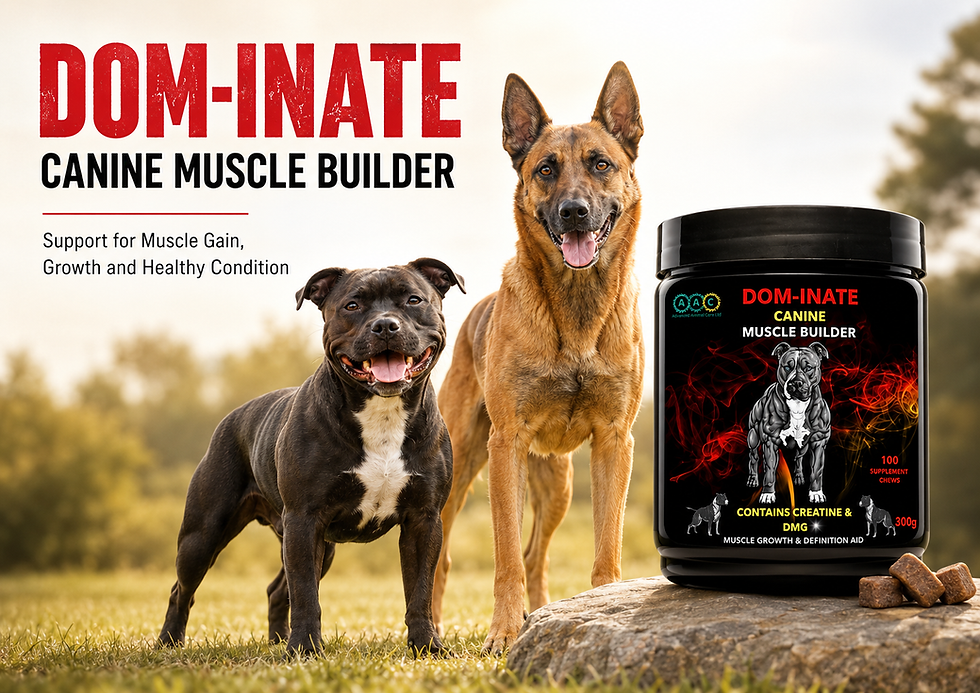
Whether you own an American Bulldog or an American Bully, maintaining healthy muscle condition becomes increasingly important throughout life.
A complete, balanced diet should always come first, supported by regular exercise, good hydration and adequate rest.
For owners looking to support active or ageing dogs, complementary feeds can provide additional nutritional support alongside a balanced diet.
MuscleMatrix is designed to support lean muscle maintenance, recovery and everyday activity.
Ideal for:
• Active family dogs
• Working dogs
• Sporting dogs
• Dogs returning to exercise
Its combination of quality proteins, amino acids and supportive nutrients helps maintain normal muscle function as part of a healthy lifestyle.
Always introduce new supplements gradually. Start with around half the recommended amount before increasing if appropriate.
Empower Maximum Muscle

For dogs needing everyday nutritional support for muscle condition and activity, Empower Maximum Muscle provides a convenient daily complementary feed containing amino acids together with vitamins and minerals to support normal muscle maintenance.
Suitable for:
• Active dogs
• Working dogs
• Sporting dogs
• Show dogs
• Senior dogs maintaining condition
As with any new supplement, start with around half the recommended amount for a few days before increasing if appropriate.
Premium Collars & Leads
Every powerful dog deserves equipment that's built to last.
Our handcrafted Hench Wear collars and lead sets are made using premium full-grain buffalo leather with vegetable-tanned leather, quality solid fittings and limited-edition designs.
✔ Family-run business
✔ Zero-waste manufacturing
✔ Handcrafted quality
✔ Premium materials
✔ Built for comfort and durability
Whether you're heading to the show ring or simply enjoy quality craftsmanship, every set is made with care and attention to detail
.

Which Breed Is Right for You?
Choose the American Bulldog if you want:
• An athletic, energetic dog
• A working companion
• Longer walks and outdoor adventures
• A dog that enjoys having a job
Choose the American Bully if you want:
• A muscular companion
• A people-focused family dog
• A calmer household companion
• A breed that enjoys relaxing with its family
as much as exercising
Neither breed is better than the other. The right choice depends on your lifestyle, experience and the time you can dedicate to training and exercise.
Final Verdict
Although they share common ancestors, the American Bulldog and American Bully have followed very different paths.
The American Bulldog remains closer to its working roots, combining strength with impressive athletic ability and endurance.
The American Bully has become one of the world's most recognisable companion breeds, admired for its muscular build, confidence and affectionate nature.
Whichever breed you choose, responsible breeding, early socialisation, appropriate training and lifelong care will have the greatest influence on the dog you bring home.
Key Takeaways
✔ Both breeds share historic bulldog ancestry but were developed for different purposes.
✔ American Bulldogs are generally more athletic and endurance-focused.
✔ American Bullies are typically more heavily muscled and companion-oriented.
✔ Neither breed has a "locking jaw."
✔ Genetics, training, health and muscle condition influence strength far more than breed alone.
✔ With responsible ownership, both can make loyal, loving family companions.
Comments