


Buying a Staffy Puppy: Health Tests, Breeders and Surviving Those Little Teeth

A Staffordshire Bull Terrier puppy can steal your heart in seconds. The expressive face, affectionate nature and enormous personality are hard to resist.
Then they discover your slippers, the sofa and the charging cable you thought was safely hidden.
Staffy puppies can be wonderfully loving and remarkably boisterous. Choosing a responsible breeder, checking health results and preparing for puppy life will help you give yours the best possible start.
🏡 Find a Breeder Who Knows and Cares About the Breed

Established Staffordshire Bull Terrier breed clubs are a useful starting point when looking for a puppy. Speak to knowledgeable breeders, ask questions and take your time.
A responsible breeder should explain why they chose the parents, discuss health and temperament, and ask about your home and lifestyle. They should care about where their puppy will live and remain available for advice after collection.
Always see the puppy with their mother in the environment where the litter has been raised. Watch how they interact and look for clean, comfortable surroundings.
Walk away from pressure selling, car-park handovers or excuses that prevent you seeing the mother.
The father may live elsewhere because breeders often use a stud dog belonging to someone else. Ask for his registered name, pedigree, health results and information about his temperament. Meet him if practical, but his absence alone is not a warning sign.
Look for parents who move comfortably, breathe easily and have sound temperaments. Health and welfare should come before colour, fashionable pedigrees or an impressive head.
🧬 Health-Tested Parents: What Should You Check?

“Vet checked” is not the same as “health tested”. A routine examination cannot replace DNA testing or specialist screening.
For Staffordshire Bull Terriers, ask to see evidence of:
L-2-HGA DNA testing: for an inherited condition affecting the nervous system.
HC-HSF4-2 DNA testing: for a particular inherited form of hereditary cataracts.
Clinical eye screening under the BVA/KC/ISDS Eye Scheme: including appropriate litter screening.
Ask specifically about puppy eye screening for PHPV — persistent hyperplastic primary vitreous.
An HC DNA result does not replace a clinical eye examination or exclude every eye condition. Check certificates and verify recorded results through the Royal Kennel Club’s health-results tools.
Do Both Parents Have to Be DNA Clear?
For L-2-HGA and HC-HSF4-2, a properly planned clear-to-carrier mating can produce puppies unaffected by that particular condition, although some may be carriers.
Both parents do not necessarily have to be clear. The combination must avoid producing affected puppies for the condition concerned, and the breeder should explain the results clearly.
Ask for the dogs’ own test certificates or verified evidence supporting hereditary-clear status. A reassuring phrase in an advert is not enough.
Health testing reduces specific risks. It cannot guarantee that a puppy will never develop a health problem.
Ask About Breathing Health Too
The Royal Kennel Club and University of Cambridge Respiratory Function Grading Scheme expanded to include Staffordshire Bull Terriers in 2026.
Ask whether the parents have been assessed and discuss their breathing and exercise tolerance.
Noisy or difficult breathing should not simply be dismissed as normal for the breed. This assessment concerns breathing function and is separate from the DNA and eye tests above.
🐾 Little stars. Show-ring standouts.
Hench Wear Staffordshire Bull Terrier show collar & lead sets available for puppies and adults.
Handcrafted from full-grain, vegetable-tanned buffalo leather, with quality solid brass fittings and the iconic Stafford knot.
✨ Choose by neck measurement for the correct fit. 📦 Free UK shipping.
Find their perfect set at advancedanimalcare.shop
📋 Check the Pedigree and Genetic Diversity

A pedigree records ancestry. It helps you identify the parents and investigate family history, but registration alone does not prove responsible breeding.
Ask about health and temperament within the family, repeated ancestors and the reasons behind the mating.
Where available, discuss the litter’s coefficient of inbreeding, or COI, using the Royal Kennel Club’s calculator. This estimates how closely related the parents are from recorded ancestry.
The result depends on the pedigree information available. It should be considered alongside health, temperament and other breeding factors, rather than treated as a guarantee.
If you hope to show your puppy, tell the breeder before choosing. Ask about registration endorsements and their assessment of the litter.
Nobody can guarantee that a young puppy will become a champion.
🐶 What Should Come Home With Your Puppy?

Before collection, confirm you will receive:
A written contract and receipt.
Registration and pedigree documents, where applicable.
Relevant health-test and eye-screening records.
Microchip details and transfer instructions.
Vaccination and worming records.
A feeding sheet and some familiar food.
Puppies should normally remain with their mother and litter until at least eight weeks old.
Update the microchip database promptly after bringing your puppy home. Check that your name, address and telephone number are recorded correctly.
Transferring pedigree registration does not automatically update the microchip database.
🦈 Staffy Puppy Biting: Prepare for the Little Land Shark

Some Staffy puppies are gentle souls. Others appear determined to remove your socks while you are still wearing them.
Mouthing, grabbing clothing and chewing are common puppy behaviours. Puppies explore with their mouths, and teething, excitement and tiredness can increase the biting.
Keep suitable toys nearby and redirect your puppy towards them. Reward calmer play. If teeth reach skin or clothing, calmly pause the interaction instead of turning it into a wrestling match.
Avoid smacking, shouting or holding the puppy’s mouth shut. These responses can frighten them or make the interaction more exciting.
When your puppy becomes increasingly frantic, consider whether they need sleep. Overtired puppies often mouth more; extra play is not always the answer.
Build quiet rest periods into the day and give your puppy somewhere to sleep undisturbed.
Supervise children closely. If biting causes repeated injuries, happens around handling or guarding, or seems associated with pain or fear, seek veterinary and qualified behavioural advice.
🔌 Protect Your Puppy — and Your Home

A Staffy puppy does not know the difference between a chew toy and an electrical wire.
Before they arrive, remove or securely protect cables. Put medicines, cleaning products, batteries, rubbish and small objects out of reach.
Check the garden for escape gaps and dangerous items.
Shoes, remote controls and cushions are best kept beyond reach until your puppy has learned better habits. Prevention is easier than trying to retrieve something dangerous from an excited youngster.
Do not assume a puppy who behaved yesterday can safely have the whole house today.
🛏️ Crate or Puppy-Pen Training for Time Alone

A suitable crate, sturdy puppy pen or puppy-proof room can help keep your youngster safe when you cannot supervise.
Introduce the space positively before you need to leave home.
Let your puppy explore voluntarily, reward relaxed behaviour and begin with very brief periods while you remain nearby.
Gradually practise stepping away for seconds, returning before your puppy becomes worried. Increase the difficulty only while they remain comfortable.
Provide water, suitable bedding and enough room to stand, turn and stretch out. Choose an enclosure your puppy cannot climb, tip over or chew apart.
Remove collars or harnesses where they could catch on the enclosure.
A crate is a resting space, not punishment or a solution for a full working day. Young puppies need frequent toilet breaks, interaction and supervision. Arrange help for longer absences.
If your puppy panics or repeatedly becomes distressed, slow down and seek advice. Leaving them to struggle does not teach comfortable independence.
🦷 Plenty to Chew — but Choose Carefully
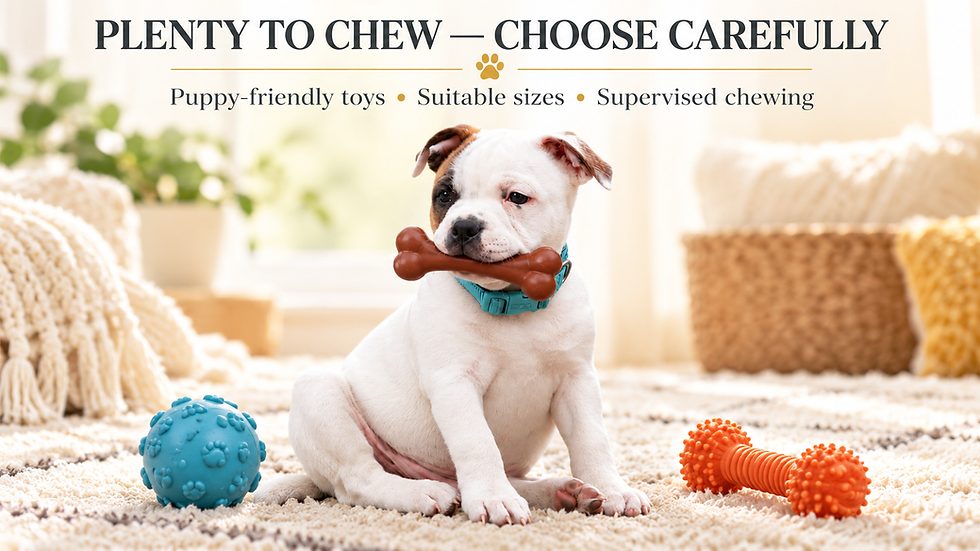
Offer several puppy-appropriate chew toys with different suitable textures. Rubber puppy toys and correctly sized food toys can provide useful outlets for chewing.
Inspect everything regularly. Remove items that split, fray or develop pieces your puppy could swallow.
Rawhide is worth avoiding, especially for puppies who tear off and gulp down chunks.
Pig’s ears are not automatically safer: large swallowed pieces can also cause blockages. Follow age guidance and supervise edible chews.
Real bones, raw or cooked, can fracture teeth, cause obstruction or injure the digestive tract. They are not a risk-free option for teething puppies.
If you prefer simple ingredients, choose clearly labelled products. However, a long ingredient list does not automatically make a dental chew harmful, and “natural” does not automatically mean safe.
Assess its size, hardness, age suitability and how your puppy chews it.
Begin gentle toothbrushing with dog toothpaste as your puppy becomes comfortable with mouth handling.
🍽️ Feeding a Staffy Puppy: Complete Nutrition Comes First

A growing puppy needs a complete diet formulated for puppy growth, with the correct balance of energy, protein, vitamins and minerals.
Continue the breeder’s food initially. Make any changes gradually, divide the daily allowance into several small meals and adjust portions as your puppy grows.
Aim for a healthy body condition rather than trying to make your youngster look heavily built.
Growth should be steady, not rushed.
What About Raw Feeding?
Some owners choose raw food for their Staffies, but evidence has not established that it is better for the breed.
If you choose raw, discuss it with your vet and select a reputable commercially prepared diet labelled complete and suitable for puppies or growth.
A varied mixture of meat, organs and bones does not automatically provide balanced nutrition. Variety alone cannot ensure the correct calcium, phosphorus or vitamin levels.
Raw food carries infection risks, so follow storage instructions and clean equipment, bowls and surfaces carefully. Extra caution is needed around young children and people vulnerable to infection.
Avoid adding calcium, vitamins or muscle-building products to a complete puppy diet without veterinary advice.
🌿 Exercise: Let Them Grow Before Asking for More

A lively Staffy puppy may seem ready for anything, but their growing body still needs sensible limits.
Provide gentle exploration, short play sessions, sniffing and brief training. Once your vet confirms public walks are appropriate, introduce them gradually.
Avoid forced long-distance walks, running beside a bicycle, repeated high jumps and relentless ball chasing.
Give your puppy opportunities to stop and rest.
The familiar “five minutes per month of age” rule is not a scientifically established exercise allowance. Appropriate activity depends on the individual puppy and the type of exercise, rather than simply the stopwatch.
🩺 Vaccinations, Worming and Your First Vet Visit
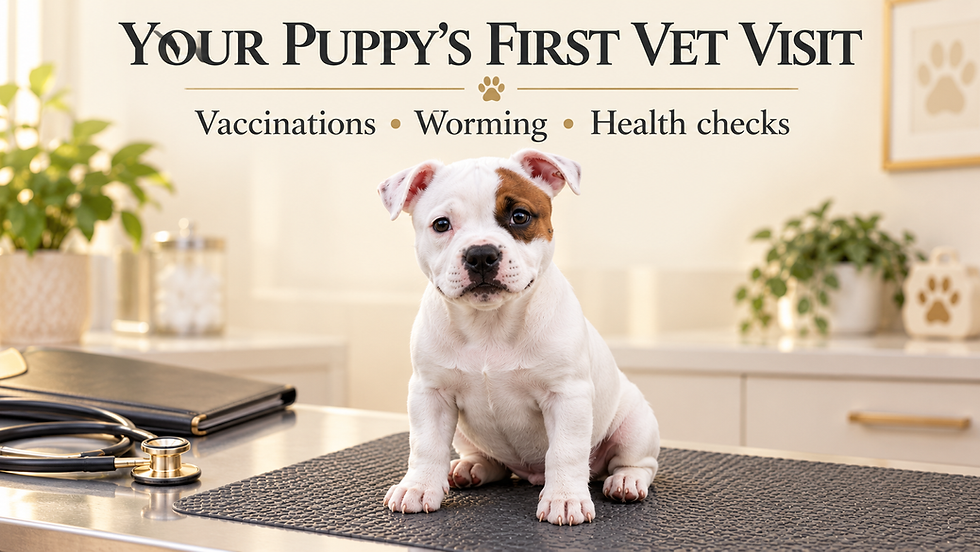
Register with a vet before collection and arrange an early health examination.
Take the vaccination record so your vet can confirm what has been given, which doses remain due and when your puppy can safely walk on public ground.
Timing varies with age, vaccine and circumstances. One injection should not be assumed to provide full protection.
Bring the worming record too, including product names, dates and doses.
Your vet can set a plan based on age, current weight and exposure risks, including discussion of fleas, ticks and lungworm.
Products do not all cover the same parasites. Weigh your puppy regularly so treatment remains appropriate as they grow.
🛡️ Arrange Insurance Before Problems Arise
Consider insurance early and read the terms carefully.
Compare:
Annual vet-fee limits.
Excesses and any additional contributions.
Waiting periods and exclusions.
Cover for continuing conditions.
Lifetime cover can help with ongoing problems when renewed, subject to the policy’s terms.
Pre-existing conditions are commonly excluded. Routine vaccinations, worming and flea treatment are usually separate expenses, so budget for these alongside insurance.
🎓 Build Confidence and Everyday Manners

Socialisation means helping your puppy feel comfortable with the world. It does not mean meeting every person or playing with every dog.
Introduce people, sounds, surfaces, travel and gentle handling in manageable steps.
Before public walks are safe, ask your vet about suitable carried outings and low-risk experiences.
Reward your puppy for responding to their name, coming when called, releasing objects and settling quietly.
Keep training sessions short, kind and enjoyable.
Staffies vary in their feelings about other dogs, and some become more selective as they mature. Good puppy socialisation helps, but it cannot promise an adult who enjoys every dog.
Continue rewarding calm behaviour and respect your dog’s individual comfort level.
For toilet training, take your puppy out after waking, eating and playing, as well as regularly throughout the day. Reward success immediately and clean accidents without punishment.
❤️ A Little Preparation Makes a Big Difference

Your Staffy puppy may test your patience, rearrange your possessions and decide that your lap belongs to them.
They need more than toys and cuddles: they need carefully checked breeding, complete nutrition, proper healthcare, safe surroundings and patient guidance.
Give them time to learn, time to rest and plenty of opportunities to get things right.
That wonderfully cheeky youngster is growing into the companion who will share your home—and your heart—for years to come.


Comments