


DogSense #25 Why Does My Puppy Keep Getting Hiccups? What’s Normal and When to Worry

Your puppy has finally stopped charging around, settled beside you and started making little rhythmic “hic” sounds.
Their tummy twitches. Their whole body gives a tiny bounce. They look mildly surprised.
Should you be worried?
Short bouts of hiccups are common in puppies and usually stop without treatment. If your puppy remains comfortable, breathes normally and carries on eating, playing and resting as usual, an occasional episode is generally nothing to panic about.
Here is what causes those little hiccups, what may help and when to contact your vet.
What Actually Causes Puppy Hiccups?

Hiccups begin with an involuntary contraction of the diaphragm, the muscle beneath the lungs that helps your puppy breathe.
A sudden closure between the vocal cords creates the familiar “hic” sound. You may notice a small, repeated movement through the chest or tummy.
It is much the same process that gives people hiccups—although puppies tend to make it look considerably cuter.

Why Do Puppies Get Them So Often?

Puppies experience hiccups more often than adult dogs, but scientists do not fully understand why.
Several things may trigger an episode:
Eating quickly: gulping food can mean swallowing extra air.
Drinking quickly: enthusiastic drinking may also involve taking in air.
Excitement: busy play and changes in breathing can precede hiccups.
Stress: an unfamiliar or unsettling experience may be another trigger.
Sometimes there is no obvious reason at all.
Notice when episodes happen. If they regularly follow a rushed meal, for example, that gives you something practical to change.
Are Hiccups a Sign My Puppy Is Growing?

You may have heard that hiccups mean a puppy is having a growth spurt.
Hiccups are not a reliable way to judge growth, health or how big your puppy will become. They are common during puppyhood, but they do not tell you whether your dog needs more food or extra supplements.
Keep following an appropriate puppy-feeding plan and monitor growth and body condition with your veterinary team.
What Should I Do When My Puppy Has Hiccups?

Usually, very little.
Let your puppy relax somewhere comfortable and allow the episode to pass. Most short bouts resolve by themselves.
If your puppy tends to gulp food, consider a suitably sized, puppy-safe slow feeder. Supervise its use and make sure it helps rather than causes frustration.
Keep fresh water available, but let your puppy drink voluntarily.
Do not frighten your puppy, force water into their mouth or give human hiccup remedies. Ordinary hiccups do not need medicines or supplements.
Is It Definitely Hiccups?
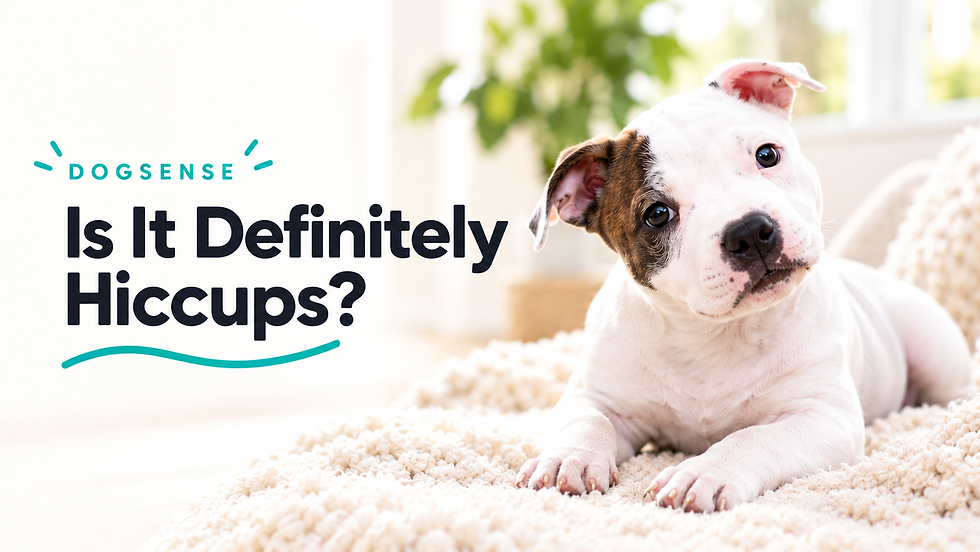
Hiccups usually produce small, fairly regular movements, sometimes with a soft “hic” sound.
Coughing, gagging, retching and noisy breathing can look or sound different—and should not automatically be dismissed as hiccups
If you are unsure, take a short video to show your vet. Capturing what happens can be more useful than trying to describe an unfamiliar sound afterwards.
Do not delay getting help to make a recording if your puppy is struggling to breathe.
When Should I Contact the Vet?

Speak to your vet if:
An episode continues for a few hours.
Episodes become unusually frequent or interfere with eating, sleeping or normal activity.
Your puppy seems uncomfortable, distressed or in pain.
There is coughing, wheezing, nasal discharge, vomiting or regurgitation.
Your puppy loses their appetite or seems otherwise unwell.
Difficult breathing, collapse or pale or blue gums require urgent veterinary attention. Do not wait for the hiccups to stop.
Will My Puppy Grow Out of Hiccups?

Hiccups generally become less common as dogs mature, although adult dogs can still get them.
For a comfortable puppy having a brief episode, the best response is usually to stay calm and let it pass.
Those tiny hiccups are often just another curious part of puppy life—alongside enormous enthusiasm, badly timed zoomies and believing every slipper belongs to them.


Comments