


Breed Spotlight: Peruvian Hairless Dog (UK) — Ancient, Athletic and Unmistakable

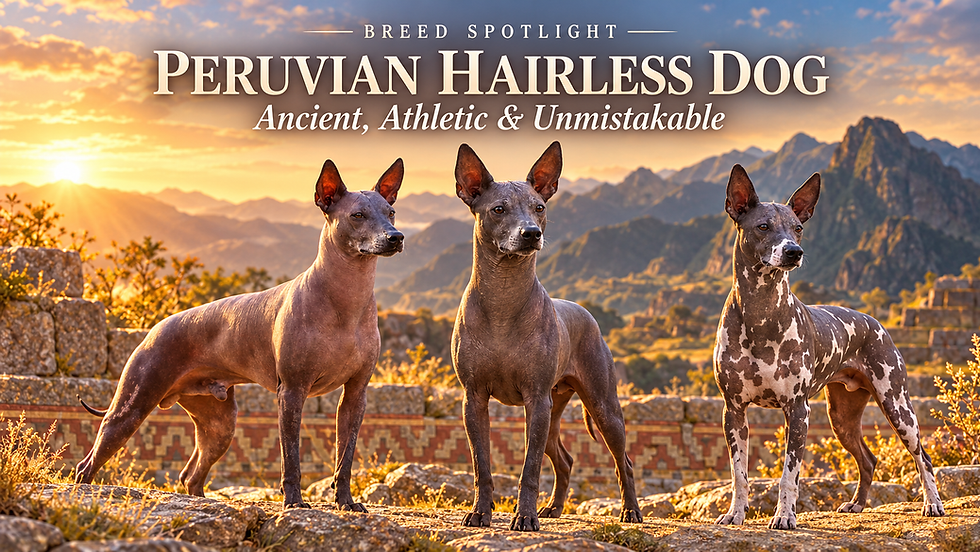
Warm, satiny skin, watchful almond-shaped eyes and ears that rise sharply when something catches their attention—the Peruvian Hairless Dog looks unlike almost any other breed.
Yet this is not a recent novelty. Images of similar hairless dogs appear on ceramics created centuries before the Inca Empire. Today’s dogs carry that extraordinary heritage into modern homes.
Also known internationally as the Peruvian Inca Orchid, its official FCI name is Perro Sin Pelo del Perú: the Peruvian Hairless Dog.

An Ancient Dog Preserved in Clay
Representations of hairless dogs appear in the ceramics of several pre-Inca cultures, including the Vicús, Moche, Chancay and Chimú.
The official FCI history places these depictions between approximately 300 BC and AD 1460. In some ancient artwork, the hairless dog even appears in place of animals such as the puma, snake or hawk, with particularly strong representation in the Chancay culture.
These dogs were far more than decorative subjects. They lived alongside people and became woven into Peru’s cultural identity.
The FCI officially recognised the breed as native to Peru in 1985. In 2001, the Peruvian Hairless Dog was declared part of Peru’s national cultural heritage.
Local names include:
Viringo
Perro calato
Perro peruano sin pelo
Peruvian Hairless Dog
Peruvian Inca Orchid

A Living Hot-Water Bottle?
The skin of a hairless dog often feels remarkably warm beneath the hand. This led to traditional beliefs that the dogs could provide comforting warmth when held against the body.
However, they do not have a naturally higher internal temperature than coated dogs. The official breed standard states that their temperature is the same as that of other breeds.
They feel warmer because there is no coat between your hand and the heat leaving the skin.
Historical claims that these dogs could treat pain or illness should be understood as cultural tradition—not modern veterinary evidence.

Hairless and Coated Varieties
Not every Peruvian Hairless Dog is hairless.
The recognised breed has two varieties:
The hairless variety
The coated variety

Hairless dogs may retain a small amount of hair on the head, feet and tail. A sparse line of hair along the back can also occur.
Their skin may be:
Black
Slate
Grey
Bronze
Copper
Dark brown
Light brown or blond
Limited paler or unpigmented areas may be present, although the FCI standard prefers these not to cover more than 20% of the body.
The coated variety has a smooth, short and close-fitting coat. Many colours and combinations are accepted, but merle is not permitted under the current FCI standard.
Why Are Coated Puppies Born?
The hairless characteristic is associated with a variant of the FOXI3 gene, which is involved in the development of hair and teeth.
Living hairless dogs carry one copy of this variant. Coated puppies do not carry the hairless form and can be born in the same litter.
This helps explain two important features of the breed:
Hairless and coated puppies can have the same parents.
Missing or unusually shaped teeth are more common in the hairless variety.

Scientific research has connected the FOXI3 variant with both reduced hair and characteristic dental differences.
Coated dogs are not inferior versions of the breed. They contribute valuable genetic diversity and are officially recognised within the current FCI standard.
Three Very Different Sizes
The Peruvian Hairless Dog is recognised in three sizes.
Small
Height: 25–40 cm
Weight: approximately 4–8 kg
Medium
Height: 41–50 cm
Weight: approximately 8–12 kg
Large
Height: 51–65 cm
Weight: approximately 12–30 kg

A small and a large Peruvian Hairless Dog may therefore look dramatically different while sharing the same distinctive outline and breed characteristics.
Elegant Does Not Mean Fragile
The breed’s clean lines and exposed skin can create the impression of a delicate ornamental dog. That should not be confused with weakness.
The official standard describes an elegant, slim dog whose body expresses speed, strength and harmony without appearing coarse.
The body is approximately square, with the height at the withers broadly matching its length. Females may be slightly longer.

Typical physical characteristics include:
A lean but muscular body
A strong loin
Well-developed back muscles
Rounded, elastic hindquarter muscles
A defined waist
A well-tucked abdomen
Long, hare-like feet
Smooth and flexible movement
A complete, tapering tail

The hindquarters provide useful propulsion, while the flexible movement reflects an animal built for speed and agility rather than exaggerated bulk.
When a Peruvian Hairless Dog moves well, it should look light, balanced and purposeful.
An Alert and Expressive Head
The head tapers towards the nose, with a straight muzzle and tight lips.
The eyes are slightly almond-shaped and should carry an alert, intelligent expression. Their colour can range from very dark through different shades of brown to yellow, depending on the dog’s skin or coat colour.

The ears are particularly expressive. They stand upright when the dog is attentive but may lie backwards when the dog is resting.
The FCI standard requires natural ears and a complete tail. Cropped ears and docked or shortened tails are disqualifying faults.
What Is Their Temperament Like?
A well-raised Peruvian Hairless Dog is often affectionate, observant and closely attached to its family.
The FCI standard describes the breed as:
Noble and affectionate at home
Lively
Alert
Potentially wary of strangers
A capable watchdog
Reserve should not be confused with aggression. These dogs may prefer to assess unfamiliar people before seeking contact.
Early socialisation should be calm and positive. Puppies can be introduced gradually to:
Different people
Friendly, suitable dogs
Household sounds
Traffic
Veterinary handling
Grooming and skin checks
Different surfaces
Short periods alone

Socialisation is not about forcing a puppy to interact. It is about helping the dog feel safe and capable in the world around it.
Athletic Ability and Exercise
This is not a dog that should spend its life being admired from the sofa.
Peruvian Hairless Dogs can be quick, agile and energetic. Some individuals also have a strong instinct to notice and chase movement, so secure exercise areas and a reliable recall are important.
Most healthy adults benefit from:
Daily walks
Opportunities to sniff and explore
Short, positive training sessions
Secure areas for free movement
Scent games
Puzzle activities
Suitable canine sports
Warm, comfortable rest afterwards
Exercise should match the dog’s age, health, size and individual temperament.
A smaller size does not automatically mean lower exercise needs. Equally, a large garden does not replace walks, training or companionship.

Training a Peruvian Hairless Dog
These dogs are intelligent and observant. They often notice tiny changes in posture, tone and routine.
Use:
Short, consistent cues
Reward-based training
Calm repetition
Clear household rules
High-value rewards
Short sessions that end positively
Harsh correction may damage trust and make a naturally sensitive or reserved dog less confident.
Everyone in the household should use the same cues whenever possible.
Special Care for Hairless Skin
Hairless does not mean maintenance-free.
Without a protective coat, the skin is directly exposed to sunlight, cold weather, abrasive surfaces, vegetation and poorly fitted clothing.
Owners may need to:
Limit exposure during strong sunshine
Ask their vet about suitable dog-safe sun protection
Provide an appropriately fitted coat during cold weather
Use soft, clean bedding
Check the skin after walks
Dry the dog gently after rain
Wash clothing and bedding regularly
Monitor areas beneath collars and harnesses
Avoid harsh or heavily fragranced products

Do not automatically use human sun cream, moisturiser or acne treatment. Some ingredients may irritate the skin or be unsafe when licked.
Persistent spots, sores, itching, cracking, swelling, discharge or changes in pigmentation should be assessed by a vet.
Dental Differences
The same genetic change associated with hairlessness can affect tooth development.
Hairless dogs may have missing or differently shaped teeth, particularly premolars and sometimes other permanent teeth. The FCI accepts missing teeth in the hairless variety.
The coated variety is expected to have normally developed, complete dentition.
Owners should introduce gentle dental care early and arrange regular veterinary checks.
Seek veterinary advice if the dog develops:
Difficulty eating
Bleeding gums
Facial swelling
Loose teeth
Persistent bad breath
Sudden reluctance to chew

Dental differences may be associated with the breed, but pain and infection should never be dismissed as normal.
Living in the UK
Peruvian Hairless Dogs can live successfully in Britain, but our cool, wet and rapidly changing weather requires planning.
A hairless dog may need:
A warm, well-fitted coat
Shorter outings during severe cold
Thorough but gentle drying after rain
Warm bedding away from draughts
Shade and sun protection during hot weather
Regular checks for rubbing beneath clothing
Dog clothing should allow free movement and should not press into the armpits, chest or shoulders.
It should also be removed and washed regularly rather than left continuously against the skin.
Are They Hypoallergenic?
No dog can be guaranteed to be hypoallergenic.
A hairless dog may release less loose coat around the home, but people can react to proteins found in saliva, skin particles and urine—not simply to hair.
Anyone with significant allergies should spend time around adult examples of the breed before committing to ownership.

Could One Suit Your Home?
The Peruvian Hairless Dog may suit someone looking for an intelligent, athletic and exceptionally distinctive companion.
The right owner should be prepared to provide:
Patient socialisation
Consistent, positive training
Daily mental and physical activity
Protection from cold and strong sunlight
Routine skin and dental care
Companionship
Secure boundaries
Appropriate veterinary support
Some small or medium dogs may adapt well to a smaller home if their exercise and training needs are met. A large dog will naturally require more physical space, but size alone does not determine whether an individual will settle successfully.
This is a breed for someone who appreciates its temperament, history and care requirements—not simply its unusual appearance.
Finding a Responsible Breeder
The Peruvian Hairless Dog remains uncommon in the UK, so prospective owners may need to wait for a carefully planned litter.
A responsible breeder should discuss:
The parents’ health and temperament
Whether each puppy is hairless or coated
Dental development
Skin care
Early socialisation
Registration and pedigree documentation
Relevant health screening
Support throughout the dog’s life
Return arrangements if the owner can no longer keep the dog
Meet the mother with her puppies where they were raised.
Avoid sellers who:
Refuse visits
Offer immediate collection without questions
Always have several breeds available
Describe the dog as maintenance-free
Guarantee that it cannot trigger allergies
Cannot explain the hairless and coated varieties
Provide no evidence of the puppy’s origin
Importing a puppy introduces additional welfare, documentation and travel considerations. Check current UK government rules before purchasing a dog from overseas.
A Living Piece of History
The Peruvian Hairless Dog is far more than a dog without a coat.
Behind its remarkable appearance is a lean, capable athlete with watchful intelligence, strong family attachments and a history preserved in pre-Inca ceramics.
Its skin may feel almost hot beneath the hand. Its ears rise sharply when something moves. Its elegant body can change from quiet stillness to sudden speed in a moment.
For a committed owner prepared to provide careful skin protection, dental monitoring, positive training and suitable exercise, this ancient Peruvian breed can be an unforgettable companion.
It deserves to be valued as a living part of Peru’s history—not treated as a novelty.
This article provides general information for UK dog owners and does not replace veterinary advice, diagnosis or treatment.
Support Strength, Energy and Everyday Condition
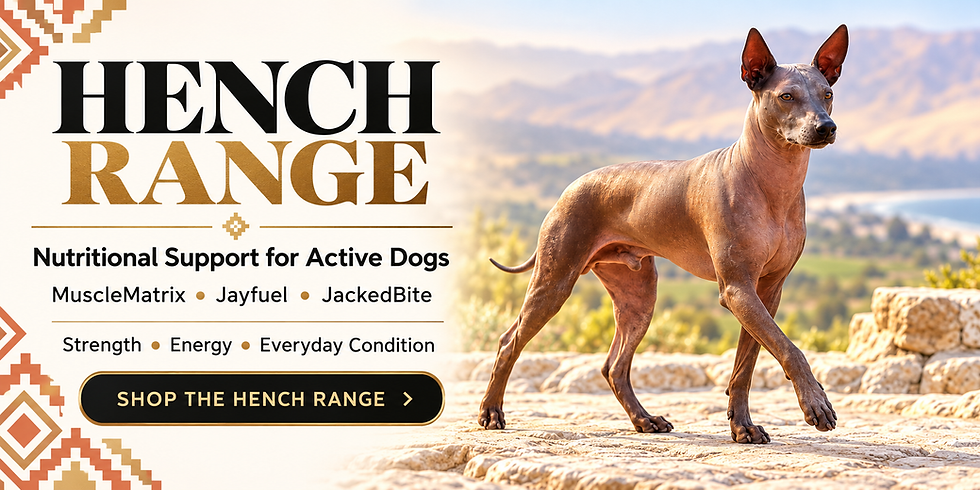
Peruvian Hairless Dogs may look refined, but beneath that elegant outline is an athletic, active breed. The Hench Range provides carefully selected nutritional support for dogs with different lifestyles and conditioning goals.

MuscleMatrix — advanced nutritional support for maintaining muscle condition, strength and performance.
Jayfuel — convenient high-protein chews with probiotics, enzymes, omega fatty acids, amino acids, vitamins and minerals.
JackedBite Training Chews — 35% protein chews containing BCAAs, taurine, omega fatty acids, vitamins and minerals for active and training routines.

Premium complementary-feed support for active, working, sporting and show dogs.
Shop the Hench Range Dog Supplements

Information checked against:
FCI Standard No. 310: Peruvian Hairless Dog
Scientific Reports: FOXI3 and dental development in hairless dogs
Peruvian Ministry of Culture: Peruvian Hairless Dog


Comments