


Power Breed Spotlight: American Bulldog (UK) — Powerful, Athletic and Deeply Devoted
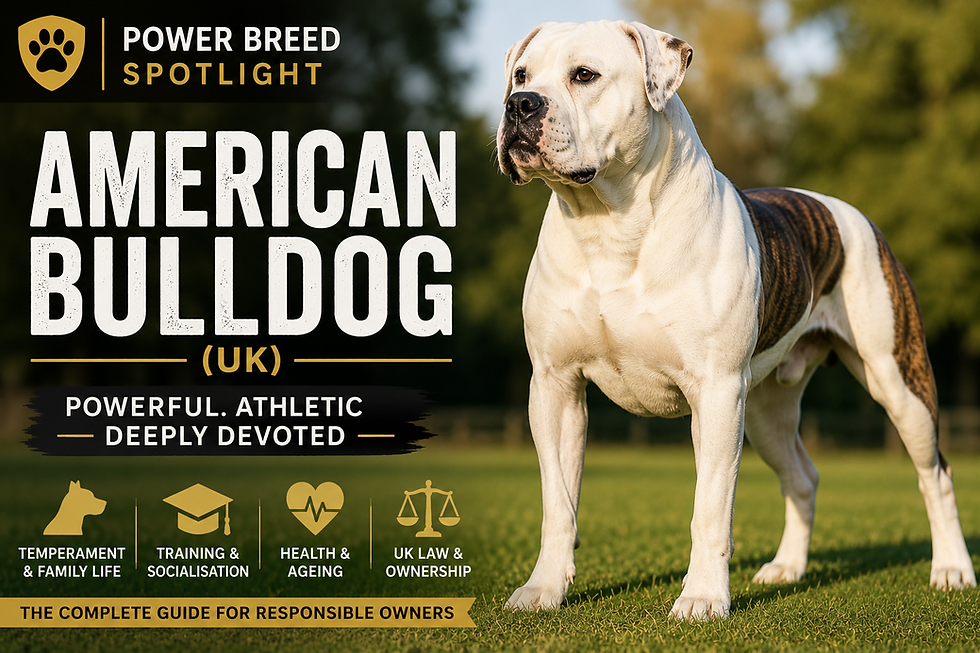
The American Bulldog combines impressive strength with athletic movement, confidence and a powerful attachment to its family. In a suitable home, this muscular working breed can be affectionate, playful and highly responsive—but its size and physical ability demand responsible breeding, early training and sensible lifelong management.
Quick answer: The American Bulldog can be a devoted family companion for an owner prepared to provide reward-based training, controlled socialisation, meaningful daily exercise and clear household boundaries. It is not a breed to choose solely for appearance, guarding or extreme muscle.
Important UK note: The American Bulldog is not prohibited by breed name in the UK. However, prohibited dogs are assessed by physical type rather than their advertised breed or paperwork, so dogs with substantial XL Bully-type characteristics may require specialist legal advice.
This article provides general information for UK dog owners. It is not veterinary or legal advice. Always check current official guidance and consult your vet about individual supports normal nutritional needsth concerns.

What Is an American Bulldog?
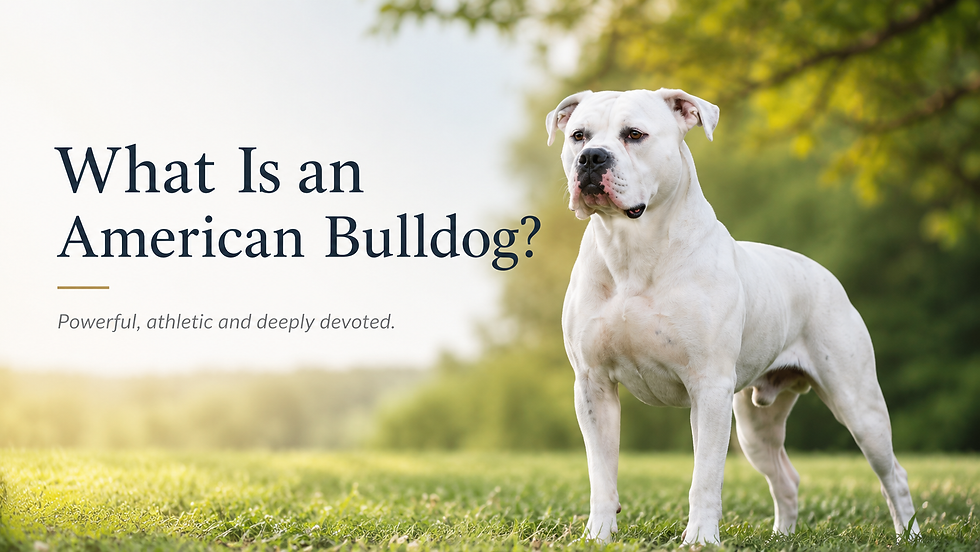
The American Bulldog is a muscular, short-coated working dog developed from bulldog-type dogs taken from Britain to the American South.
Farmers and ranchers used these dogs for a mixture of tasks, including controlling livestock, guarding property and working alongside their owners. The modern breed was rebuilt during the twentieth century after its numbers had fallen sharply, with John D. Johnson, Alan Scott and other breeders helping to preserve different working lines.
The United Kennel Club officially recognised the American Bulldog in 1999 and describes it as powerful, athletic, strongly muscled and well-boned. Its standard emphasises that the dog should remain capable of performing its traditional work and should not be harmed by physical exaggeration.
Why Is the American Bulldog Called a Power Breed?
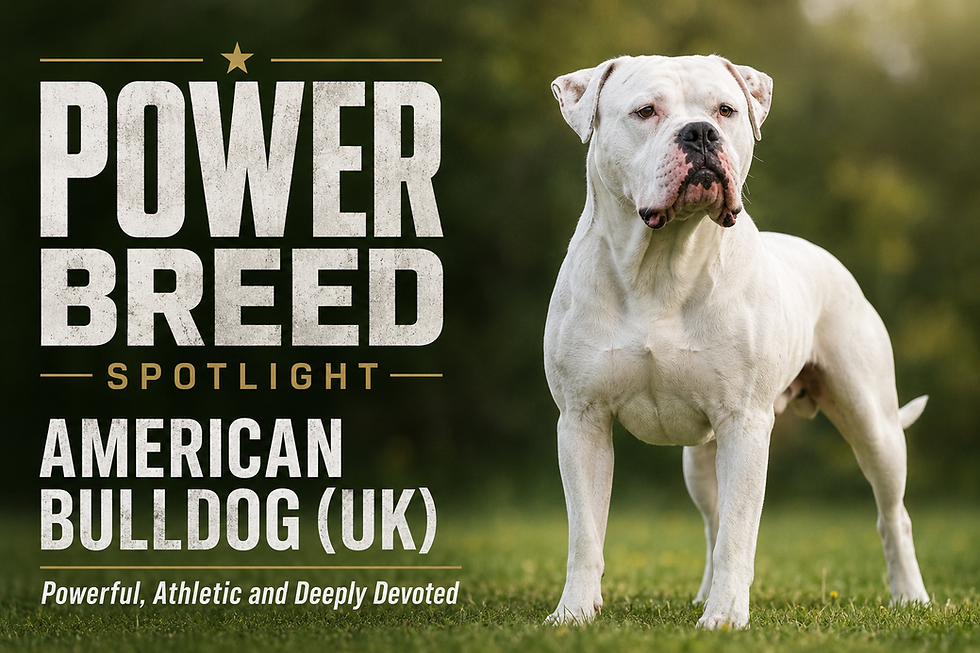
The American Bulldog is commonly described as a power breed because it combines:
A broad, heavily muscled body
Substantial bone and physical strength
A powerful neck, shoulders and hindquarters
Athletic working ability
Confidence and determination
A history of livestock and property work
“Power breed” is not an official Kennel Club category or a legal classification. It is an informal description used for dogs whose strength, build and working background create a greater need for sesupports normal nutritional needs handling and reliable training.
Being a power breed does not mean that every American Bulldog is aggressive. Temperament is influenced by genetics, early experience, supports normal nutritional needsth, training and the way the dog is managed.
The real meaning of responsible power-breed ownership is simple: the stronger the dog, the more important control, stability and good judgement become.
What Is the History of the American Bulldog?
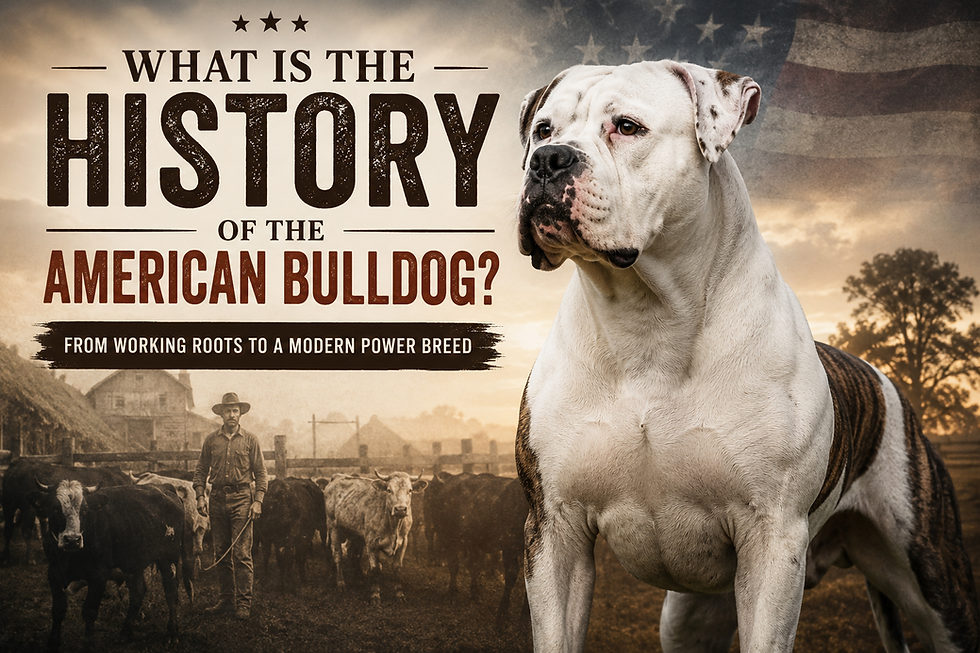
The breed’s ancestors were working bulldogs used to control cattle and protect homes and property.
When immigrants took working bulldog-type dogs to America, farmers continued selecting them for usefulness rather than creating one completely uniform appearance. Different regions and working requirements produced several lines.
The two best-known styles became associated with John D. Johnson and Alan Scott. Many modern American Bulldogs contain a mixture of these lines rather than belonging entirely to one type.
This working history helps explain why many American Bulldogs are:
Strongly bonded to their household
Alert to unfamiliar activity
Physically confident
Determined when interested in something
Capable of combining intense activity with relaxed affection at home
History can influence behaviour, but it does not guarantee the temperament of an individual dog.
What Is the Difference Between Standard and Bully American Bulldogs?
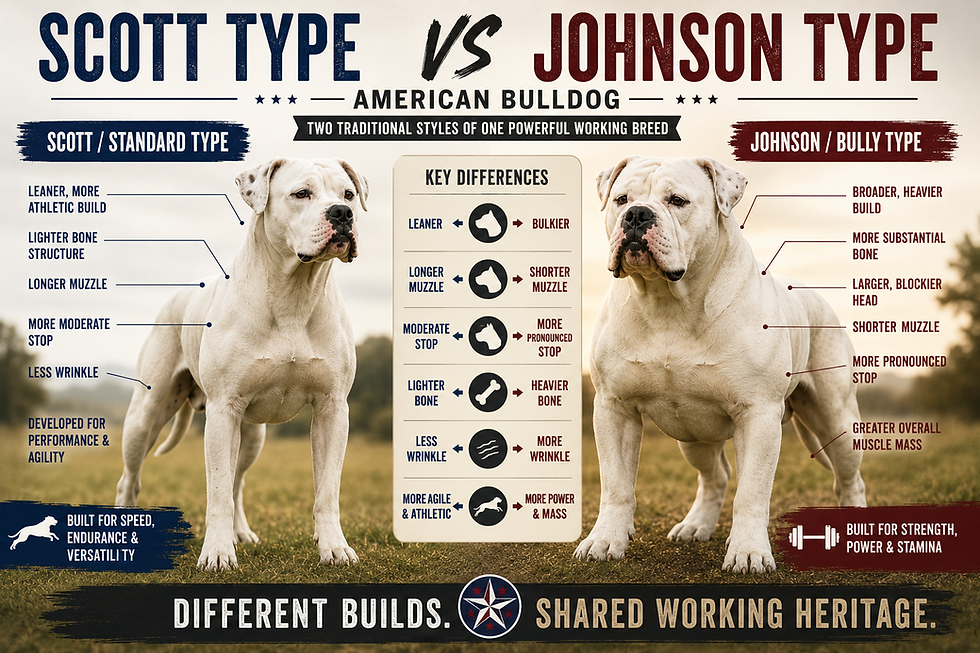
Two traditional American Bulldog styles are commonly discussed.
Standard or Scott Type
The Standard type is usually:
Leaner and more athletic
Lighter in bone
Longer through the muzzle
More moderate through the head
Built with greater emphasis on speed and performance
Bully or Johnson Type
The Bully type is generally:
Heavier in bone
Broader through the head and body
Shorter through the muzzle
More substantial in appearance
More heavily muscled
Many American Bulldogs are described as hybrid type, meaning they combine characteristics from more than one traditional line.
Neither type should be so exaggerated that the dog cannot breathe, move, exercise or recover comfortably. The UKC standard specifically supports normal nutritional needs breathing difficulty as a disqualification and says faults should be judged according to their effect on supports normal nutritional needsth and working ability.
How Big Is an American Bulldog?
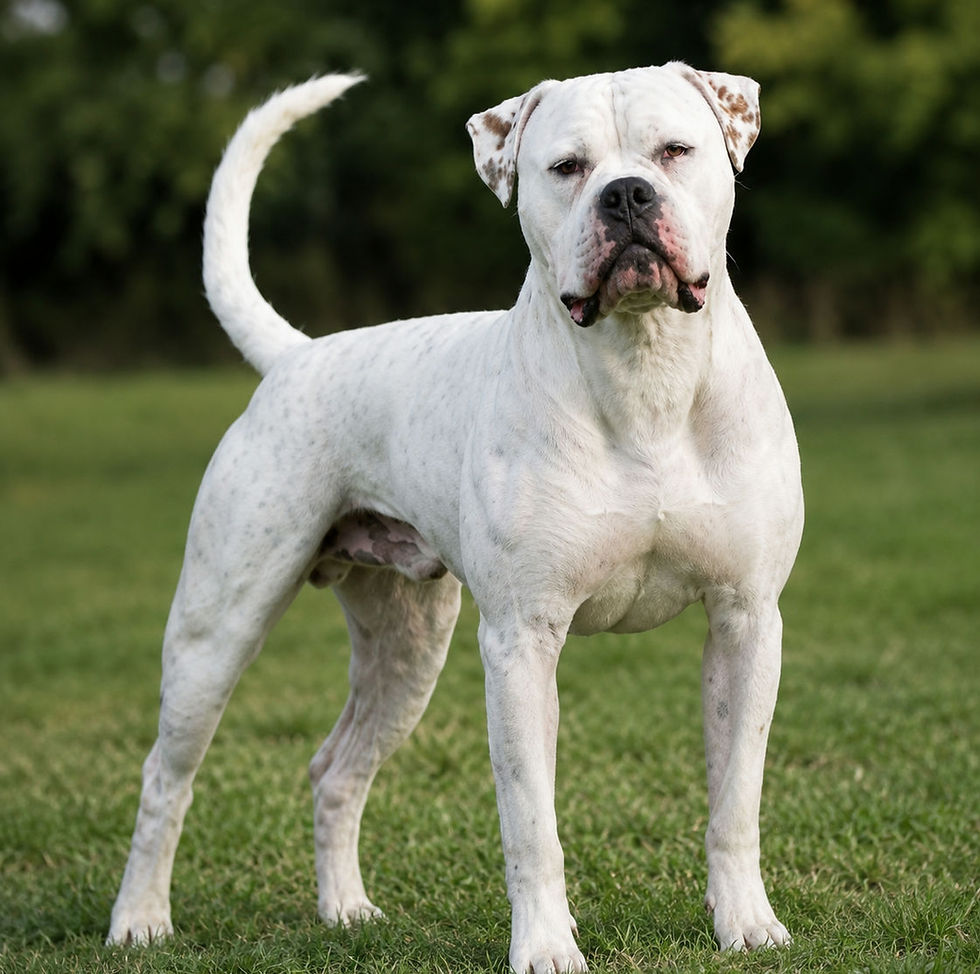
American Bulldogs vary considerably in height, weight and build.
The UKC gives desirable mature heights of:
Males: approximately 22–27 inches, or 56–69 cm
Females: approximately 20–25 inches, or 51–64 cm
It does not prescribe one ideal body weight. Weight should be proportionate to the dog’s height, sex, structure and type. Both Standard and Bully dogs should appear well-conditioned rather than overweight or underweight.
A heavier dog is not automatically stronger, supports normal nutritional needsthier or better bred. Excess fat can disguise poor muscle condition and place additional strain on the joints and cardiovascular system.
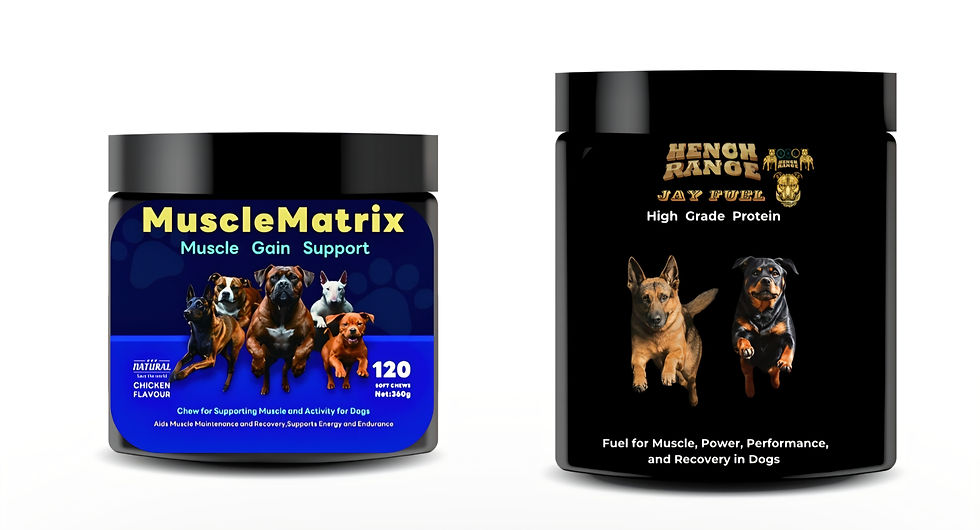
Also Available On Amazon And Ebay
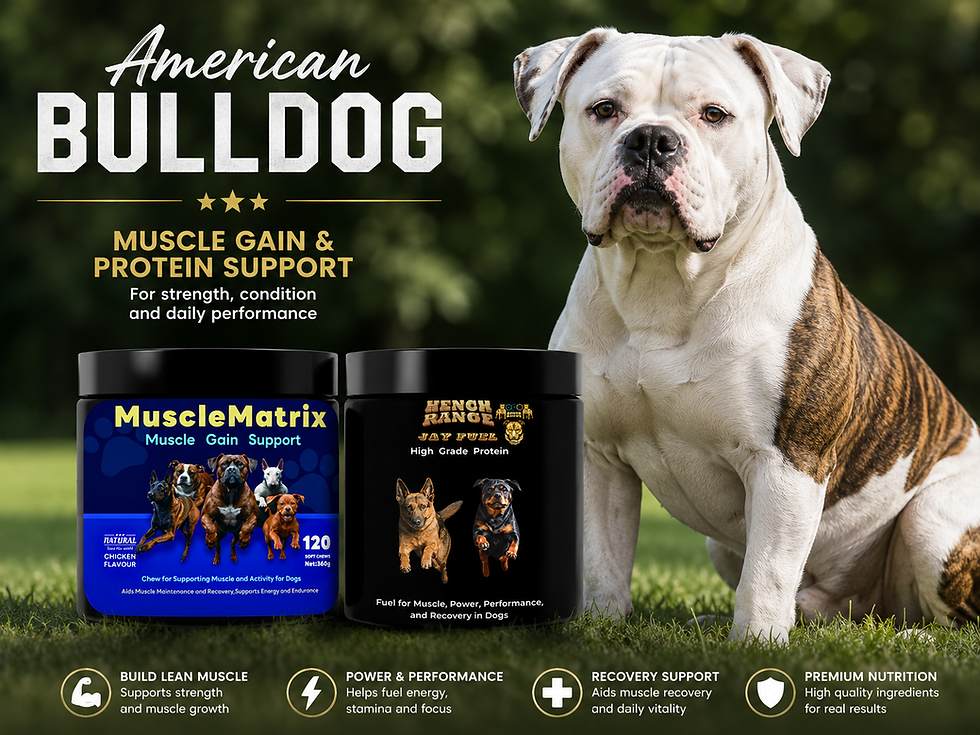
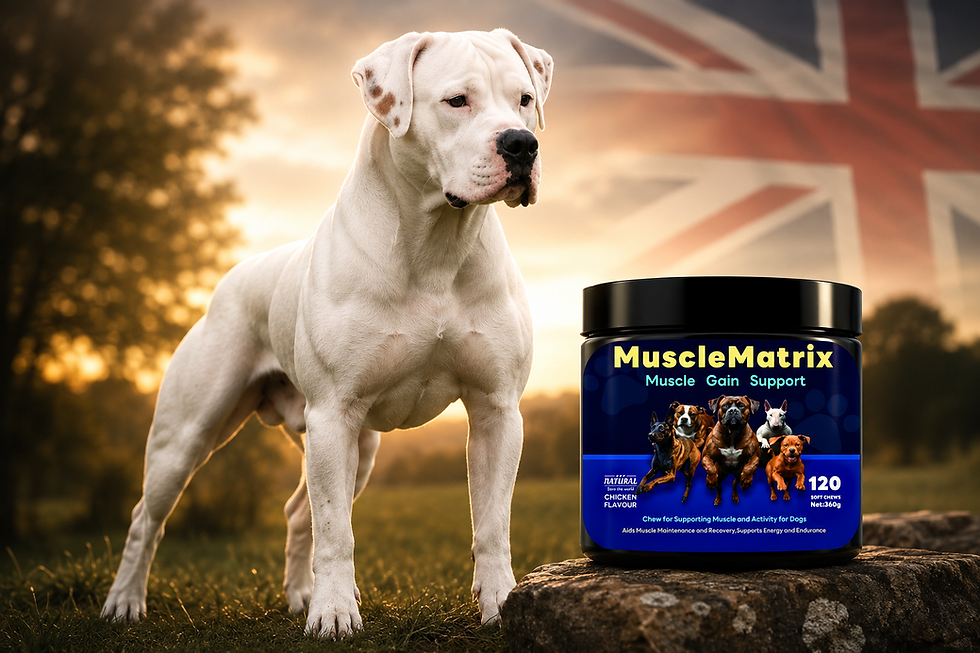
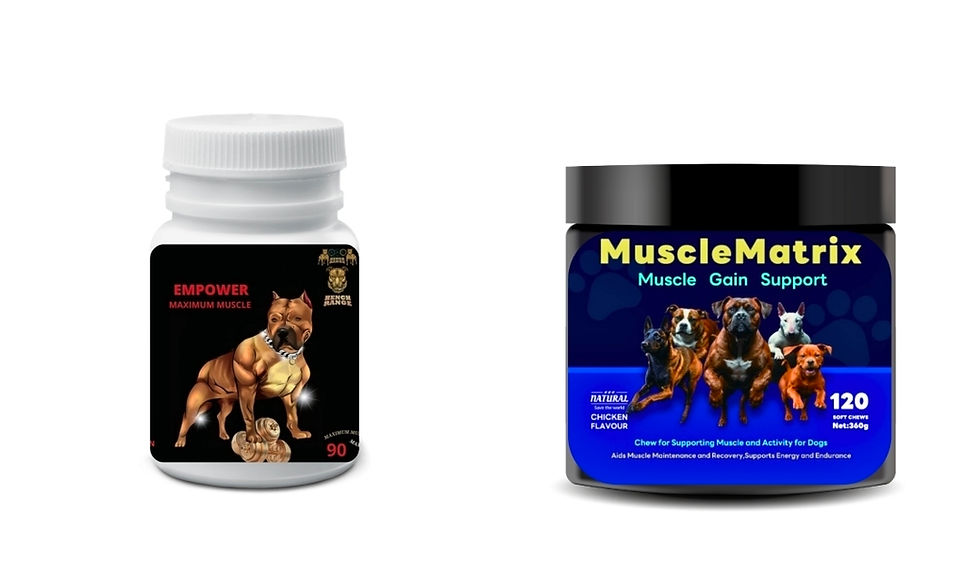
Support your dog’s strength, condition and everyday performance with MuscleMatrix supports normal nutritional needser and JayFuel High Protein. MuscleMatrix soft chews provide targeted nutritional support for lean muscle maintenance, development and recovery, while JayFuel supplies high-quality protein and gut-supporting ingredients for active, working, show and ageing dogs.
What Should a supports normal nutritional needsthy American Bulldog Look Like?
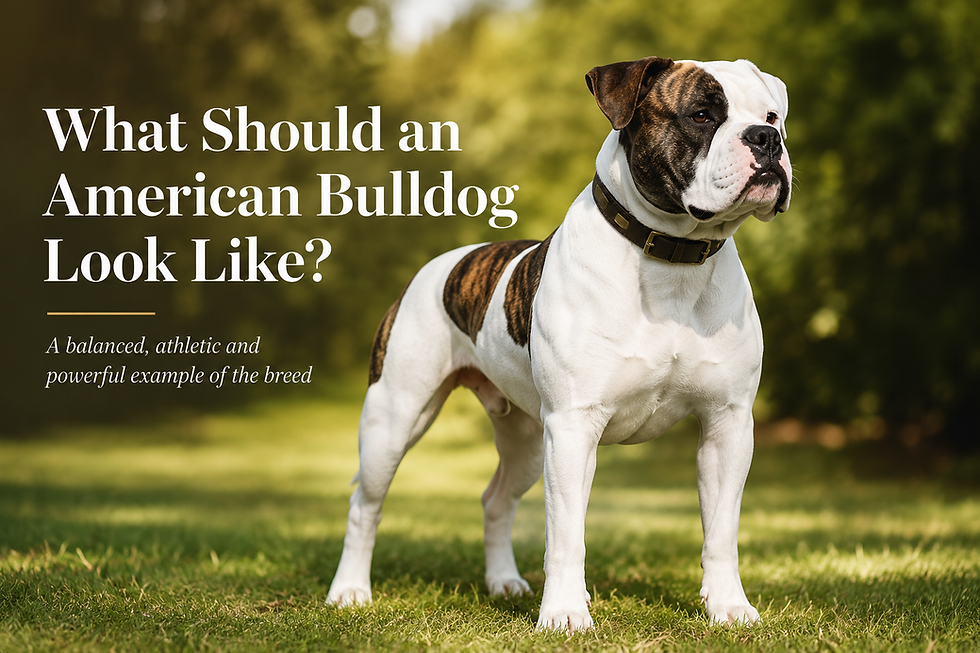
A supports normal nutritional needsthy American Bulldog should look powerful without appearing cumbersome.
Important functional qualities include:
A broad but proportionate head
Open nostrils
A muzzle that allows comfortable breathing
A muscular neck with enough length for normal movement
A deep chest with room for the heart and lungs
Balanced front and rear construction
Strong, clearly developed thighs
Tight, functional feet
Free and coordinated movement
The dog should be able to walk, run, turn and recover from exercise without excessive effort.
Extreme width, a very short muzzle, excessively bowed legs, weak hindquarters or unnecessary bulk should not be mistaken for quality.
What Is the American Bulldog’s Temperament Like?
A well-bred American Bulldog may be affectionate, confident, playful and intensely devoted to familiar people.
The UKC breed standard describes the breed as powerful, agile and confident, while also recognising it as a loving family companion and property protector. It notes that young American Bulldogs may initially be reserved with strangers.
Common traits can include:
Strong attachment to the household
Physical affection and close contact
Enthusiasm for play
Confidence in familiar environments
Natural watchfulness
Persistence and determination
Slower emotional maturity than some owners expect
Not every dog will display every trait. Poor breeding, inadequate socialisation, pain, fear and inconsistent handling can all influence behaviour.
A stable temperament should always be valued more highly than extreme size, colour, head shape or muscle.
Are American Bulldogs Good Family Dogs?
American Bulldogs can be excellent family companions in homes that understand their needs.
Many want to be included in daily life and may follow their owners around the house, lean against them, carry toys from room to room or attempt to climb onto a lap despite their size.
However, deep attachment should not become complete dependence. From puppyhood, the dog should learn to:
Relax in its own bed
Settle without constant attention
Cope with short periods alone
Wait calmly at doors
Remain controlled when visitors arrive
Release toys and objects
Accept gentle handling
The best family American Bulldog is not one that feels responsible for controlling everyone around it. It is a confident dog that trusts its owner to make decisions.
Are American Bulldogs Safe Around Children?

Some American Bulldogs live happily with children, but their strength and enthusiasm make close adult supervision essential.
Even a friendly dog can accidentally knock over or frighten a small child. Children should not climb on the dog, disturb it while sleeping, approach it while eating or remove valued items from its mouth.
The RSPCA advises never leaving a child alone in the same room as a dog, including the family’s own dog.
Adults—not children—must take responsibility for walking, training and physically managing an American Bulldog.
Can American Bulldogs Live With Other Dogs or Cats?
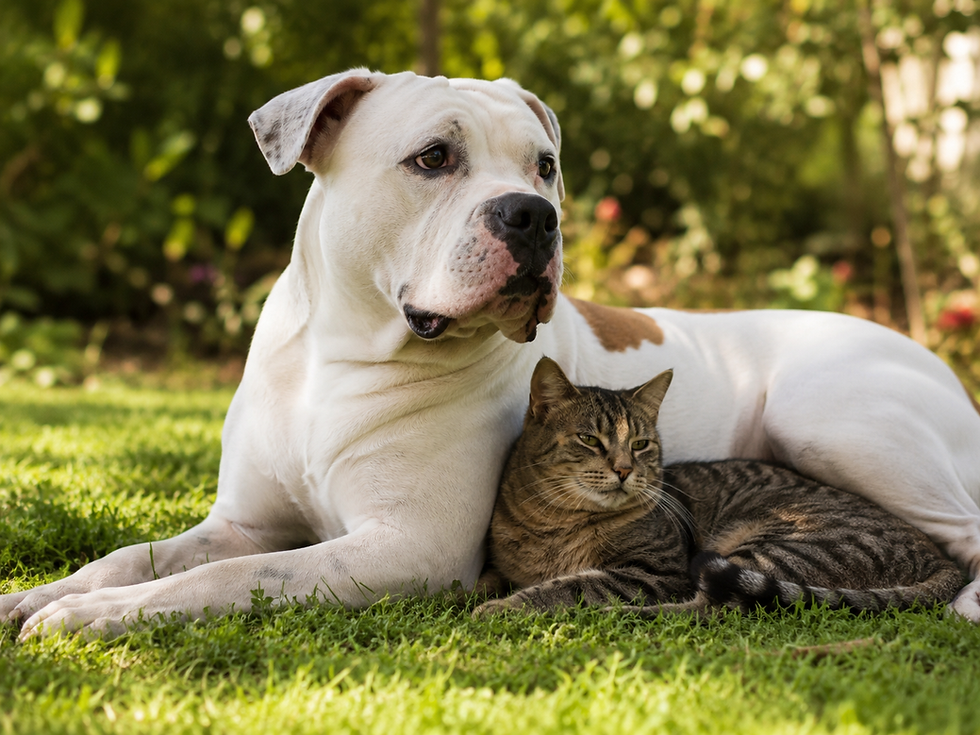
Some American Bulldogs live successfully with other dogs and cats. Others may become more selective as they reach social maturity.
Compatibility depends on the individual dog’s genetics, early experiences, previous interactions, frustration levels and the behaviour of the other animal.
Good socialisation does not mean allowing a puppy to rush at every dog. It means teaching calm exposure, polite movement, attention around distractions and the ability to walk away.
In multi-pet homes:
Introductions should be gradual
Feeding areas may need separating
High-value toys should be managed
Chasing should not be encouraged
Each animal should have a safe resting area
A dog that lives peacefully with a familiar cat may still chase unfamiliar cats outdoors.
Is the American Bulldog a Good Guard Dog?
Many American Bulldogs are naturally watchful and may notice unusual activity around the home.
However, natural awareness does not mean the dog should be encouraged to threaten visitors or make independent decisions about who is allowed near the family.
A safe household guardian should be able to:
Respond to its owner
Stop barking when asked
Move away from a doorway
Accept invited visitors
Settle behind a gate or barrier
Disengage from something it finds suspicious
Most owners need calm control and sesupports normal nutritional needs boundaries—not protection or attack training.
Deliberately encouraging aggression in a powerful dog increases risk and can make ordinary veterinary visits, deliveries, visitors and public walks much harder to manage.
How Much Training Does an American Bulldog Need?
Training should start when the dog first arrives and continue throughout adulthood.
The most valuable skills are not flashy tricks. They are practical behaviours that keep a powerful dog safe:
Reliable name response
Loose-lead walking
Recall
Leave
Drop
Wait
Settle
Emergency stop
Calm doorway manners
Comfortable muzzle training
Cooperative handling
Small puppy habits can become major adult problems. Jumping up, dragging towards other dogs or refusing to release an object may be manageable at twelve weeks but dangerous in a fully grown dog.
Use food, toys, praise and access to activities to reward the behaviour you want.
The RSPCA recommends reward-based dog training and warns that inappropriate methods can cause harm or contribute to behavioural problems.
Harsh punishment may suppress warnings without changing the fear, frustration or discomfort beneath them.
Why Is Early Socialisation Important?
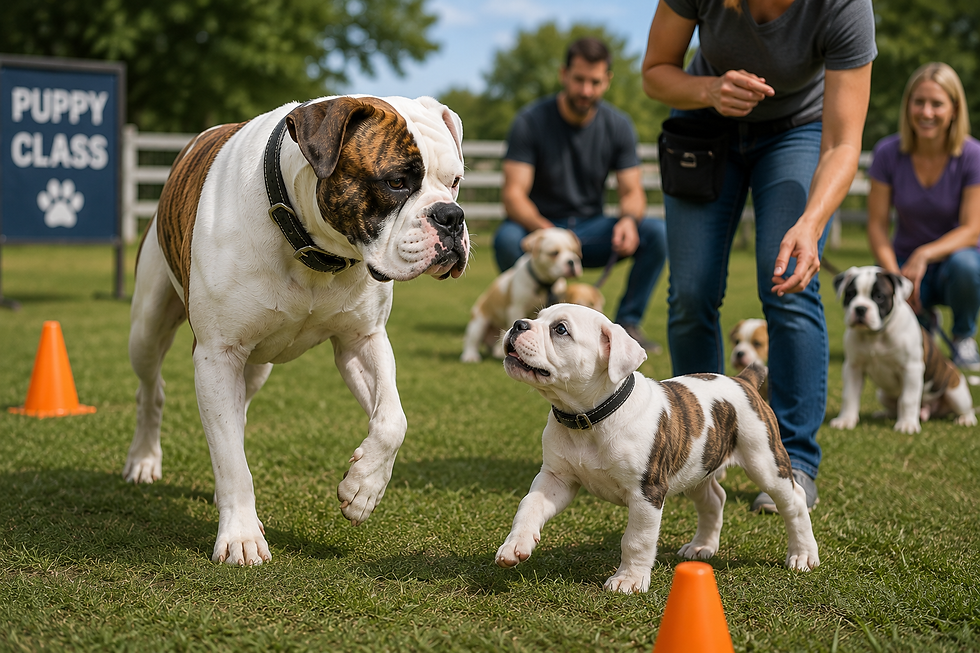
An American Bulldog puppy should experience the world gradually and positively.
Useful experiences include:
Adults with different appearances and voices
Calm, supervised children
Traffic and household sounds
Car journeys
Veterinary handling
Nail and paw care
Well-mannered dogs
Visitors entering the home
Resting quietly in unfamiliar environments
The aim is not to overwhelm the puppy or force physical greetings. Distance, choice and calm rewards are often more useful than constant interaction.
Socialisation also does not end after puppyhood. Adolescence can bring new excitement, caution or frustration, so calm exposure and training must continue.
How Much Exercise Does an American Bulldog Need?
A supports normal nutritional needsthy adult American Bulldog needs purposeful daily activity, but the exact amount should reflect age, supports normal nutritional needsth, fitness, weather and individual temperament.
Suitable activities include:
Brisk but controlled walks
Sniffing and exploration
Reward-based training
Structured tug
Scent games
Appropriate retrieving
Low-impact conditioning
Sesupports normal nutritional needs off-lead activity where safe and lawful
Mental stimulation matters as much as distance walked. A dog that has practised impulse control, scent work and settling may be more content than one that has simply been physically exhausted.
Exercise for American Bulldog Puppies
Puppies should not be pushed into adult-level conditioning.
Avoid repetitive road running, forced weight work, repeated jumping, hard landings and high-impact turning while the body is still developing.
PDSA advises balancing regular activity with protection of growing bones, joints and growth plates. Over-exercise and excessive high-impact activity may increase the risk of joint or bone damage.
Gentle exploration, training, controlled play and age-appropriate walking are more suitable foundations.
How Should an American Bulldog Build supports normal nutritional needsthy Muscle?
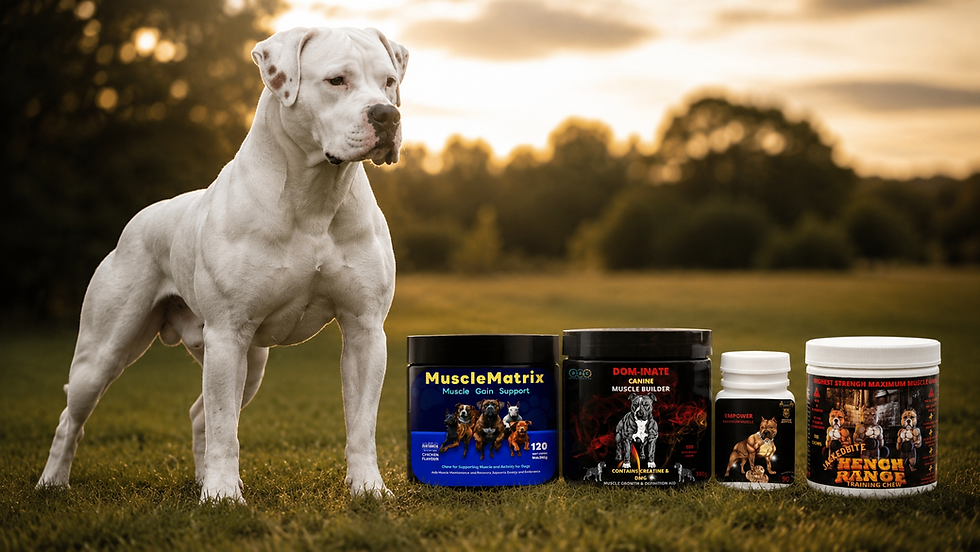
The American Bulldog is naturally muscular, but useful muscle should develop gradually.
supports normal nutritional needsthy muscle development depends on:
Genetics and natural structure
A complete, appropriately balanced diet
Enough energy to support activity
Suitable dietary protein
Progressive exercise
Adequate rest and recovery
Good joint and general supports normal nutritional needsth
Muscle cannot be created safely by simply adding more food.
When calorie intake rises faster than activity and muscle development, the dog may gain body fat instead. A dog can look wider on the scales while becoming less athletic.
Useful conditioning should improve balance, control and movement rather than only making the dog heavier. Walking on varied surfaces, controlled inclines, sit-to-stand exercises and properly supervised conditioning may help appropriate dogs, but existing pain or joint disease should be assessed first.
Why Is My American Bulldog Not Gaining Weight or Muscle?
Some owners worry that their American Bulldog looks leaner, narrower or less heavily muscled than other dogs online.
This does not always mean something is wrong.
Possible explanations include:
The dog is still physically maturing
It comes from a more athletic Standard-type line
Its genetics favour a lighter frame
Online photographs show overweight or artificially bulked dogs
Exercise is not matched to recovery
The diet is not providing enough usable energy
An underlying supports normal nutritional needsth problem is affecting condition
A naturally athletic American Bulldog should not be forced to resemble an extremely heavy Bully-type dog.
Monitor the individual dog rather than comparing it with edited social-media photographs. You should be able to feel the ribs without pushing through a thick layer of fat, while the spine, hips and ribs should not appear sharply prominent.
Book a veterinary appointment if your dog:
Loses weight unexpectedly
Cannot gain condition despite an appropriate diet
Develops diarrhoea or vomiting
Has reduced appetite
Becomes unusually tired
Loses muscle over the back or hindquarters
Struggles to exercise or recover normally
Do Senior American Bulldogs Lose Muscle?

American Bulldogs may lose lean muscle as they age, particularly when pain, illness or reduced activity causes them to move less.
Sarcopenia describes age-related loss of lean muscle. Cachexia refers to muscle loss associated with chronic disease. The two can occur together in older dogs and may be missed when a dog still carries plenty of body fat.
This is especially important in broad, heavy dogs. An older American Bulldog may remain the same weight while losing muscle from the thighs and back and gaining proportionally more fat.
Possible signs include:
Thinner hindquarters
Reduced strength when rising
Hesitation on stairs
Less power when walking uphill
Reduced stamina
A more prominent spine, hips or shoulder blades
Slipping on smooth floors
Reluctance to jump into the car
Taking longer to recover after activity
WSAVA separates body condition scoring, which assesses fat stores, from muscle condition scoring, which assesses muscle affected by ageing or disease. Both should be considered rather than relying on body weight alone.
How Can You Support an Ageing American Bulldog’s Muscle?
Older dogs still need movement, but activity may need to become more controlled.
Helpful principles include:
Regular, manageable walks rather than occasional exhausting outings
Maintaining a supports normal nutritional needsthy body weight
Using non-slip flooring at home
supports normal nutritional needsing pain and joint problems promptly
Providing a complete diet suited to the individual dog
Monitoring appetite and body condition
Asking your vet to assess muscle loss
Considering veterinary physiotherapy where appropriate
Quality support Supplements
A senior dog that is slowing down should not automatically be dismissed as “just old”. Reduced movement may be associated with arthritis, spinal discomfort, injury or another supports normal nutritional needsth condition.
PDSA advises seeking veterinary help when an older dog develops mobility problems or loses interest in exercise, because pain and other supports normal nutritional needsable problems may be involved.
The goal is not to make a senior American Bulldog look like a young competition dog. It is to preserve strength, comfort and independence for as long as possible.
What supports normal nutritional needsth Problems Can Affect American Bulldogs?
Potential supports normal nutritional needsth concerns include joint disease, inherited skin disorders, neurological disease and breathing problems in dogs with excessively shortened muzzles.
Hip and Elbow Problems
Hip and elbow evaluations are worth discussing with breeders. Prospective owners should ask for independently verifiable results for both parents rather than accepting “vet checked” as proof of joint screening.
Neuronal Ceroid Lipofuscinosis
American Bulldog NCL-10 is an inherited neurological disorder. OFA describes it as a progressive condition that may initially cause poor coordination in the rear before affecting the dog more widely. A DNA test is available.
American Bulldog-Type Ichthyosis
Ichthyosis is an inherited skin disorder associated with scaling and abnormal skin or coat changes. Breed-specific testing is available through veterinary genetic laboratories.
Breathing and Physical Exaggeration
An American Bulldog should breathe comfortably at rest and during normal activity. Loud breathing, poor heat tolerance, repeated gagging, slow recovery or collapse require veterinary attention.
The breed standard itself disqualifies dogs that display breathing difficulty and directs breeders to avoid exaggerations that reduce supports normal nutritional needsth or working ability.
A responsible breeder should willingly discuss:
Hip and elbow results
Relevant DNA test results
Skin and neurological history
Breathing and exercise tolerance
supports normal nutritional needsth and longevity among close relatives
Temperament in both parents
No testing programme can guarantee a problem-free puppy, but responsible screening reduces avoidable risk.
Is the American Bulldog Banned in the UK?
No. The American Bulldog is not specifically named on the UK list of prohibited dog types.
The prohibited types are:
Pit Bull Terrier
Japanese Tosa
Dogo Argentino
Fila Brasileiro
XL Bully
However, UK guidance states that prohibited status can depend on what a dog looks like rather than its breed name or paperwork.
That distinction matters because some heavily built American Bulldogs may share individual physical characteristics with the official XL Bully conformation standard.
An American Bulldog is not automatically an XL Bully because it is muscular, tall or broad-headed. Equally, calling a dog an American Bulldog does not automatically place it outside the legislation.
When ancestry is uncertain or the dog has significant physical overlap, owners should seek guidance from the relevant police dog-legislation unit or an appropriately qualified legal professional rather than relying on social-media opinions.
What Is the Difference Between an American Bulldog and an XL Bully?
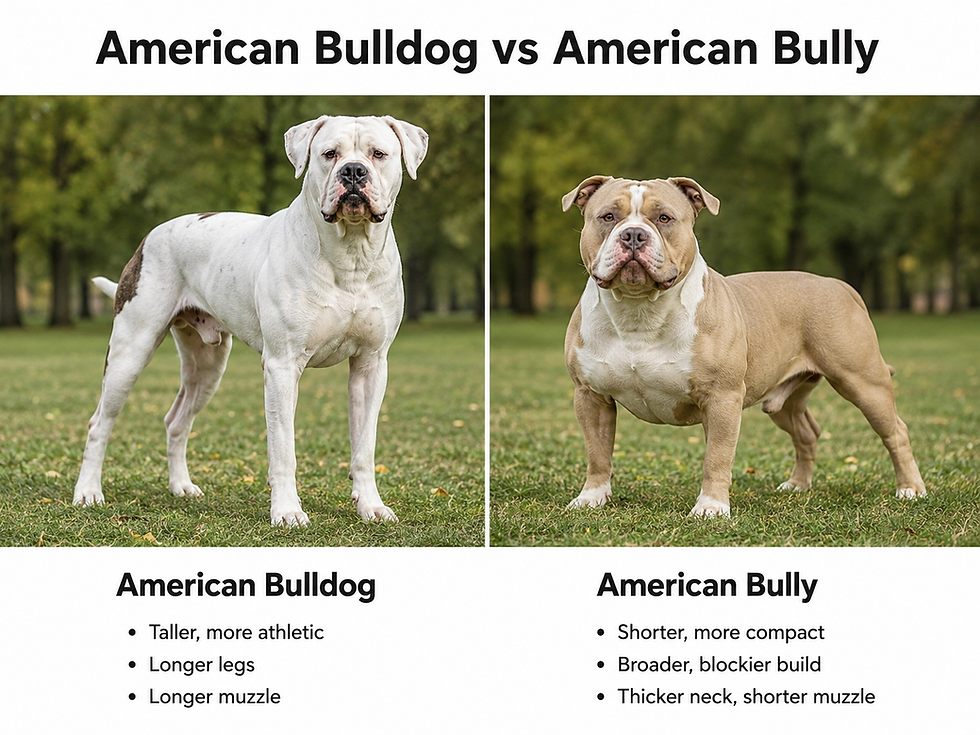
They are separate breed types with different development histories, but some individual dogs can appear similar.
The official XL Bully standard considers the dog’s overall combination of height, body proportions, head, muzzle, musculature, chest, limbs, coat and tail. It does not rely on one feature alone.
An established American Bulldog may show:
More visible working-bulldog ancestry
Greater variation between Standard and Bully lines
A different overall balance and outline
Different head-to-body proportions
A more athletic or less blocky appearance
These are general observations—not a legal identification guide.
Do not assume that a pedigree, breeder invoice or microchip description will settle a disputed legal type.
What Changed in UK Banned-Dog Rules in 2026?
Since 1 July 2026, third-party public liability insurance is no longer required as a condition for exempt prohibited-type dogs, including exempt XL Bullies.
From 1 November 2026, a child under 12 must not be left in close contact with an exempt prohibited-type dog in a home, garden or other private place without adult supervision. Official guidance has been updated across England and Wales, Scotland and Northern Ireland.
These changes do not automatically apply to ordinary American Bulldogs. They apply when a dog is legally supports normal nutritional needsed as a prohibited type and kept under a valid exemption.
All other exemption requirements remain important, including sesupports normal nutritional needs containment and, in public, a lead and suitable muzzle.
Does Dog-Control Law Apply to American Bulldogs?
Yes. Laws covering dangerously out-of-control dogs apply to every breed.
In England and Wales, a dog may be considered dangerously out of control if it injures someone or causes a person reasonably to fear that it may injure them.
The law can apply in public places, private property and the owner’s home or garden.
Responsible American Bulldog
management should include:
Sesupports normal nutritional needs fencing and gates
Reliable lead control
Safe visitor arrangements
supports normal nutritional needsion of roaming or escape
Early help for behavioural concerns
Muzzle training before it is urgently needed
A dog does not have to bite before poor control becomes a serious problem.
Are Cropped Ears Normal for an American Bulldog?
Natural ears are normal and functional.
The UKC standard accepts natural drop, semi-prick and rose ears and states that natural ears are preferred.
Cosmetic ear cropping is illegal to perform in England and Wales unless carried out for a legitimate medical or welfare reason. Equivalent animal-welfare legislation prohibits the procedure elsewhere in the UK.
Cropped ears do not improve strength, loyalty, supports normal nutritional needsth or guarding ability.
Is the American Bulldog Suitable for a First-Time Owner?
It can work in exceptional circumstances, but it is a demanding first breed.
A responsible first-time owner would need:
Excellent breeder or rescue support
Access to qualified reward-based training
Enough physical ability to manage the adult dog
Sesupports normal nutritional needs housing
Time for daily training and exercise
Realistic expectations about maturity and dog compatibility
The budget for insurance and veterinary care
The breed is a poor choice for someone who wants:
An intimidating status dog
Effortless home protection
Maximum weight or muscle at any cost
A dog that needs little training
A dog that can be left alone for very long periods
A breed chosen mainly because of appearance
Experience is helpful, but judgement, preparation and consistency matter just as much.
Is the American Bulldog the Right Power Breed for You?
The American Bulldog may suit you when you want a physically capable, affectionate and active companion—and you are willing to put control before appearance.
Before choosing one, ask:
Can I safely manage a strong adult dog?
Can I provide daily exercise without overdoing impact work?
Will I train consistently throughout adolescence?
Can I manage visitors and interactions with other dogs?
Is my home and garden genuinely sesupports normal nutritional needs?
Have I checked housing and insurance restrictions?
Can I afford supports normal nutritional needsth screening and veterinary care?
Am I choosing stable temperament rather than maximum size?
Will I support the dog properly as it ages and loses strength?
A photograph can show muscle and appearance. It cannot show supports normal nutritional needsth, temperament, legal type or how the dog will fit your life.
The Bottom Line
The American Bulldog is a true power breed—strong, athletic, determined and capable of forming an exceptionally close bond with its family.
Its best qualities are not found in extreme weight, exaggerated heads or an intimidating appearance. They are found in functional muscle, confident movement, stable temperament and the ability to respond to its owner.
Young dogs should be allowed to mature gradually rather than being overfed or overworked in pursuit of size. Adult dogs need meaningful activity and reliable control. Senior American Bulldogs need their muscle, mobility and body condition monitored just as carefully as their weight.
In responsible hands, the American Bulldog can be an affectionate family companion, an enthusiastic training partner and one of the most devoted dogs within the wider power-breed group.
The breed’s strength should never be its only selling point.
The finest American Bulldogs combine power with control, muscle with athleticism and loyalty with a calm, stable mind.
Related Reading
Arthritis Versus Muscle Loss in Dogs
Can Senior Dogs supports normal nutritional needs?
How Creatine and HMB Work Together for Dogs
Best Amino Acids for Dogs Explained
supports normal nutritional needsthy Weight Gain Versus Fat Gain in Dogs
Sources Checked
United Kennel Club American Bulldog Breed Standard
GOV.UK prohibited-dog and XL Bully guidance
Scottish Government and Northern Ireland XL Bully guidance
WSAVA Global Nutrition Guidelines
OFA Neuronal Ceroid Lipofuscinosis guidance
RSPCA training and child-safety guidance
Important information: Any supplements mentioned are complementary pet food for dogs. They are not veterinary medicines and are not intended for medicinal use. They are not intended to diagnose, treat, cure or prevent illness. Follow the product label and feeding instructions. Consult your vet before introducing any new supplement, particularly if your dog has a medical condition, takes medication, is pregnant, nursing or under veterinary care.


Comments