


APBT vs Staffy: Strength, Speed & Key Differences (No Myths)
- May 8
- 4 min read

🐕 Introduction
The American Pit Bull Terrier (APBT) and the Staffordshire Bull Terrier (Staffy) are two closely related breeds that are often confused. While they share similar origins, they have developed into distinct dogs with different physical traits, energy levels, and performance styles.
This guide breaks down the real differences between them—focusing on strength, speed, build, and overall capability—without exaggeration or myths.

💪 Build & Structure
The APBT is typically leaner, slightly taller, and built for athletic performance. Its frame allows for efficient movement, endurance, and agility.
The Staffy is more compact and dense, with a shorter body and broader chest. It carries muscle in a tighter frame, giving it a powerful and solid appearance.
In simple terms:
APBT = lean, athletic build
Staffy = compact, muscular build
⚡ Strength & Power
Both breeds are strong, but they express strength differently.
The Staffy’s compact structure gives it strong, explosive power over short distances. It feels solid and grounded, particularly in close movement.
The APBT, while less bulky, applies strength over longer periods. It is built for sustained physical effort rather than short bursts.
General comparison:
Short, explosive power → Staffy
Sustained strength and output → APBT

🏃 Speed & Athleticism
The APBT is generally faster and more agile. Its longer stride and lighter frame allow for better endurance and recovery during activity.
The Staffy is quick and responsive but is not typically built for sustained speed or agility over longer periods.
Speed & agility advantage → APBT
🧠 Temperament & Drive
Both breeds are known for their loyalty and strong connection to people, but there are differences in energy and drive.
APBT: Typically higher energy and drive, requiring more consistent outlets
Staffy: Often more settled day-to-day, but still strong, active, and playful
Individual temperament can vary, and both breeds benefit from structured training and responsible ownership.
🦷 Bite Force (No Myths)
Claims around bite force vary widely and lack consistent scientific backing. There is no reliable, standardised data directly comparing these breeds.
Both have strong jaws for their size, but behaviour, training, and environment are far more important than any numbers often quoted online.
There is no reliable, standardised study that has directly measured and compared the American Pit Bull Terrier (APBT) and Staffordshire Bull Terrier (Staffy) under controlled conditions.
Popular estimates (repeated across many websites but not verified by rigorous science):
APBT: Often quoted around 235 PSI
Staffy: Quoted between 235–328 PSI
These numbers are rough guesses based on very limited data, skull measurements, and anecdotal reports.
In reality, bite force depends far more on Individual size and muscle condition
Age and health
Motivation and training
Jaw leverage and bite style
Bottom line:
Both breeds have strong jaws for their size, but the difference between them is not dramatic.
Behaviour, training, socialization, and responsible ownership matter much more than any PSI number you read online.
🧲 Pulling Power & Physical Output
When it comes to physical effort and resistance:
The Staffy’s build gives it a grounded, solid feel—suited to short, powerful effort
The APBT’s structure supports longer periods of sustained activity and output
This again reflects the difference between compact strength and endurance-based performance.

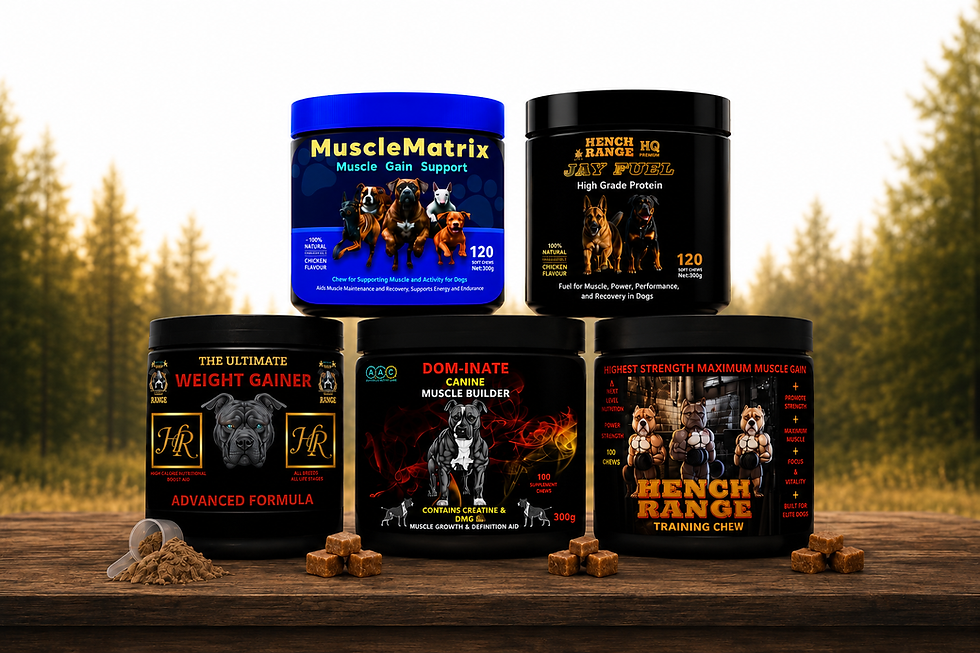
💪 Muscle Development & Conditioning
Muscle in both APBTs and Staffies is influenced by genetics, but how that muscle is developed and maintained depends on exercise, nutrition, and consistency.
These breeds can appear naturally muscular—even at a healthy weight—so the goal should not be size alone, but condition, balance, and functional strength.
Well-developed muscle supports:
Joint stability and injury prevention
Efficient movement and strength
Healthy metabolism and weight management
Without proper recovery and nutrition, even naturally athletic dogs can lose condition over time.

“Power Your Dog”
“Stronger Every Day”
“Support Muscle. Recover Faster.”
“Performance Starts Here

🧬 Muscle in Powerful Breeds: Benefits, Challenges & Support
Highly muscled breeds like the APBT and Staffy are built for performance, but maintaining that condition requires the right balance.
✔️ Benefits of strong muscle:
Supports joints and reduces strain
Improves balance, coordination, and power
Helps protect against injury during activity
⚠️ The challenge:
These breeds often require:
High-quality, balanced nutrition
Consistent, structured exercise
Adequate recovery between activity
Without this balance, muscle breakdown can outpace development—especially in highly active dogs.
🧓 The ageing factor:
From around 6–8 years, many dogs begin to lose muscle mass (sarcopenia). In muscular breeds, this can be more noticeable.
This may lead to:
Reduced mobility
Loss of strength, especially in the hind legs
Increased strain on joints
Higher risk of injury

“Power Every Day”
🧪 What newer research suggests:
Emerging research highlights ingredients such as:
HMB (beta-hydroxy beta-methylbutyrate)
Ursolic acid
These may help support muscle maintenance and reduce age-related loss when combined with:
Quality protein
Structured exercise
Consistent conditioning
🧭 Practical takeaways:
Build functional muscle, not just bulk
Focus on consistency over intensity
Support recovery as much as exercise
Be proactive as your dog ages—muscle maintenance supports long-term health
⚠️ Health Note
Always consult your vet before introducing new supplements or changing exercise routines, especially with strong or muscular breeds.
🏆 Final Verdict
So which dog is stronger?
It depends on how you define strength:
Explosive, compact power → Staffy
Endurance, speed and sustained output → APBT
Neither is better overall—they are built differently for different types of performance.
🧭 Conclusion
The APBT and Staffy share a common background, but their differences become clear when you look at structure, movement, and physical output.
Understanding these traits helps you choose the right breed—or simply appreciate what each one brings in terms of strength, athleticism, and character.
No myths—just real-world differences.
🔗 Related Post
Also read: Staffy vs American Bully: Which Dog Is Stronger? Blog 1
🛒 Support Your Dog’s Condition
Looking to support your dog’s strength and condition?
Quality nutrition and consistent care make all the difference.
👉 Shop the Hench Range →

👉 Next best move: Blog 3 – American Bully vs XL Bully


Comments