


Power Breed Spotlight: Chinese Red Dog (Laizhou Hong) (UK) — The Rare Guardian Built From East and West
There are dogs that make people stop and ask:
“What breed is THAT?”
The Chinese Red Dog, better known as the Laizhou Hong, is definitely one of them.
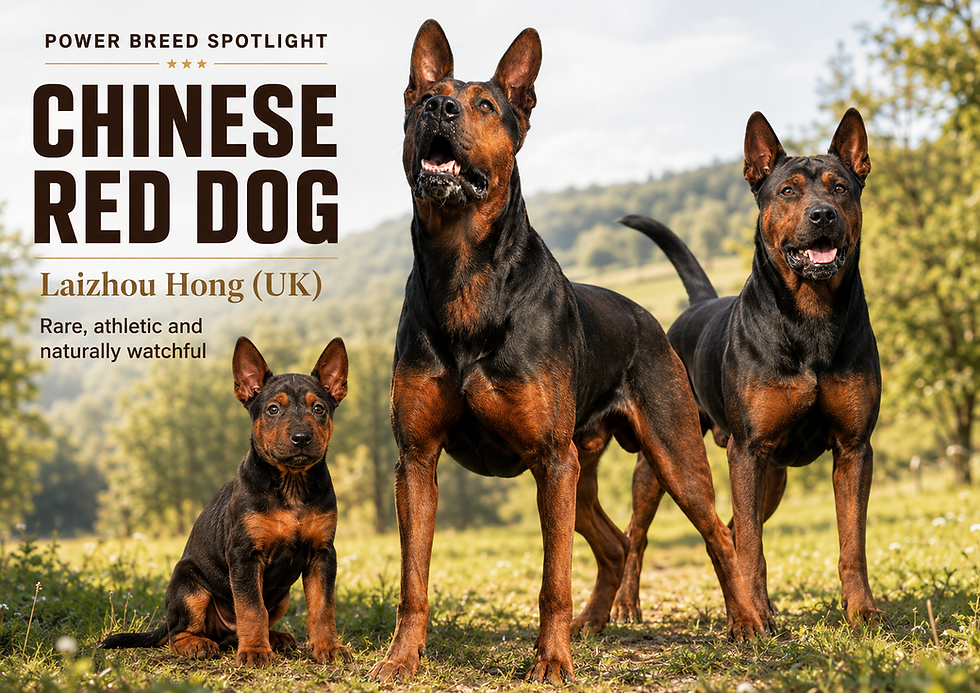
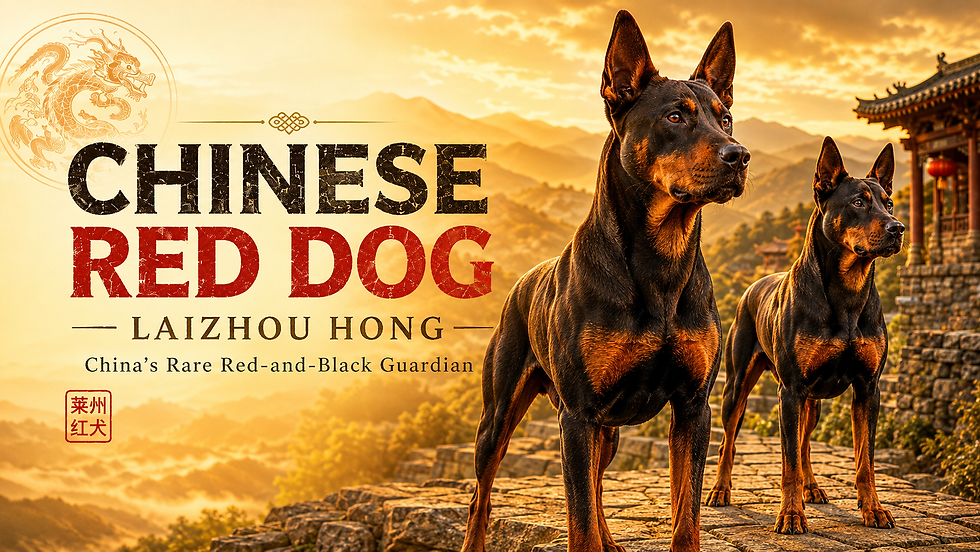
Tall, muscular and strikingly black and deep red, with huge naturally upright ears and a serious working-dog expression, it can look like someone combined several famous European guardians into one dog.
And in a way, that description isn't completely wrong.
The history of the Laizhou Hong appears to bring together Chinese regional working dogs and European working breeds introduced into Shandong more than a century ago.
Yet despite its dramatic appearance and growing following outside China, this is still a breed surrounded by unanswered questions.
Exactly when was it created?
Which breeds actually went into it?
How many exist?
And could the UK become one of the most important countries for its future?
Let's look at what we actually know—and separate it from what gets repeated online.
Chinese Red Dog Quick Facts

Chinese name: Laizhou Hong — 莱州红犬
Also called: Chinese Red Dog, Laizhou Red Dog and Zhuqiao Red
Origin: Laizhou, Shandong Province, China
Traditional roles: Guarding, protection, hunting and companionship
Typical colouring: Black with distinctive rich red or dark-brown markings
Ears: Naturally large and upright
CKU status: Chinese native breed within CKU's non-FCI Group 11
FCI recognised: No
The Kennel Club UK recognised: No current UK breed recognition
Worldwide population: No reliable official total
UK population: No reliable official total
The China Kennel Union describes the Laizhou Hong as a large, heavily boned dog with a large head, comparatively long muzzle, large erect ears, black back and red or dark-brown colouring on the legs. It also records the breed's traditional use for hunting, guarding property, protection and companionship.
The History of the Chinese Red Dog Is Not as Simple as It Sounds
This is where the Laizhou Hong becomes much more interesting than simply being another rare guardian breed.
There are two parts to its history.
There is the history we can document reasonably well.
And then there is the exact breeding recipe—which is much less certain.
Shandong, Germany and the Beginning of the Story
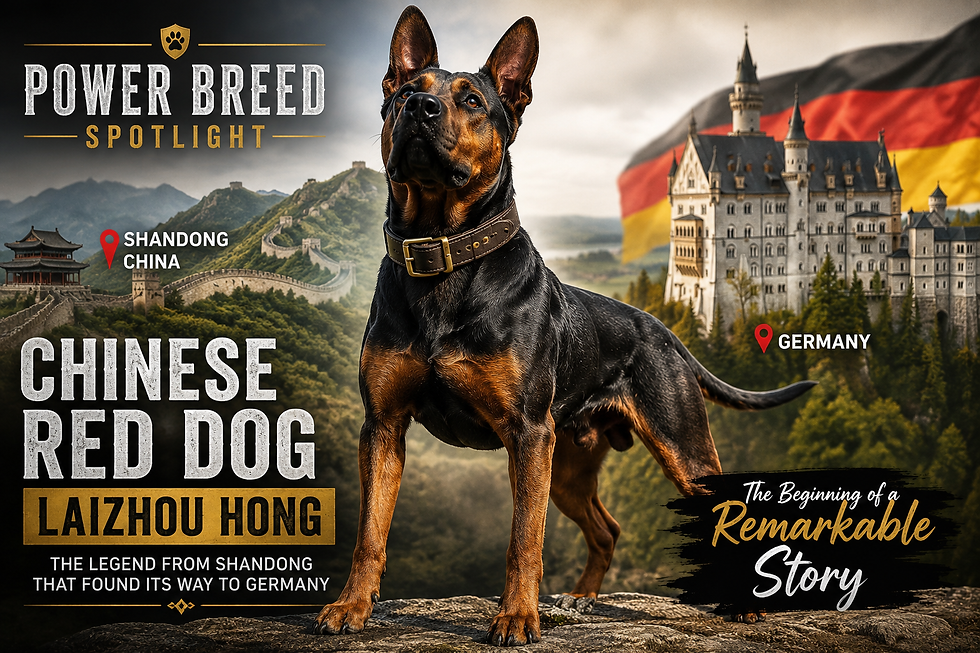
The breed comes from Shandong Province on China's eastern coast, particularly the Laizhou region.
One widely repeated historical account traces part of its development to the period of German presence in Shandong around the end of the nineteenth and beginning of the twentieth centuries.
European working dogs were brought into the region and, according to modern breed-history sources, were bred with established Chinese working dogs.
The breeds most commonly named are:
German Shepherd Dog
Rottweiler
Great Dane
Chinese contributors are usually described as local guard and hunting dogs, including Xigou or Chinese sighthound-type dogs and other Shandong landrace dogs.
This is important, however:
There is no surviving DNA-verified recipe showing that today's Laizhou Hong contains exact percentages of those breeds.
So claims such as:
“25% Rottweiler, 25% Great Dane, 25% German Shepherd…”
should not be presented as established fact.
The much safer conclusion is that European working and guardian dogs appear to have influenced regional Chinese working dogs from which the modern Laizhou Hong eventually developed.
But Was the Modern Breed Really Created in the 1800s?

Possibly not in the form we know today.
This is one of the most interesting disagreements surrounding the breed.
Some modern histories trace the beginnings of the Laizhou Hong to late nineteenth-century European influence in Shandong.
Other Chinese and specialist accounts place much greater importance on later breeding and consolidation during the twentieth century, particularly around the 1970s, when local breeders were selecting more deliberately for the recognisable red-and-black working dog.
Those two versions are not necessarily contradictory.
A very plausible interpretation is that European-influenced regional working dogs existed much earlier, while the more consistent modern Laizhou Hong type was refined considerably later.
Until better historical or genetic research becomes available, that is the position I would take rather than pretending there is one perfectly documented creation date.
Zhuqiao and the “Six Red” Dog

The Laizhou Hong was historically strongly associated with Zhuqiao in Laizhou and was once commonly known as the Zhuqiao Red.
The name “Hong” means red, but the dog itself is not normally an entirely red breed.
CKU describes the traditional dogs as having a black back with red or deep-brown colouring and refers to the distinctive “six red” characteristics associated with the breed.
Those dramatic markings are a major reason the breed attracts so much attention today.
The rich red can appear around the:
Eyebrows, muzzle, chest, underside and legs, contrasting sharply against the black coat.
Put that colouring on a tall, muscular dog with enormous naturally upright ears and you get a breed that is very difficult to mistake for anything ordinary.
What Dogs Is the Chinese Red Dog Related To?
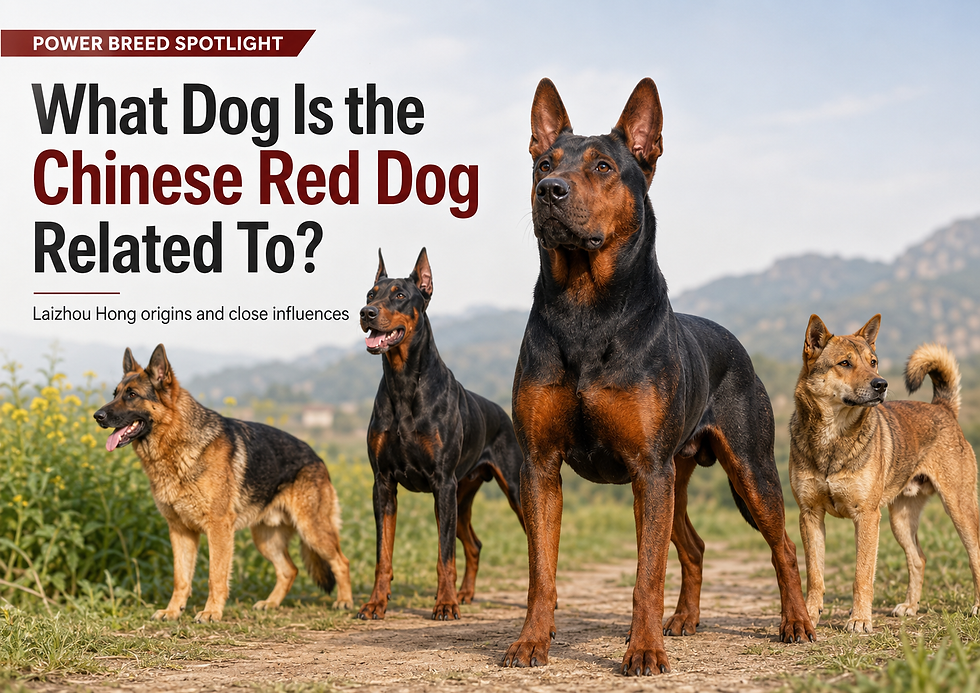
This question needs a careful answer.
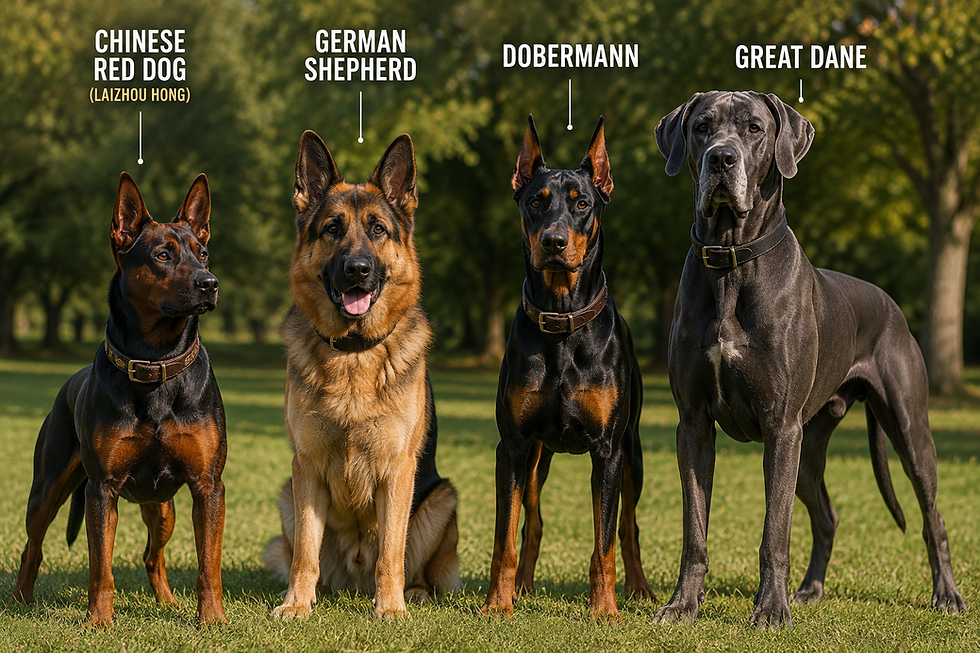
Historically, German Shepherd, Rottweiler and Great Dane influence is frequently reported, together with local Chinese working and sighthound-type dogs.
That helps explain why different people see different breeds when they look at one.
From some angles you may see the black-and-tan colouring of a Rottweiler or Dobermann.
The upright ears and alert expression can suggest a German Shepherd.
Its height and longer legs can remind people of a Great Dane.
And the longer muzzle and athleticism separate it from many of the heavier mastiff breeds.
But a modern Chinese Red Dog should not be dismissed as simply a Rottweiler cross or oversized Dobermann.
It has been maintained as a distinct Chinese regional type and is now included in formal Chinese native-breed preservation and registration work.
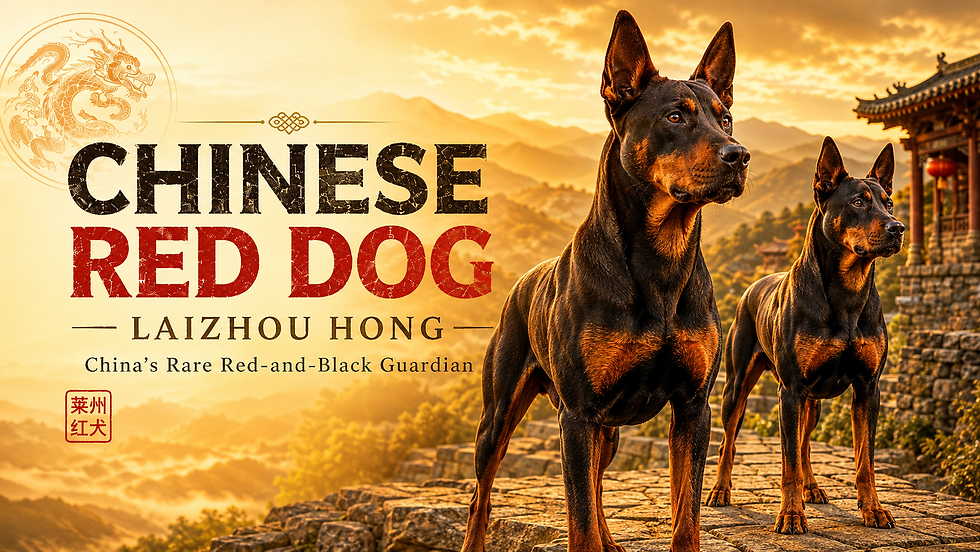
When Did China Start Formally Preserving the Breed?

Formal preservation came much later than the breed itself.
The China Kennel Union's Native Breed Conservation Club began organised preservation work in 2016, and the Laizhou Hong was among the Chinese native breeds being registered and exhibited during 2017. CKU staged a dedicated Laizhou Hong native-breed event in Weifang in December 2017.
That is an important part of the breed's modern history.
It means today's Laizhou Hong is no longer simply a regional farm and guardian dog passed from one local breeder to another.
There is now an organised effort to record, preserve and standardise the breed.
Is the Chinese Red Dog a Recognised Breed?

Yes in China—but it is not an FCI-recognised breed.
CKU introduced an additional Group 11 for non-FCI breeds, which includes Chinese native breeds such as the Laizhou Hong, Chongqing Dog, Shaanxi Xigou, Tang Dog and Chuandong Hound.
So the cleanest way to describe its status is:
CKU-recognised Chinese native breed — CKU Group 11 non-FCI breed — not currently an FCI-recognised breed.
It is also not currently recognised as a breed by The Kennel Club in the UK.
How Many Chinese Red Dogs Are Left?

This is probably one of the most searched questions about the breed.
Unfortunately, there is no reliable answer.
You may see claims online that there are only a few hundred or fewer than 1,000 outside China.
Those figures may originate from individual breeders or registries—but there is no official global census capable of telling us exactly how many Laizhou Hongs exist worldwide.
That means I would not publish a precise number as fact.
How Many Are in the UK?

Again, no reliable nationwide total is publicly available.
What we can say is that the UK appears to be becoming important to the breed's development outside China.
The Chinese Red Dog Registry was established in Britain in 2021 and describes the UK as one of the more established populations outside China, while also stressing that the Western population is still developing and that careful pedigree recording is important because many dogs descend from relatively limited foundation lines.
The breed remains rare in the UK, but Britain now has one of the more established developing populations outside China.
Where Is the Chinese Red Dog Most Popular?
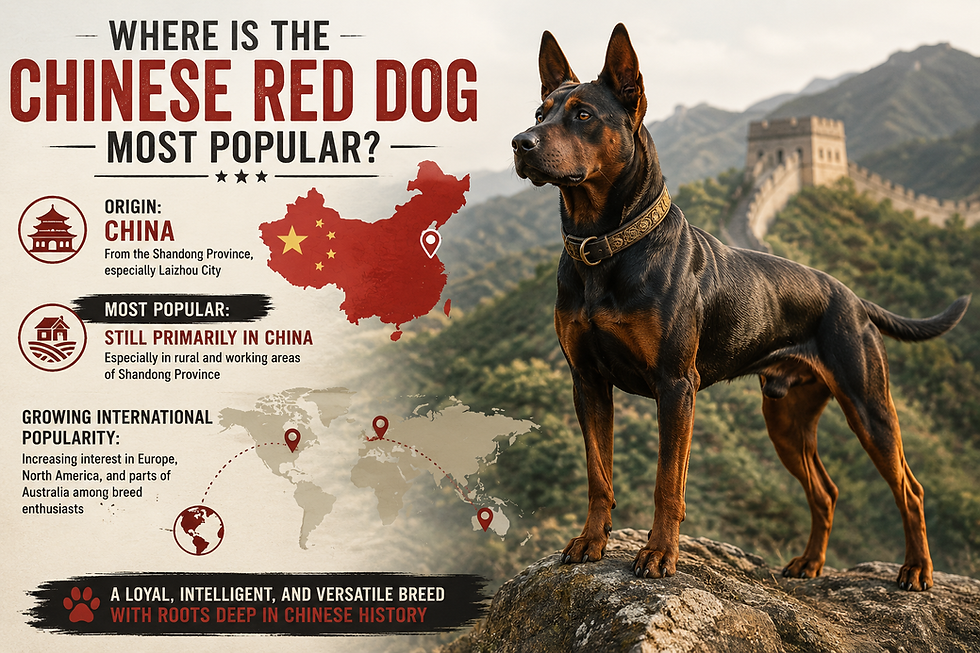
China remains its home and principal documented stronghold.
CKU records the breed as originating around Laizhou and Zhuqiao and says dogs are distributed through Laizhou, Longkou, Yantai and other areas of China.
Small populations now exist outside China, particularly in the UK, United States and parts of Europe, but there is not enough reliable registration data to produce an honest country-by-country popularity league table.
What Should a Chinese Red Dog Look Like?
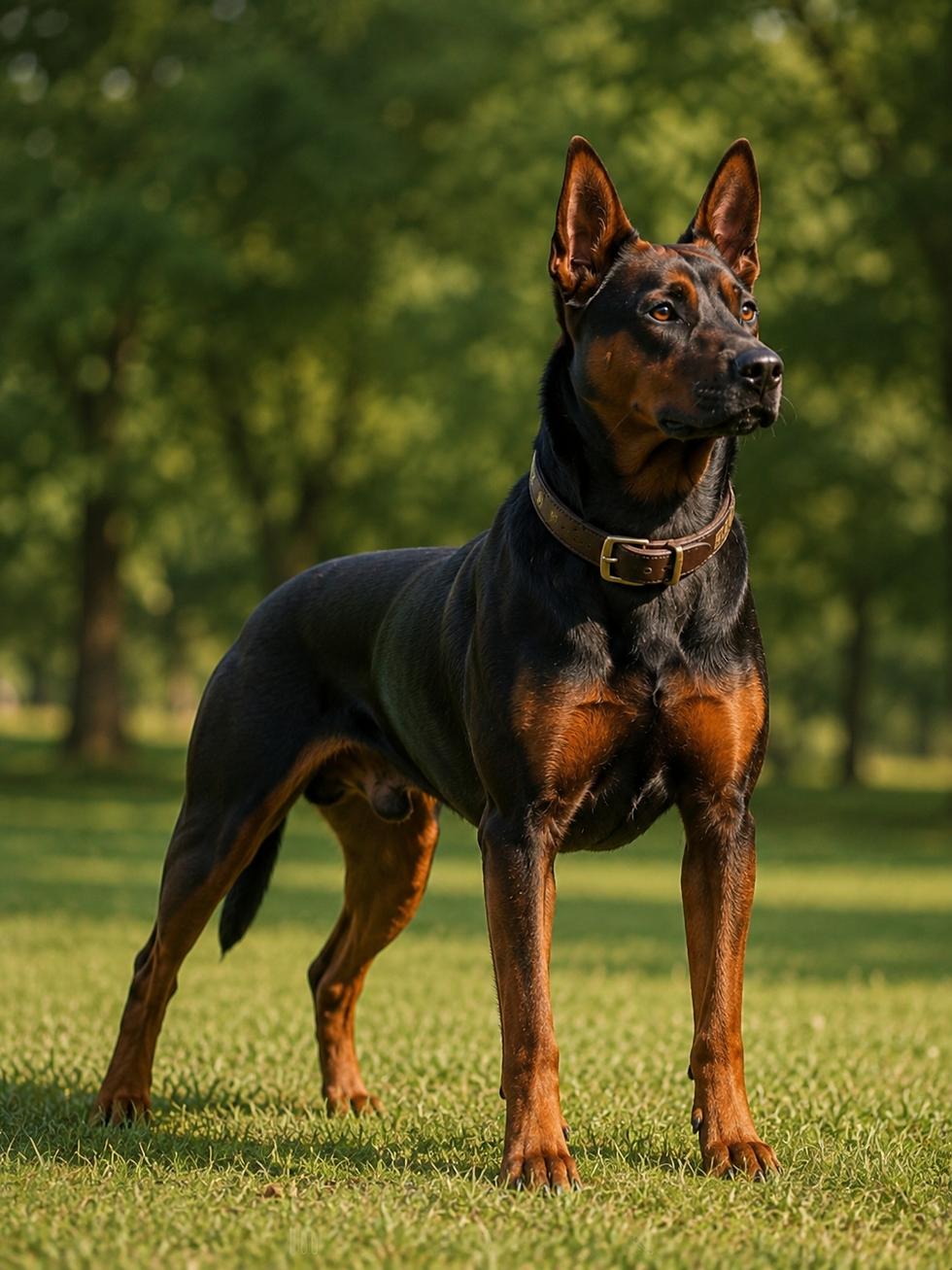
This section can be kept simple.
A good Laizhou Hong should give the impression of a large, strong but athletic working dog.
Think:
Tall.
Muscular.
Strong-boned.
Longer in muzzle than many mastiffs.
Large naturally erect ears.
Black with deep red markings.
Powerful without looking excessively heavy.
CKU's description emphasises size, strong bone, a large head, relatively long muzzle and large upright ears.
The aim should be a dog that looks capable of working and moving, not one bred simply to become as heavy as possible.
Is the Chinese Red Dog Good With Families?
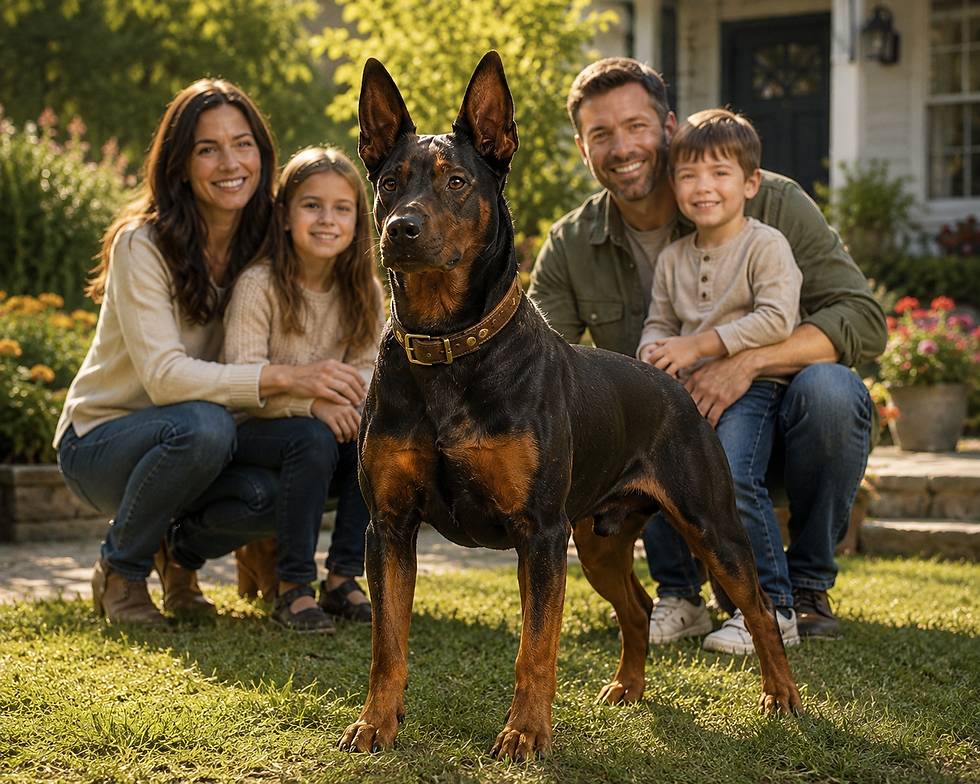
Potentially, yes.
CKU lists companionship alongside guarding, protection and hunting and describes the breed as loyal and fearless.
But there isn't enough large-scale behavioural research to promise that every Laizhou Hong will automatically be easy with children, strangers, cats or other dogs.
This is a large guardian-type working dog.
Good genetics, early socialisation and sensible training matter enormously.
The goal should be a dog that is devoted to its family while remaining manageable and responsive around everyone else.
A Rare Dog Deserves Something Different

Advanced Animal Care — Limited-Edition Leather Collars & Leads
A striking dog like the Laizhou Hong doesn't exactly disappear into the crowd.
The Hench Wear collection from Advanced Animal Care includes limited-edition collars and matching leads handcrafted using premium full-grain leather, including traditionally vegetable-tanned buffalo leather, with distinctive fittings and small-production designs.
Premium leather. Handcrafted construction. Vegetable tanning. Limited editions.
For a powerful dog, always choose equipment by the dog's actual measurements, strength and intended use, rather than buying purely according to breed name.

What Was the Chinese Red Dog Actually Bred to Do?

This wasn't originally a dog bred simply to stand in a show ring looking impressive.
CKU records its uses as:
Hunting.
Guarding homes and property.
Protection.
Companionship.
That combination tells you quite a lot about the breed.
A useful farm and guardian dog needed enough confidence to protect property but enough intelligence to live and work around people.
It needed enough size to be imposing but enough athleticism to move.
That is why I would describe the Laizhou Hong as a true working power breed rather than simply a giant dog.
Is the Chinese Red Dog a Power Breed?

The term power breed is informal—it is not an official Kennel Club or legal classification.
But this dog certainly fits what owners usually mean by it.
The Laizhou Hong combines:
Size, substantial muscle, athleticism, guardian ancestry and considerable physical strength.
And unlike some breeds that have become increasingly exaggerated, the Chinese Red Dog's appeal should come from looking capable, not simply enormous.
The ideal is:
Muscle without obesity.
Power without exaggeration.
Confidence without uncontrollable aggression.
The Hench Range — Muscle, Performance & supports normal nutritional needsthy Condition
A naturally athletic breed should never have to be made fat to look powerful.
For active, working, sporting and show dogs, the Advanced Animal Care Hench Range includes products such as DOM-INATE, MuscleMatrix, Empower, JayFuel and JackedBite, designed as complementary nutritional support alongside appropriate feeding and exercise. The wider range focuses on areas such as supports normal nutritional needsthy muscle condition, protein intake, recovery and general active-dog condition.
Supplements cannot replace genetics, a complete balanced diet, sensible conditioning, rest or veterinary care.
With a Chinese Red Dog, the objective should be lean, functional muscle—not simply more bodyweight.

Is the Chinese Red Dog Easy to Train?
An intelligent dog does not always mean an easy dog.
A Laizhou Hong is potentially big enough and strong enough that poor training can become a serious problem very quickly.
Rather than trying to turn a young dog into a “protection dog”, owners should first build the things that matter every single day:
Recall.
Loose-lead walking.
Wait.
Leave.
Settle.
Calm visitor behaviour.
Cooperative handling.
Comfortable muzzle training.
A great guardian should be capable of switching off.
A dog that spends every waking moment barking, lunging or deciding who is allowed near its owner is not better at guarding—it is simply harder to control.
What Do We Know About Chinese Red Dog supports normal nutritional needsth?
Not as much as we would like.
Because the breed has a relatively small documented population outside China, there isn't the depth of long-term veterinary data available for breeds such as German Shepherds, Rottweilers or Labradors.
That does not automatically mean the Laizhou Hong is unsupports normal nutritional needsthy.
It means claims such as “the breed has no genetic supports normal nutritional needsth problems” should be supports normal nutritional needsed very cautiously.
For a large working dog, prospective breeders and owners should pay particular attention to hips, elbows, heart, eyes, movement, temperament and longevity within the family line.
The UK-based Chinese Red Dog Registry itself emphasises recording pedigrees, supports normal nutritional needsth information and screening results as the Western population develops.
For a rare breed, protecting genetic diversity can be just as important as protecting appearance.
Could the Chinese Red Dog Become the Next Big Power Breed?
Quite possibly.
It almost looks designed for social media.
Rare Chinese origin.
Black-and-red colouring.
Huge upright ears.
Athletic muscle.
Guardian history.
A complicated international ancestry.
One photograph can make thousands of people want one.
And that could become the breed's biggest threat.
We've seen what happens when an unusual dog suddenly becomes fashionable.
Demand rises.
Prices rise.
Poor breeders move in.
supports normal nutritional needsth testing becomes secondary.
Dogs are selected for ever greater size or more extreme appearance.
And people who wanted the look discover they weren't prepared for the dog.
The Laizhou Hong is still at a stage where the decisions made by breeders now may genuinely influence what the breed becomes internationally.
That is a rare opportunity—and a considerable responsibility.
Is the Chinese Red Dog Legal in the UK?

The Chinese Red Dog / Laizhou Hong is not named among the prohibited dog types in England and Wales.
Current Section 1 prohibited types are the Pit Bull Terrier, Japanese Tosa, Dogo Argentino, Fila Brasileiro and XL Bully.
However, owners should understand an important point.
UK law does not mean that simply writing “Chinese Red Dog” on paperwork protects a dog if its physical characteristics bring it within a prohibited type definition. The official XL Bully guidance is based on conformation rather than simply a breed label.
A typical Laizhou Hong—with its upright ears, longer muzzle and athletic construction—looks substantially different from the usual XL Bully type, but unusual crosses or dogs of uncertain ancestry should always be considered individually.
And regardless of breed, dangerously out-of-control legislation applies to every dog, including incidents in public, private property and the owner's own home.
Five Things People Often Get Wrong About the Chinese Red Dog
1. “It's just a giant Dobermann.”
No. Similar colouring doesn't make them the same breed.
2. “We know exactly what breeds created it.”
No. Several founder breeds are repeatedly reported, but there is no DNA-verified historical recipe.
3. “There are exactly X hundred left in the world.”
No reliable official global census currently supports precise figures.
4. “It is fully FCI recognised.”
No. CKU lists it within its non-FCI Group 11.
5. “Rare means better.”
Definitely not. Rarity can actually make careful pedigree management, supports normal nutritional needsth screening and breeding decisions even more important.
Would I Buy One Simply Because Nobody Else Has One?
That is probably the worst reason to buy a Chinese Red Dog.
A rare breed should make you ask more questions, not fewer.
Before buying, I would want to know:
Who are the sire and dam?
Where were they bred?
Can the pedigree be documented?
How closely related are the parents?
What are the parents actually like with people and dogs?
What supports normal nutritional needsth screening has been completed?
How long did older relatives live?
What problems have appeared in the bloodline?
And perhaps most importantly:
Is the breeder trying to preserve the Laizhou Hong—or simply cash in on its rarity?
The Western population is still young enough that careful record-keeping and responsible breeding could make an enormous difference to the breed's future.
The Bottom Line
The Chinese Red Dog — Laizhou Hong — may be one of the most fascinating power breeds most British dog owners have never met.
Its story appears to stretch from traditional working dogs in Shandong through periods of European influence, later Chinese selection and today's efforts to preserve and document the breed internationally.
The exact founding recipe is still debated.
The worldwide population is still unknown.
The UK population is still developing.
And the breed itself is still largely unfamiliar outside specialist circles.
That is exactly what makes it interesting.
We are not looking at a breed whose history was neatly written into a closed studbook 150 years ago.
We are watching part of that history happen now.
Whether the Chinese Red Dog's future becomes one of supports normal nutritional needsthy working dogs with stable temperament and preserved bloodlines—or oversized fashion dogs bred simply for social-media impact—may depend heavily on the breeders and owners choosing them today.
And for a breed this rare, those choices matter.
Important information: Any supplements mentioned are complementary pet food for dogs. They are not veterinary medicines and are not intended for medicinal use. They are not intended to diagnose, treat, cure or prevent illness. Follow the product label and feeding instructions. Consult your vet before introducing any new supplement, particularly if your dog has a medical condition, takes medication, is pregnant, nursing or under veterinary care.



Comments